

Increasing active transportation is an ongoing effort for transportation planners. Biking and walking can help decrease auto dependence, air pollution, and climate change and improve public health. Plus, it can help transportation agencies meet their strategic goals. The challenge? Making good decisions requires good data, and data for walking and biking trips can be hard to find.
Continue reading Crowdsourcing meets transportation planning with bike and pedestrian data countsTag Archives: cts

Treating Stormwater with Local By-Products Reduces Road Construction Costs, Minimizes Waste
This article was originally published in Catalyst, August 2022.
Ongoing research is looking into the possibility of using local industrial waste for roadside stormwater construction projects. This would help reduce material and transportation costs and put otherwise wasted materials to use.
Continue reading Treating Stormwater with Local By-Products Reduces Road Construction Costs, Minimizes Waste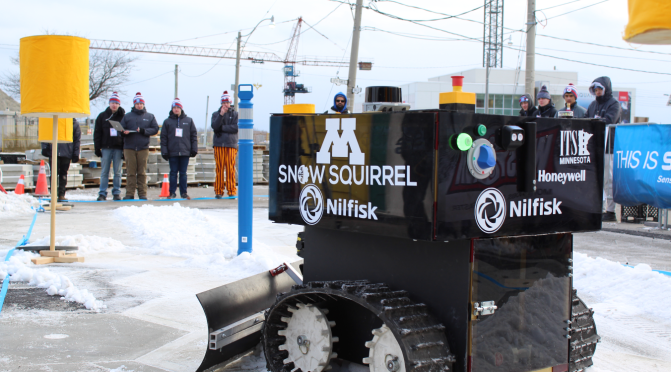
Automated Vehicles Could Increase Accessibility for Twin Cities East Metro
This article was originally published in Catalyst, August 2022.
Connected and automated vehicle (CAV) technology is moving forward, with three pilot shuttle projects on tap in Minnesota this year alone. Rapid developments are leaving little time for planners and policymakers to prepare for the mainstreaming of technology and the evolution of the current transportation system—all while ensuring that transportation equity has a seat in the vehicle.
Continue reading Automated Vehicles Could Increase Accessibility for Twin Cities East Metro
Could remote drivers be the future of ride-hailing?
This article was originally published in Catalyst, August 2022.
A new technology combining nearly autonomous vehicles with remote “tele-operators” has the potential to overcome both the technological and societal hurdles posed by driverless vehicles. Ride-hailing providers will be an important application for remote-driving technology, and U of M researchers found it offers clear advantages for companies and their customers.
Continue reading Could remote drivers be the future of ride-hailing?Portable weigh-in-motion system demonstration
Weigh-in-motion (WIM) systems consist of sensors placed in road pavements to measure the weight of vehicles passing over them, along with other data such as speed, axle load and spacing, and vehicle type. This data is used to enforce weight limits on trucks and is also useful in a wide range of other applications, such as pavement design and traffic analysis.
However, constructing and maintaining permanent roadside WIM stations is expensive, so these systems are installed primarily on roadways with heavy traffic, such as interstate and trunk highways, and rarely used for rural local roads. Meanwhile, heavy truck volumes on local roads are increasing, significantly shortening their lives. A less costly, portable WIM system is needed for such roads so that collected data can be used to better design these roads to accommodate heavy truck traffic.
One solution for bringing WIM technology to local roads is to implement a portable, reusable system similar to pneumatic tube counters used to conduct traffic counts. With funding and technical assistance from MnDOT and the Local Road Research Board, Professor Taek Kwon of the University of Minnesota—Duluth has developed a prototype system that has already proven to be nearly as accurate as the more expensive, permanent systems. MnDOT Research Services staff drove up to MnROAD this week to observe a live demonstration of the technology, and made this short video.
The research being conducted here is part of an implementation project based on Kwon’s original study, the results of which can be found in this research report and its accompanying two-page technical summary from MnDOT Research Services.
White House honors MnDOT traffic boss for work on rural intersection safety
The White House named Minnesota Department of Transportation State Traffic Engineer Sue Groth one of its 12 transportation “Champions of Change” for her role in implementing life-saving technology to help prevent collisions at rural intersections. The rural intersection conflict warning systems, which use sensors and lights to give motorists real-time warnings about traffic conditions, were developed by MnDOT’s Office of Traffic, Safety and Technology.
It’s worth noting that MnDOT Research Services and the University of Minnesota are also currently working on a project to develop a low-cost version of these systems using LEDs and solar panels. The ongoing research, being conducted by University of Minnesota— Duluth Professor Taek Kwon, is a continuation of the Advanced Light-Emitting Diode Warning System project completed in 2010.
Here’s the press release from MnDOT:
ST. PAUL, Minn. – On Wednesday, May 8, 2013, the White House honored Sue Groth, Minnesota Department of Transportation’s state traffic engineer, as one of 12 people who are Transportation “Champions of Change.” The Champions event, “Transportation Technology Solutions for the 21st Century,” focused on individuals or organizations that have provided exemplary leadership in developing or implementing transportation technology solutions to enhance performance, reduce congestion, improve safety and facilitate communication across the transportation industry at the local, state or national level.
“These Champions represent the very best in American leadership, innovation and progress,” said Secretary Ray LaHood. “I’m proud to recognize these transportation leaders who work every day to grow our economy and help us reach our destinations more quickly, efficiently and safely.”
The MnDOT Office of Traffic, Safety and Technology has been selected as a Champion of Change for their work to reduce fatal and life-changing crashes on Minnesota roadways, while enhancing mobility for all users. OTST is being honored for designing, testing and helping to deploy dozens of life-saving rural intersection conflict warning systems throughout Minnesota, while leading a national effort to do more of the same throughout rural America. These systems save lives at rural intersections that might otherwise not warrant or afford more traditional traffic control devices or geometric improvements.
See also:
- “Advanced LED Warning Signs for Rural Intersections Powered by Renewable Energy” — Technical Summary (PDF, 920 KB, 2 pages)
- White House Champions of Change — Website
Research partnerships create better pavements
As is painfully evident this time of year, Minnesota’s weather is highly destructive to our asphalt roadways. One of the biggest challenges for transportation practitioners in cold-climate states like ours is low-temperature cracking in asphalt pavements. The distress caused by our extreme weather variations and constant freeze-thaw cycles wreaks havoc on our asphalt streets and highways, causing decreased ride quality, increased maintenance costs and shorter pavement lifespans.
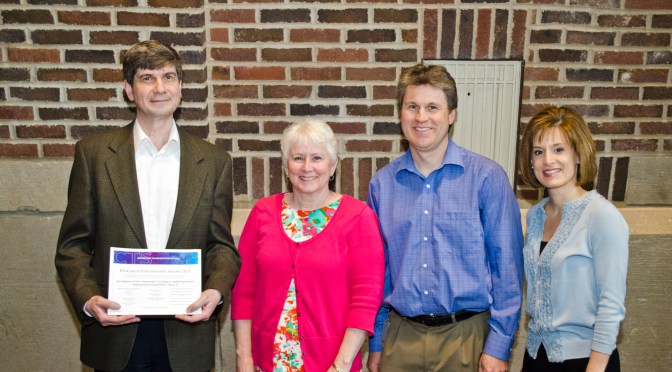
On April 17, the Center for Transportation Studies presented its 2013 Research Partnership Award to the team members of a multi-state, Minnesota-led study designed to combat the problem. The project, “Investigation of Low Temperature Cracking in Asphalt Pavements, Phase II,” was a national pooled-fund study involving six state DOTs, four universities, the Minnesota Local Road Research Board and the Federal Highway Administration. It resulted in a new set of tools — test methods, material specifications and predictive models — that will be used to build longer-lasting pavements.
The project is a prime example of the value and benefits of cooperative research. Each organization brought its own unique strengths and expertise to bear on the problem. The University of Minnesota, led by Professor Mihai Marasteanu, brought its strength in lab testing of binders and mixtures, for example; other universities leveraged their respective expertise in data analysis, statistics and modeling capabilities. MnDOT, as the lead state agency, controlled the finances and kept the research on track, guiding the process through technical advisory panels. MnDOT’s materials laboratory and its unique MnROAD pavement research facility also played a key role in the study.
The above video provides an excellent overview of the project and includes commentary from key MnDOT and University of Minnesota team members. MnDOT is already moving to implement the results. It plans to use the new test procedure on several road construction projects this year. Iowa and Connecticut are among the other states reportedly planning implementation projects.
See also:
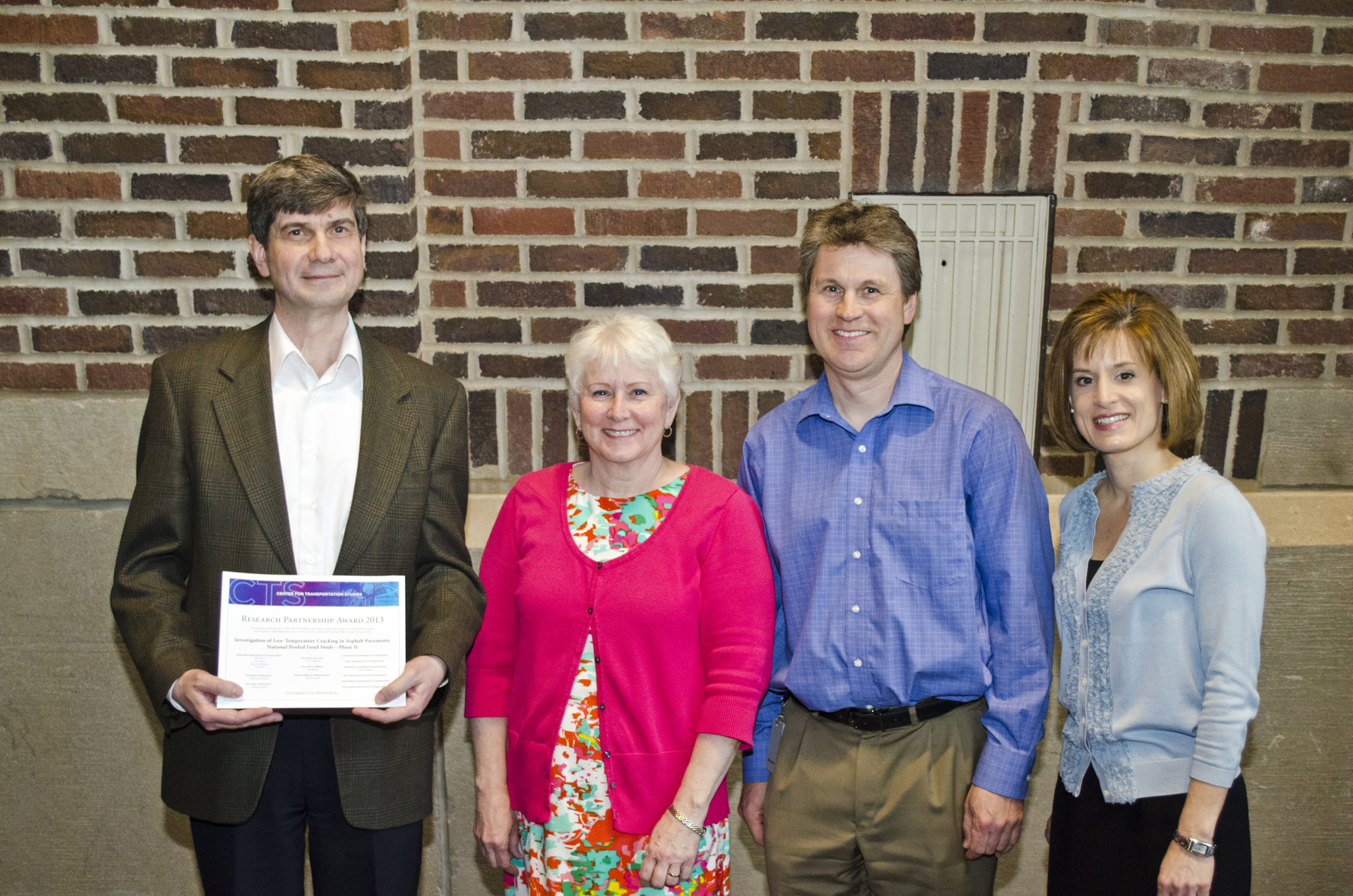
- From left: University of Minnesota Professor Mihai Marasteanu, the project’s principal investigator; MnDOT State Aid Director Julie Skallman; MnROAD Operations Engineer Ben Worel; and CTS Associate Director for Development and Finance Dawn Spanhake, who presented the award. (Photo by Cadie Adhikary, Center for Transportation Studies)
 Crossroads