When transportation officials determine which route a heavy truck should take, their aim is maximizing efficiency while ensuring safety. Detours around bridges on critical freight routes increase fuel and labor costs for the trucking industry—and eventually hit consumer pocketbooks, too.
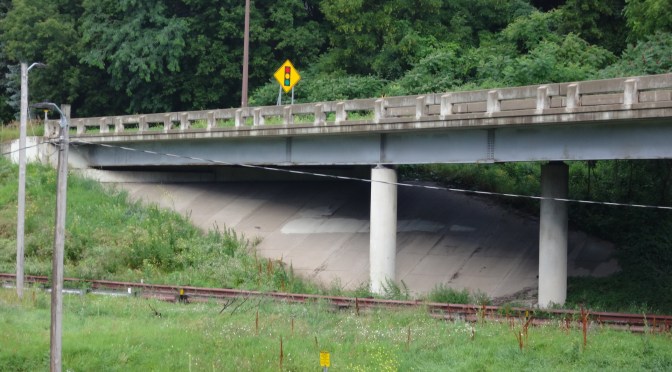
Detours around bridges in a critical freight transportation route create costs to the trucking industry, taxpayers and state economy. New load rating factors for the slab-span bridges across Shingle Creek will give MnDOT more flexibility in managing truck traffic and keeping freight moving efficiently.
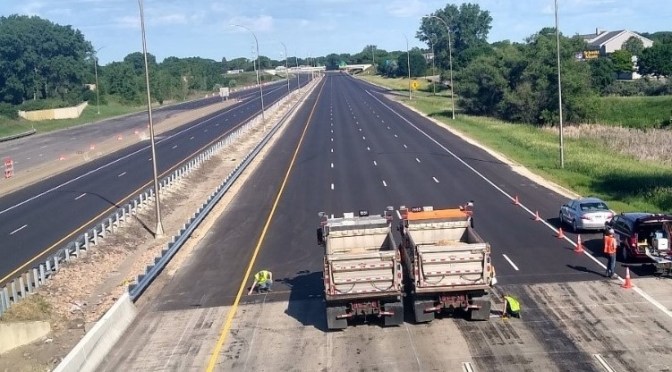
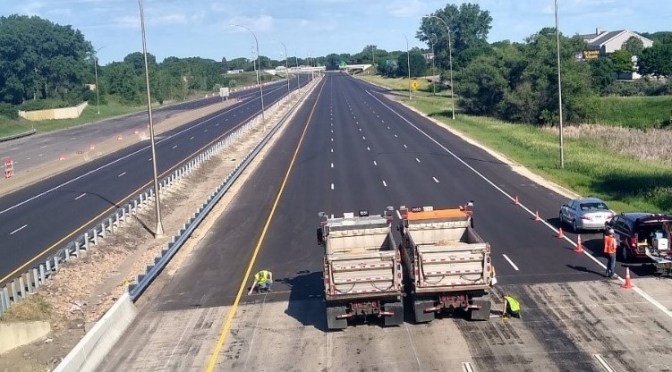
In recent years, MnDOT has seen an increase in cracking of low slump overlays. Cracking of overlays allows chlorides to get into the bridge deck which leads to deterioration of the reinforcement and eventual delamination or spalling. This means that the bridge deck needs to be repaired or even replaced before the service life has been reached.
What is a low slump overlay? A low slump overlay is a technique used by DOTs to extend the life of bridge decks. They are typically 2″ thick and designed to provide low permeability.
Reinforced concrete bridges are built to handle heavy loads and routine traffic for 75 years or more. But bridges in climates like Minnesota’s are exposed to moisture and chlorides from road salts that may penetrate these structures and corrode the steel.
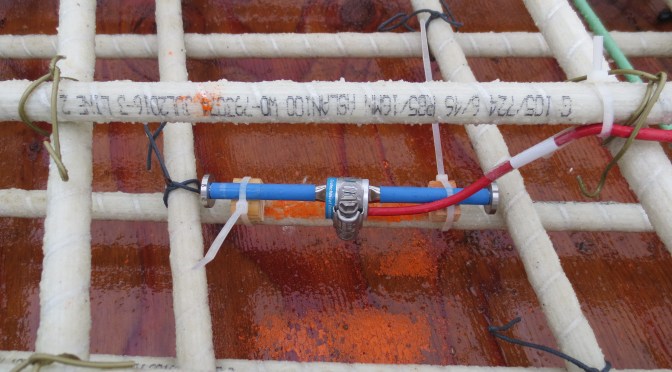
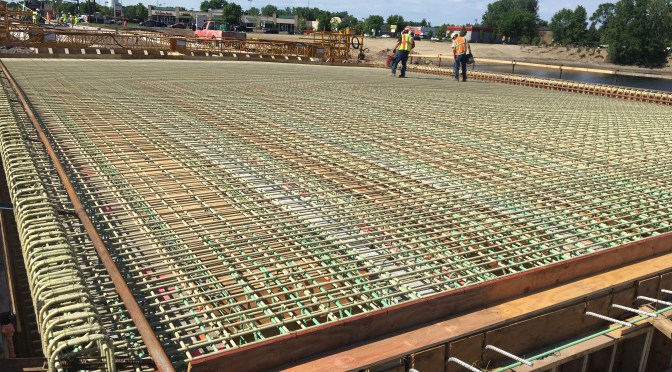
In a recently completed research project, funded by MnDOT and the Local Road Research Board, researchers studied a rural bridge built in 2017 near Elgin, MN, that used glass fiber–reinforced polymer (GFRP) rebar in the bridge deck. They found that GFRP performed well, proving sufficiently strong for use as an alternative to corrosion-susceptible steel rebar.
Well-documented efforts undertaken two decades ago to mitigate corrosion of a Highway 394 reinforced concrete bridge have given researchers the perfect scenario for evaluating the treatments’ long-term effectiveness. The test results are mixed: State-of-the-art methods for electrochemical chloride extraction and fiber-reinforced polymer wrapping of bridge elements performed well in combination, but poorly in isolation.
A new spreadsheet tool developed by the Minnesota Department of Transportation draws on historical data to help project engineers better estimate bridge construction time. The method allows users to project time-frames based on bridge design elements, work scheduling and other inputs, utilizing estimates from comparable projects in a 10-year database of bridge-building data.
An evaluation of five maintenance paint coating systems on Minnesota steel bridges with localized corrosion found that each maintenance coating performed well, and, if corrosion is identified early and maintenance painting occurs, the service life of the paint coating system can be extended five years before repainting is required. Based on the test data, researchers recommended an update to MnDOT’s Bridge Maintenance Painting Manual that includes guidance on when to apply maintenance paint coatings and when to remove paint and recoat bridges.
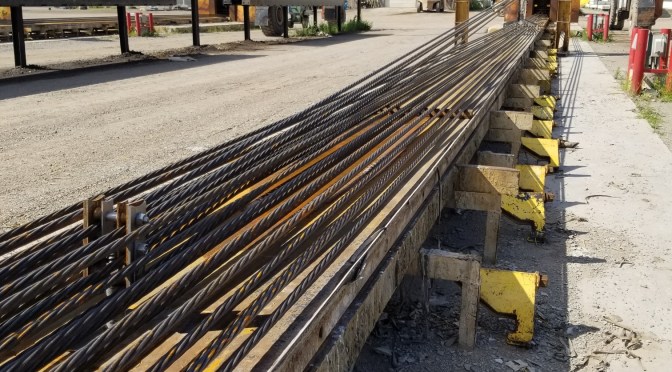
A new MnDOT-funded research study has found that most agencies in states with weather similar to Minnesota’s use debonded strands in prestressed concrete bridge beams. MnDOT may begin piloting debonding as an alternative to draping, which manufacturers claim is time-consuming, challenging to worker safety and expensive.
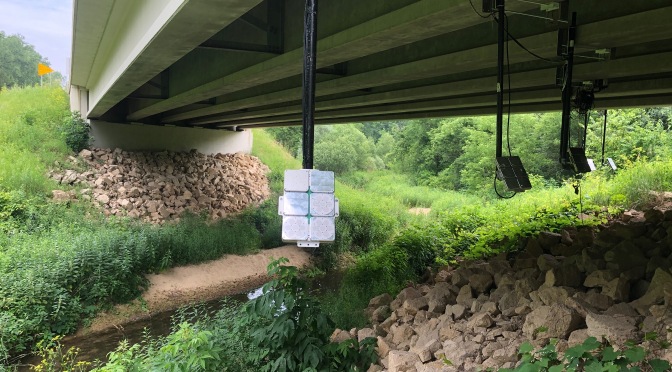
MnDOT has funded a study to evaluate the use of non-lethal ultrasonic acoustic devices to temporarily deter bats from bridges before and during construction projects.
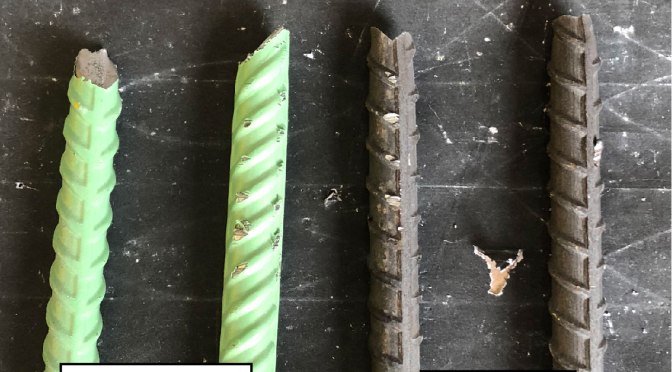
The Minnesota Department of Transportation (MnDOT) had suspended the use of post-installed epoxy-coated rebar for concrete barrier repairs as a precautionary measure because chemical adhesives used in the process are not designed for use with coated bars. But laboratory testing (conducted in a recent MnDOT-sponsored research study) has now shown that using these adhesives with coated rebar for post-installation works well and provides a safety level 200 to 300 times that predicted by manufacturer specifications. MnDOT is considering research recommendations to modify the installation process in order to resume using coated rebar in post-installed concrete crash barriers.



 Crossroads