Join us in person on the U of M campus or tune in online to the CTS winter research seminars. The seminars will highlight a sampling of the latest transportation research at the U of M.
Each seminar will be held in Room 50B at the Humphrey School of Public Affairs. Or, if you can’t make it in person, you can watch the seminars live online or view recordings posted after the events. For details about the live broadcasts, see the individual seminar web pages.
There’s no cost to attend, and each seminar qualifies for one Professional Development Hour.
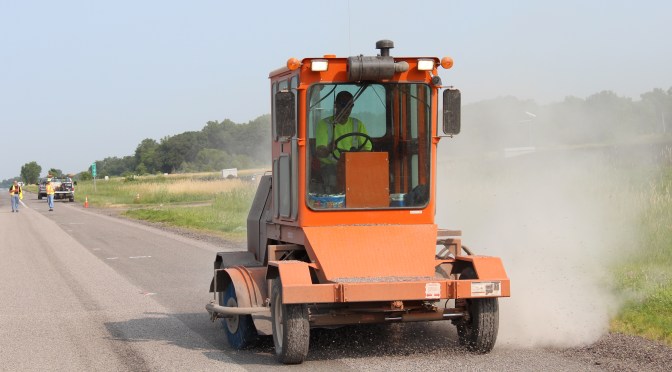
Chip-sealing — spraying an asphalt emulsion over existing pavement and then covering it with fine aggregate — is a cost-effective alternative to resurfacing asphalt pavements. Traditionally, however, it has only been used on rural and low-volume urban roadways.
During a recent visit to MnROAD, we filmed a road crew chip-sealing a test section on I-94 and spoke with MnDOT Research Project Supervisor Tom Wood, who explained why chip sealing can also be an effective treatment for high-volume roadways.
*Note: This story was updated on 08/12/2014 to clarify that the chip sealing shown in the video involves spraying an “asphalt emulsion” rather than “hot liquid asphalt,” as stated in an earlier version of this post.
If there was ever a winter that demonstrated what cold weather can do to asphalt pavements, last one was it. But future winters may wreak less havoc on Minnesota roadways, thanks to a new asphalt mixture test in the final stages of evaluation by MnDOT’s Office of Materials and Road Research (OMRR).
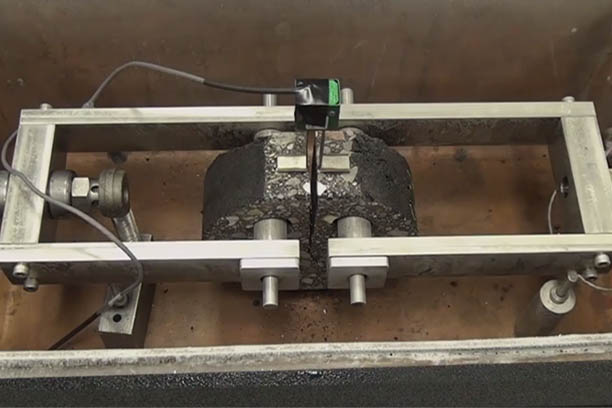
Developed through a decade-long multi-state research project, the Disc-shaped Compact Tension (DCT) test evaluates the low-temperature performance of asphalt mixes. (See a video about the project that helped develop the DCT test below.)
For the first time, engineers will be able to predict how well a contractor’s proposed asphalt mix will hold up under harsh Minnesota winters.
“Performance testing is assuring that we’re getting what we’re paying for,” explained MnDOT Research Project Engineer Luke Johanneck.
Low-temperature cracking is the most prevalent form of distress found in asphalt pavements in cold climates. As the temperature drops, the pavement tries to shrink, creating cracks that allow water to seep in and eventually lead to pavement deterioration.
Until now, engineers have typically evaluated the individual components (such as amount of crushed aggregate and asphalt binder grade) and volumetric properties (such as air voids and asphalt content) of an asphalt mix, not how the final product performs in low temperature.
“It’s like baking a cake,” explained MnDOT Bituminous Engineer John Garrity. “Our current system says put in a half-cup of oil, two eggs and cake mix. Rather than just looking just at those individual components, taste the cake to see how good it is.”
Created by researchers at the University of Illinois, the DCT test applies tension to an asphalt mixture sample to determine its thermal fracture resistance. The test was determined to be the best of several methods looked at in another research study, conducted by the University of Minnesota with assistance from neighboring state universities.
The test measures the fracture energy of asphalt mixture lab or field specimens, which can be used in performance specifications to control various forms of cracking.
The Office of Materials and Road Research is conducting pilot tests to become more familiar with the DCT test and to educate road contractors, who may eventually be required to use the test in Minnesota.
“This is very new to a lot of people that have been in the business for a long time,” Johanneck said.
Last summer, OMRR asked five contractors to submit asphalt mixes for testing. If a mix didn’t pass, the contractor was given suggestions for how to modify their recipe to better resist thermal cracking. This summer, OMRR plans to collect asphalt mixes from around the state to see how they measure up against a set of performance targets that were developed in the pooled fund study.
“We envision this at some point being part of our standard bid specifications,” Garrity said.
Those with a professional interest in the subject might be interested in a new video from MnDOT Research Services & Library (below) that demonstrates how to do the sample preparation for the DCT test.
On Wednesday, I had a chance to watch a demonstration of a uniquely Minnesotan pavement patching technology that combines an industrial-strength microwave with a special asphalt mix. What makes it “uniquely Minnesotan?” In addition to having been developed by University of Minnesota researchers and a Monticello-based company (and with some funding from MnDOT), this innovative method involves a special asphalt mix using magnetite, a mineral that abounds on Minnesota’s Iron Range.
It also addresses a very Minnesotan transportation problem: winter pavement repair. In the video above, Kirk Kjellberg of Microwave Utilities, Inc., highlights some of the benefits of using the 50,000-watt microwave to heat the pavement during patching. In addition to creating a longer-lasting patch, the microwave is considerably faster than many alternative techniques. The technology is still relatively new, but its supporters claim it allows for pavement repairs in the middle of winter that are as strong and durable as the ones road crews do in the summer.
The demonstration, which was organized for members of the Local Road Research Board, took place at MnDOT’s District 3 training facility in St. Cloud.
In April, we posted about an innovative pothole-filling technology being developed by the Minnesota Department of Transportation and the University of Minnesota, Duluth. The technique involves zapping pothole patches and the surrounding pavement with a special truck-mounted, 50,000-watt microwave. Researchers have found that heating the base and the patch material at the same time creates a stronger, longer-lasting bond that provides for a more permanent pothole fix.
Last week, the MnDOT/UMD microwave technology found its way into a new MnDOT video (above) that also explores two other experimental pothole-patching methods. One involves using a large “electric oven”-type heating element instead of a microwave. The other utilizes a new exothermic (i.e. heat-generating) asphalt mixture containing taconite from northern Minnesota mines. The video compares the potential benefits of all three of the new technologies, which the department hopes will someday lead to “more pothole-patching power for the taxpayer dollar.”
As is painfully evident this time of year, Minnesota’s weather is highly destructive to our asphalt roadways. One of the biggest challenges for transportation practitioners in cold-climate states like ours is low-temperature cracking in asphalt pavements. The distress caused by our extreme weather variations and constant freeze-thaw cycles wreaks havoc on our asphalt streets and highways, causing decreased ride quality, increased maintenance costs and shorter pavement lifespans.
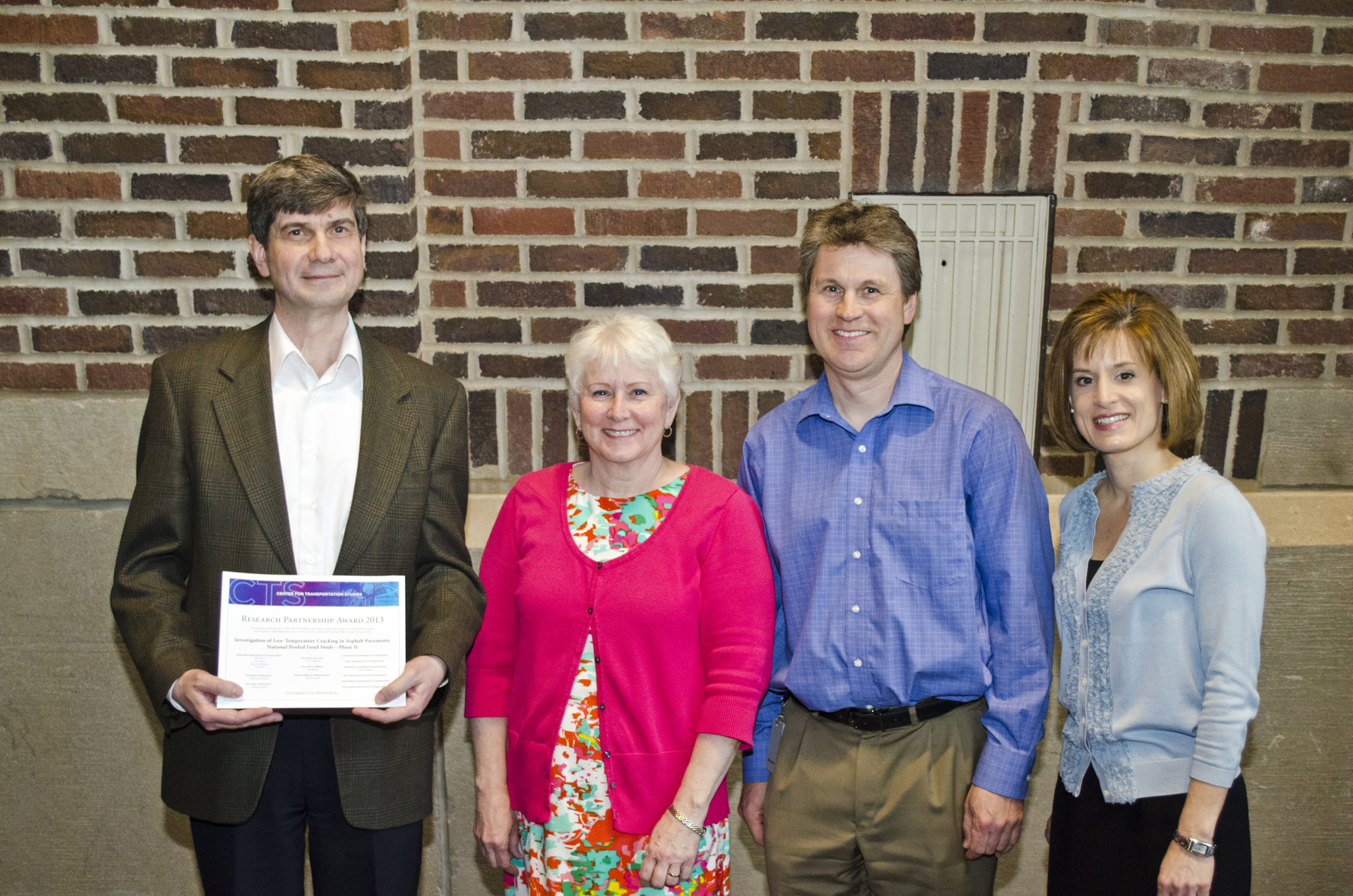
On April 17, the Center for Transportation Studies presented its 2013 Research Partnership Award to the team members of a multi-state, Minnesota-led study designed to combat the problem. The project, “Investigation of Low Temperature Cracking in Asphalt Pavements, Phase II,” was a national pooled-fund study involving six state DOTs, four universities, the Minnesota Local Road Research Board and the Federal Highway Administration. It resulted in a new set of tools — test methods, material specifications and predictive models — that will be used to build longer-lasting pavements.
The project is a prime example of the value and benefits of cooperative research. Each organization brought its own unique strengths and expertise to bear on the problem. The University of Minnesota, led by Professor Mihai Marasteanu, brought its strength in lab testing of binders and mixtures, for example; other universities leveraged their respective expertise in data analysis, statistics and modeling capabilities. MnDOT, as the lead state agency, controlled the finances and kept the research on track, guiding the process through technical advisory panels. MnDOT’s materials laboratory and its unique MnROAD pavement research facility also played a key role in the study.
The above video provides an excellent overview of the project and includes commentary from key MnDOT and University of Minnesota team members. MnDOT is already moving to implement the results. It plans to use the new test procedure on several road construction projects this year. Iowa and Connecticut are among the other states reportedly planning implementation projects.
From left: University of Minnesota Professor Mihai Marasteanu, the project’s principal investigator; MnDOT State Aid Director Julie Skallman; MnROAD Operations Engineer Ben Worel; and CTS Associate Director for Development and Finance Dawn Spanhake, who presented the award. (Photo by Cadie Adhikary, Center for Transportation Studies)
Last night, KARE-11 News featured innovative pavement repair research sponsored by MnDOT. In a public-private partnership, Larry Zanko of the Natural Resources Research Institute at University of Minnesota Duluth connected with Krik Kjellberg’s company to microwave a mix of asphalt and magnetite in road holes, creating a long-lasting pothole fix.
In Minnesota, with our often wildly unpredictable weather and constant freeze-thaw cycles, potholes are a fact of life. Anyone who’s climbed into a motor vehicle in the last month or so has doubtlessly encountered countless reminders of this dismal reality. Fortunately, we have a small army of public works professionals devoted to eradicating this perennial nuisance. The Minnesota Local Road Research Board recently produced this video, which nicely explains the various methods used to combat potholes in Minnesota.
Potholes form when water invades cracks in the pavement and infiltrates the soil beneath it. When that water freezes, it stretches the road surface, causing the fractures to expand. After a few cycles of freezing and thawing, the pavement begins to buckle and eventually collapses under the weight of passing traffic, creating disruptions in the road’s surface.
Road crews use a variety of methods to fill potholes. The simplest method is the “throw-and-go” procedure, in which workers simply shovel an asphalt mixture into the pothole and pack it down until the road’s surface is smooth. A related method is “throw-and-roll,” where the patch is compacted using an asphalt roller.
Other methods include:
“semi-permanent” patching, in which workers clear the pothole of moisture and debris and then square the edges with a pavement saw before applying the patch;
“spray injection,” which involves using specialized equipment to blast water and debris out of the pothole before spray-filling it with asphalt mix and finally applying a dust coat of dry aggregate on top; and
“slurry” or “microsurfacing” crack filling, in which a slurry of aggregate, asphalt emulsion and mineral filler is placed over a crack in the pavement and leveled off using a squeegee.
This Asphalt Pavement Maintenance Field Guide (PDF), co-funded by MnDOT and produced by CTS, provides a handy how-to guide to pothole patching and other types of pavement repairs commonly applied by public works professionals in Minnesota.






 Crossroads