Bridging the gap between research and implementation

The end goal of transportation research, broadly speaking, is to see the results implemented — that is, to transfer the knowledge generated through research to those who can put it to good use. Research Services and the Center for Transportation Studies use a variety of tools to help disseminate research results: our respective websites, email lists, social media, newsletters and this blog, to name a few. But what do we know about how our audiences actually interact with these various channels of communication?

At the Transportation Research Board Annual Meeting earlier this year, researchers from Nebraska presented the findings of a very interesting survey on how engineers and other transportation practitioners prefer to learn about research results. Their presentation, entitled “What Engineers Want: Identifying Transportation Professionals as an Audience for Research,” is available via Slideshare. (Unfortunately, WordPress won’t let me embed it.)

Some key takeaways from the survey:

  • Practitioners overwhelmingly prefer one- or two-page technical briefs to other types of research communication products. (Other popular formats include presentations, video highlights and webinars.)
  • By a wide margin, practitioners use search engines like Google or Bing to seek research results (compared to other options like contacting a colleague or university faculty).
  • Practitioners are mostly interested in information on how to implement findings, as well as cost-benefit analyses of implementation.

The survey results present what I think is a fairly realistic and nuanced picture of the audience for transportation research; they’re also consistent with our (Research Services) own internal research on the issue. The bottom line is that research results need to be condensed into usable bits of information and made easily accessible in a variety of formats. People want information they can use, without having to dig for it. More importantly, they want it in whatever their preferred format is, whether it be print, email, Web, RSS, social media or in-person presentations.

Interestingly, Research Services already produces the kind of two-page technical briefs described in the survey. We call them “technical summaries,” and they are among our most popular products. We generally produce a technical summary for each research project we manage, and post them on our website alongside the full research report. Reading a two-page summary, written in layman’s terms, is certainly easier than poring over research reports that oftentimes number in the hundreds of pages, so it’s not surprising that even those with a strong engineering background prefer the format.

As a side note, last Friday we published a batch of 10 new technical summaries — along with two new transportation research syntheses, which are a type of literature review. Topics range from pedestrian and bicycle safety in roundabout crossings to the effect of intelligent lane control systems on driver behavior. You can check the full list on the Research Services main page.

Now it’s your turn: What forms of communication do you think are most effective at reaching transportation practitioners? Which ones do you prefer? Let us know in the comments.

New fuel cell prototype could power rural ITS applications

Intelligent transportation systems (ITS) technologies can be used to enhance transportation safety and mobility, but the sensors and communications equipment needed for ITS applications typically require access to electricity. In rural areas, limited access to the power grid can make it challenging to implement ITS devices.

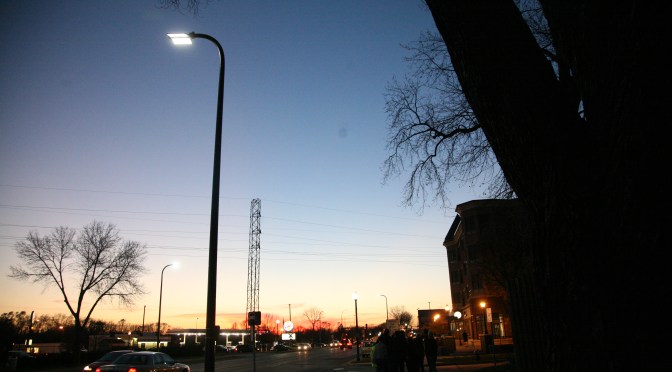
Rural intersection roadway lighting
In addition to powering ITS devices, the fuel cells could provide power for rural
intersection roadway lighting. Photo source: http://www.flickr.com/photos/36521983488@N01/175482261/

Current solutions for providing power to off-grid locations include battery packs or diesel generators, both of which require constant maintenance to recharge, refuel, or replace. Other alternatives include solar panels and wind turbines, but cost and performance concerns have limited their use.

“One of the issues with these green power alternatives, such as solar panels, is dependability… especially in the long, cold, and dark Minnesota winters,” says Victor Lund, a traffic engineer with St. Louis County Public Works. Until this technology matures, there is a need for other options that can provide confidence in generating power, Lund says.

To provide a more effective and dependable power alternative, researchers from the University of Minnesota Duluth (UMD) have developed a portable prototype system that uses hydrogen-based fuel cells to generate electricity. The UMD research team was led by chemical engineering associate professor Steven Sternberg, and the project was sponsored by the ITS Institute at the University of Minnesota.

The hydrogen-based fuel cell provides a clean, compact, high-efficiency energy source for an accompanying battery pack, which could be used to operate various ITS devices. The prototype is completely independent of the power grid, works well in cold weather, and requires maintenance only once each week for recharging. The cost of the system is about $7,500, with an additional operating cost of $2,000 per year for fuel materials.

Potential applications include powering variable message signs, dedicated short-range communication technologies, and warning blinkers on traffic signs. According to Lund, the system’s applications extend beyond powering ITS devices. For instance, the fuel cells could be used for rural intersection roadway lighting or as a back-up source for traffic signals in case of a power outage.

Reprinted from CTS Catalyst, June 2013.

Permeable pavements could protect the environment, save taxpayer dollars

KSTP has a nice story today on the Minnesota Department of Transportation’s ongoing research into permeable pavements at the MnROAD research facility. (The video isn’t embeddable on WordPress, but you can find a direct link here.)

Permeable pavements (also known as “porous” or “pervious” pavements) are designed to allow water to pass through roadways and infiltrate directly into the underlying aggregate and soil. Their primary effect is to reduce stormwater runoff, which carries harmful materials from the road’s surface out into waterways. Of course, reducing runoff also mitigates the need for the kinds of costly drainage structures that are normally required to manage stormwater. Permeable pavements also reduce noise and mitigate the potential for hydroplaning, among other documented benefits.

These types of pavements are already used in some areas in Minnesota — mainly in parking lots and city streets — and MnDOT has been studying their potential use for full-depth roadway pavements. As the video indicates, so far the results have been encouraging. (You can read more about MnDOT’s ongoing research on the MnROAD website.)

As a side note, the amount of water these pavements can absorb is quite impressive. Last month, we posted a new Local Road Research Board video on stormwater management. In one scene, a public works crew dumps what appears to be several hundred gallons of water onto a permeable pavement and watch as it disappears almost instantaneously. (Watch the clip here.)

Here are the results of some recent permeable pavement studies here in Minnesota:

Quality-of-life study helps MnDOT evaluate performance measures

As part of a study on transportation and quality of life, MnDOT has partnered with researchers from the University of Minnesota’s Tourism Center to compare current MnDOT performance measures with quality-of-life factors that matter most to Minnesotans.

driver

The evaluation was designed to help MnDOT ensure alignment between the factors that best predict transportation satisfaction among Minnesota citizens and the indicators MnDOT uses to track and measure its performance. The study team was led by Ingrid Schneider, Tourism Center director, and Karla Rains, director of customer relations at MnDOT.

To conduct the evaluation, the research team first analyzed data collected using surveys and focus groups in a previous phase of the quality-of-life study. The data included information on the categories that contribute to quality of life in Minnesota, the role of transportation, and the specific factors or services within transportation that affect citizens’ quality of life.

From these data, the team identified a list of key transportation elements that drive customer satisfaction. Results indicate that the most significant predictors can be grouped into three categories: maintenance/safety, mobility, and transparency. Within those categories, 11 specific items—such as snow and ice removal, road smoothness, commute time, and satisfaction with long-term planning—account for 56 percent of the differences in citizens’ transportation satisfaction.

The team then compared the factors most important to Minnesota citizens with MnDOT’s current performance measures. Overall findings indicate that these existing measures, which track performance in nine major areas, broadly capture much of what is important for Minnesotans’ transportation-related quality of life.

“This was an important key finding for us—we’re already measuring and reporting on many of the things that matter most to our customers,” Rains says. “It was encouraging and comforting to see that.”

In addition to affirming MnDOT’s existing measures, the evaluation identified a few gaps, specifically in the areas of safety, the environment, and transparency.quality

For example, MnDOT typically reports transportation safety in terms of total traffic fatalities and serious injuries from vehicle crashes. However, the quality-of-life study revealed citizen interest in a broader view of traveler safety. As a result, MnDOT plans to include bicycle, pedestrian, and railroad-grade crossing fatality data in future performance measures. “This is already data that we track, but now we plan to add more reporting of fatalities by mode than we have included before,” Rains says.

Based on other study-identified topics of importance, MnDOT plans to add new performance measures focused on air pollution and conduct more reporting of information related to public trust.

“We continue to use this data as guidance in our planning, and it continues to be useful,” Rains says. “We want to make sure we’re listening and measuring ourselves against the things that are most important to our customers.”

Reprinted from CTS Catalyst, June 2013.

Advanced hybrid buses have better fuel economy, fewer emissions

One of Metro Transit’s new advanced “super hybrid” buses—built in Minnesota and billed as the cleanest, most efficient diesel-electric hybrid buses in the United States—garnered national attention at the American Public Transportation Association’s Bus and Paratransit Conference May 5–8 in Indianapolis.

Photo of superbus
Photo: Metro Transit

Unique because of its all-electric accessory systems, the bus was featured at the event so that transit professionals from across the country could experience this new hybrid technology firsthand, says Chuck Wurzinger, assistant director of bus maintenance at Metro Transit. The bus is one of two advanced hybrids built for Metro Transit in 2012. They currently operate on local routes with frequent stops in downtown Minneapolis and its surrounding communities.

The decision to purchase the new hybrids was greatly influenced by the results of a University of Minnesota study aimed at improving fuel economy in diesel-electric hybrid buses, Wurzinger says. The “Superbus” study, led by mechanical engineering (ME) professor David Kittelson, included an energy audit of major accessory systems on a standard hybrid bus. The study was funded by Metro Transit, CTS, and the U of M’s Institute for Renewable Energy and the Environment (IREE).

Study findings indicated that up to half of the fuel consumed by hybrid buses is used to power accessory systems. According to the research team, powering these systems electrically could significantly improve fuel efficiency.

The new advanced hybrids do just that, using all-electric systems to power the heating, air conditioning, engine fans, power steering, and air compressor. These components improve fuel economy, reduce emissions, and allow the buses to be operated in electric-only mode for short periods.

Photo of Metro Transit diesel-electric bus
Photo: Metro Transit

One of the buses also has start/stop capabilities, which allow the engine to shut down at bus stops and traffic lights. “This reduces engine idle time while maintaining all other bus functions, including passenger comfort and safety features,” Wurzinger says.

Although the buses have been in service for only a short time, they are already showing promising increases in fuel economy, Wurzinger says. “We have also operated them consistently on electric power inside the bus garage, which helps keep the air clean in the building. This reduces the amount of ventilation required in cold weather, which means less energy is used to heat the building.”
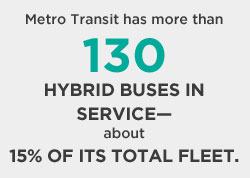
Metro Transit has more than 130 hybrid buses in services--about 15% of its total fleet

Along with a standard hybrid bus and a conventional diesel transit bus, one of the advanced hybrids will be monitored and evaluated in a new study conducted by U of M researchers in collaboration with Metro Transit. The multidisciplinary research team includes Kittelson, ME associate professor Will Northrop, ME research associate Winthrop Watts, and applied economics associate professor Steven Taff.

As part of the study, funded by IREE, the team will collect real-world, on-the-road data from the three buses in all seasons on a variety of route types. The researchers then plan to compare the efficiency and emissions of the buses and make recommendations to Metro Transit about which configuration is the best for a given application. Data collected from the study will also allow Metro Transit to work with bus manufacturers to optimize bus performance.

“We believe the results will be useful in writing bus technical specifications and also in determining if a certain type of bus is best suited to a certain type of bus route,” Wurzinger says.

Ultimately, this information could be used to determine which buses to assign to which routes as well as which type of bus to purchase given fleet replacement or expansion requirements.

The project is scheduled for completion in 2015.

Reprinted from the CTS Catalyst, June 2013.

Construction kickoff at MnROAD, the state’s high-tech road research facility (updated)

*Editor’s note: This article was updated 6/11/13 with additional information provided by MnROAD engineers.

You’re probably aware that MnDOT recently kicked off its 2013 construction season, comprising $1.1 billion in new transportation investments in more than 300 projects across Minnesota. What you might not know is that another MnDOT construction season has begun at MnROAD, the department’s unique, high-tech pavement test facility located near Albertville, Minn.

MnROAD serves as a proving ground for innovative pavement designs, equipment and construction techniques that help transportation professionals all over the world strengthen roads, cut costs, and reduce construction times. It has a two test tracks — a 3.5- mile mainline carrying “live” traffic and a 2.5-mile closed-loop, low-volume roadway — that are used for state, university and private industry pavement research. These tracks are made up of dozens of individual “cells,” which are unique stretches of pavement each representing several research projects.

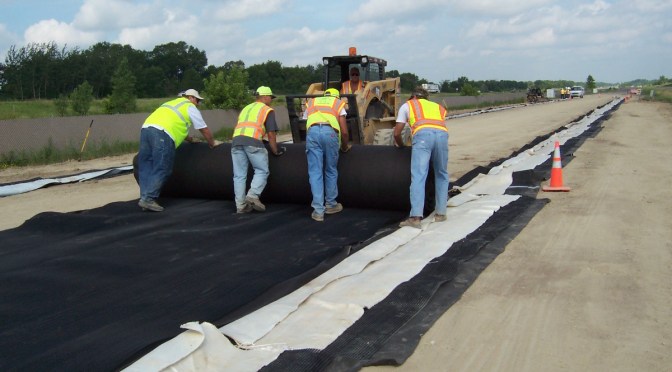
This summer, several test cells are being torn up and repaved. Cell 40, a 20-year-old concrete pavement, will receive an innovative 3-inch thick unbonded concrete overlay.  To increase the capacity of such a thin overlay , a fiber-reinforced concrete mixture will be used.  To separate and cushion the thin overlay from the existing concrete, two different thicknesses of nonwoven geotextile fabric will be laid.  This will help MnROAD researchers to understand how much cushioning is needed, as well as the drainage capacity of each fabric.  Fabric interlayers are gaining popularity as an alternative to asphalt interlayers.

Thin concrete overlays of asphalt, commonly known as whitetoppings, will also be used to reconstruct Cells 60-63.  Similar to Cell 40, fiber reinforced concrete will be used to test its benefit in supplementing load transfer at joints and across cracks.  Pavement built with this material will be strengthened by the fiber, prolonging a road’s lifespan, and potentially allowing for thinner concrete pavements.  Findings from Cells 40 and 60-63 support the ongoing development of improved design procedures for concrete overlays.

Cell 13 reconstruction is using recycled concrete aggregate provided by the contractor’s stockpile from other pavement projects. The concrete from the stockpile will be included in the concrete mix — a new practice to understand how to better recycle paving materials and ascertain the cost and benefits of this practice. Cell 13 will also be testing two innovative types of preformed joint sealants, and several joints drained by geotextile drains.

Construction updates are available on the MnROAD website as well as information regarding current research projects.

Image from MnROAD's 2013 construction kickoff.
Removing concrete in MnROAD Cell 13.

‘Three Ways to Cook a Pothole’

In April, we posted about an innovative pothole-filling technology being developed by the Minnesota Department of Transportation and the University of Minnesota, Duluth. The technique involves zapping pothole patches and the surrounding pavement with a special truck-mounted, 50,000-watt microwave. Researchers have found that heating the base and the patch material at the same time creates a stronger, longer-lasting bond that provides for a more permanent pothole fix.

Last week, the MnDOT/UMD microwave technology found its way into a new MnDOT video (above) that also explores two other experimental pothole-patching methods. One involves using a large “electric oven”-type heating element instead of a microwave. The other utilizes a new exothermic (i.e. heat-generating) asphalt mixture containing taconite from northern Minnesota mines. The video compares the potential benefits of all three of the new technologies, which the department hopes will someday lead to “more pothole-patching power for the taxpayer dollar.”

See also:

New publication highlights success in traffic safety

Cover of TZD Decade of Progress reportThe Minnesota Toward Zero Deaths program has published Minnesota TZD: 10 Years of Progress (PDF), a 12-page report highlighting the program’s successes in the decade since it began. Before 2001, efforts to improve traffic safety were mostly carried out by individual state agencies. In response to an increasing trend in the number of traffic-related fatalities and serious injuries in the state, the Minnesota Departments of Public Safety, Transportation, and Health in 2003 established the Toward Zero Deaths (TZD) program to integrate safety programs in Minnesota. Since then, traffic fatalities have decreased by 40.5 percent. This report describes some of these efforts in the areas of driver behavior, roadway environment, emergency response, and partner collaboration.

Searching for common ground in the ITS privacy debate

Should your vehicle be able to gather, store, or transmit information about where it’s been—or where it’s going? On the surface, it seems like a simple question. However, it inevitably gives rise to many others: Who will see the data? How will it be used? Can it be given or sold to a third party? Under what circumstances? Clearly, there are no straightforward solutions or answers in the debate surrounding privacy issues in intelligent transportation systems (ITS).

“The difficulty and complexity of these issues has resulted in an increasingly disconnected public discussion about privacy and ITS,” says Frank Douma, a researcher in the University of Minnesota Humphrey School of Public Affairs. “In one camp are privacy advocates, and in the other camp are technologists and the ITS industry, who generally view privacy issues as secondary when compared with the tremendous benefits of these technologies. The disconnect often results in the two sides talking past each other, with too little energy spent finding potential common ground.”

According to Douma, one cause of this disconnect is a lack of clarity on both sides about the needs, goals, and interests of those involved. To address this divide, a multidisciplinary team of U of M researchers has published a report that sheds new light on the ITS privacy debate by mapping and assessing the interests of all participants. The team was led by Douma and research assistant Tom Garry, and the project was sponsored by the ITS Institute, a program of the University of Minnesota’s Center for Transportation Studies.

The ITS privacy debate involves an interlaced web of participants with multiple interests.

Researchers began their analysis by pinpointing exactly who should be concerned about privacy as ITS technologies are developed and implemented and what their goals are with respect to privacy data. A number of diverse participant groups were identified, including ITS developers, transportation users, the government, data collectors, data users, and secondary users such as marketers and litigants.

“We found few black-and-white divides among participants in the privacy debate,” says Douma. “For example, transportation users are not simply pro-privacy, and data collectors are not inherently anti-privacy. Individuals are willing to share their locational data in exchange for real benefits in a variety of circumstances, such as GPS guidance or electronic tolling. However, there are also limits to this willingness.”

Because of this nuanced landscape, researchers concluded that while there is no all-encompassing solution to the ITS privacy debate, there are a number of potential avenues and tools for finding common ground. Their recommendations include setting limits on the time data can be retained, prohibiting unrelated secondary use of data, designing ITS systems with privacy in mind, avoiding the collection of personally identifiable locational information when possible, and implementing privacy policies such as the use of clear privacy notices.

“It’s also important to remember that the positions of participants in this debate are not entrenched,” says Douma. “As technology changes, privacy expectations will also likely evolve as well, such that what may seem important today is less so, and something we are not considering today could be critically important in the future. Consequently, it’s very important that this conversation continue in the years to come.”

Reprinted from the CTS Catalyst, May 2013.

Portable weigh-in-motion system demonstration

Weigh-in-motion (WIM) systems consist of sensors placed in road pavements to measure the weight of vehicles passing over them, along with other data such as speed, axle load and spacing, and vehicle type. This data is used to enforce weight limits on trucks and is also useful in a wide range of other applications, such as pavement design and traffic analysis.

However, constructing and maintaining permanent roadside WIM stations is expensive, so these systems are installed primarily on roadways with heavy traffic, such as interstate and trunk highways, and rarely used for rural local roads. Meanwhile, heavy truck volumes on local roads are increasing, significantly shortening their lives. A less costly, portable WIM system is needed for such roads so that collected data can be used to better design these roads to accommodate heavy truck traffic.

One solution for bringing WIM technology to local roads is to implement a portable, reusable system similar to pneumatic tube counters used to conduct traffic counts. With funding and technical assistance from MnDOT and the Local Road Research Board, Professor Taek Kwon of the University of Minnesota—Duluth has developed a prototype system that has already proven to be nearly as accurate as the more expensive, permanent systems.  MnDOT Research Services staff drove up to MnROAD this week to observe a live demonstration of the technology, and made this short video.

The research being conducted here is part of an implementation project based on Kwon’s original study, the results of which can be found in this research report and its accompanying two-page technical summary from MnDOT Research Services.

Minnesota's transportation research blog