New technology aimed at making rural intersections safer

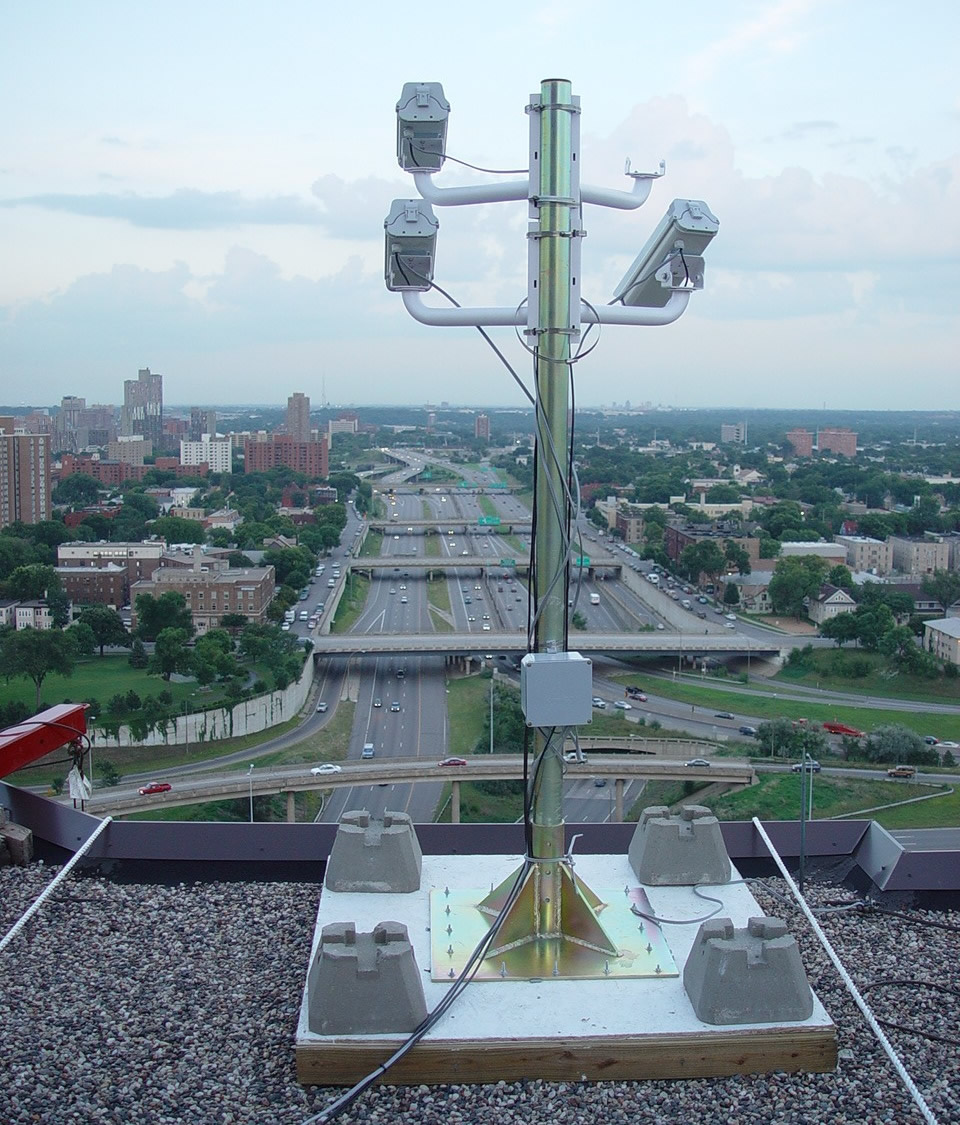
This video above showcases a new kind of intersection conflict warning system being developed for use primarily by local agencies at rural, two-way stop intersections. Called the ALERT System, it uses a simple but ingenious combination of radar, wireless communication and flashing LEDs to alert drivers to the presence of approaching vehicles, thereby helping them identify safe gaps in the cross traffic and avoid potentially deadly collisions.

These types of systems are nothing new; MnDOT and other state DOTs have been developing them for more than a decade under the ENTERPRISE pooled fund program. MnDOT also recently kicked off a three-year project to deploy 20–50 of its Rural Intersection Conflict Warning Systems at selected at-risk intersections across the state. The main difference with the ALERT System is that it’s designed to be cheaper and easier to deploy than existing ICWS technologies. While that might sound like an incremental improvement, the difference for cash-strapped local agencies could be huge.

Since the ALERT System uses solar power, it doesn’t have to be hooked up to the power grid — which means that, in theory, county public works crews could install it themselves. The system also uses a simplified controller that doesn’t require a traffic signal technician to install and maintain, and detects vehicles using radar rather than in-pavement sensors. These factors might encourage greater adoption of ICWS technologies, which studies have shown to reduce both the frequency and severity of crashes.

The project is now in its second phase. It still faces a number of hurdles before could be ready to deploy, but Vic Lund, the traffic engineer for St. Louis County and the project’s main champion, says the results so far have been encouraging. In the video below, Lund shares his thoughts on the project, its challenges and the future of Intelligent Transportation Systems in Minnesota.

Learn more:

New study to shed light on environmental impacts of deicers

Even naturally derived products like corn syrup and beet juice can impact the environment when applied to salt mixtures for winter roadways.

A wide range of products, including the ones mentioned above, are added to deicing mixes to limit the amount of salt needed for Minnesota roads each winter. However, although information is available about the corrosive properties of various deicing chemicals, less is known about the toxicity of these compounds, especially to the aquatic environment.

Thanks to a recently completed project sponsored by the Clear Roads Pooled Fund, MnDOT winter maintenance personnel will better understand the relative toxicity of eight common deicing agents, which also include non-organics like Magnesium Chloride, Calcium Chloride and Potassium Acetate.

“Because the state has been trying a lot of different alternative chemicals, we wanted to get a better handle on the environmental impacts,” said MnDOT engineer Tom Peters, the technical liaison for the 26-member, Minnesota-led pooled fund for winter maintenance research.

In January, researchers plan to release a concise summary of the toxicity rankings to help winter highway maintenance managers consider both expected levels of service and potential harm to the environment when selecting a deicer.

A Dec. 3 webinar available on the Clear Roads website discusses their findings.

About Clear Roads

Minnesota is the lead state for the Clear Roads Pooled Fund, which conducts rigorous testing of winter maintenance materials, equipment and techniques. Other recent and upcoming research (see our Technical Summary on the program) includes a winter maintenance cost-benefit analysis toolkit, snow removal techniques at extreme temperatures and environmental factors that can cause fatigue in snowplow operators.

You can learn more about Clear Roads via the project’s e-newsletter.

Robotic message painter could help keep road crews safe

Using rollers and stencils to draw turn arrows and crosswalk stripes on roads seems a bit archaic to MnDOT District 3 Maintenance Superintendent Randy Reznicek, who asked researchers if they could develop an automated road message painter.

University of Minnesota-Duluth Associate Professor Ryan Rosandich has taken that vision and created an robotic arm that can spray-paint pavement signs, with the goal of saving crews time and keeping them safer.

Designed to be mounted to the front of a maintenance vehicle, the robot is operated remotely by a laptop, programmed with numerous types of messages.

In an earlier prototype, researchers developed a trailer painter that could be pulled behind a truck.

Crews currently use heavy, eight-foot by four-foot stencils and rollers to paint designs, with an estimated 75 percent of such work involving the repainting of existing markings.

“It takes two people to lift the stencils,” explained MnDOT maintenance worker Joe Gilk, whom Reznicek presented with the idea about five years ago. “This would eliminate one position. One person could just run the truck and you could use that other person in another area of our job.”

Rosandich, who heads the Mechanical and Industrial Engineering Department at the University of Minnesota-Duluth, led the initial development of a software system and trailer painter.

MnDOT has funded further research to develop the more technically difficult robotic arm, which it anticipates could be used in other aspects of maintenance work as well.

MnDOT District 3 maintenance worker Joe Gilk, left, and maintenance superintendent Randy Reznicek watch the demonstration of the robotic message painter, an idea that came from their office.
MnDOT District 3 maintenance worker Joe Gilk, left, and District 1 traffic engineer Rob Ege watch a demonstration of the robotic message painter, an idea that came from Gilk’s office.

Rosandich recently demonstrated the mechanical arm to a MnDOT road crew (no paint was used during the demonstration), but additional software and mechanical tweaks remain before researchers take the machine out for final testing on the pavement this spring.

A companion vision system is being developed to identify existing markings to guide the robot in the repainting of existing messages.

The robot’s three-segmented aluminum shell arm is capable of painting up to a 12-foot wide lane and has enough battery power for a whole day’s worth of work, Rosandich said.

Once the prototype is complete, researchers hope to find a manufacturer to develop and produce a machine that could be used by maintenance crews across the state. MnDOT has already had great success in deploying automated pavement patching systems in some districts.

Not only would a robotic message painter free up maintenance crews and speed up sign-painting, but Rosandich sees worker safety as its “biggest selling point.”

The start-up cost for manufacturing such a device is estimated to be $150,000.

Transitways spurring economic growth and development, improving mobility, and supporting equity

Landmark regional investments such as the transit expansion underway in the greater Minneapolis-Saint Paul metropolitan area have the potential to significantly change long-term land-use patterns and travel behavior. They also raise important questions for policymakers and elected officials regarding the potential return on investment.

ImageA new synthesis report from the Transitway Impacts Research Program (TIRP) pulls together seven years of research conducted by University of Minnesota researchers to help answer these questions. The report summarizes the actual and projected impacts of transitways on the Twin Cities region, offering lessons learned to help guide the build-out of the rest of the network most effectively. It concludes with a set of implications for policymakers.

The Twin Cities metro region is in the midst of a transit build-out. The Metro Blue Line (formerly known as Hiawatha), Red Line (Cedar Avenue Bus Rapid Transit), and Northstar Commuter Rail are in operation, and the Green Line (Central Corridor) opens next year. All are part of an expanding regional transit network.

Under the TIRP program, which was launched in 2006, University of Minnesota researchers provide an objective analysis of data, public perceptions, and complex impacts resulting from transitway investments. Their research is unique in its breadth, scope, and ability to provide real-time analysis of the changes experienced when a region introduces high-quality transit service.

“This body of research and objective analysis confirm the many positive ways that expanding our transit network supports economic competitiveness, greater accessibility to jobs, opportunities for populations with low incomes, and enhanced livability for our whole region,” says Kate Wolford, president of The McKnight Foundation, the synthesis sponsor. “This report undergirds why the accelerated build-out of our transit system is so important for the future prosperity of our region and its residents.”

More information about the synthesis and key findings

New videos show how frost heave ravages roads

Regardless of whether you’re familiar with the term “frost heave,” if you live in Minnesota and drive on the roads, you’re already familiar with its destructive capacity. Many of the dips, bumps, potholes and cracks that appear on our roads every spring are a direct result of frost heave, which occurs when water accumulates in the soil beneath the pavement and begins freezing and then thawing along with the changing seasons. The resulting expansion and contraction weakens the road base and leaves it susceptible to damage from traffic loading.

These new videos produced by the Local Road Research Board explain how frost heave works, and describe some of the strategies public works departments use to combat it. The top video is is the shortened, executive-summary version, while the bottom video is the full, 13-minute version meant for transportation professionals.

Patching pavement with microwaves and magnetite

On Wednesday, I had a chance to watch a demonstration of a uniquely Minnesotan pavement patching technology that combines an industrial-strength microwave with a special asphalt mix. What makes it “uniquely Minnesotan?” In addition to having been developed by University of Minnesota researchers and a Monticello-based company (and with some funding from MnDOT), this innovative method involves a special asphalt mix using magnetite, a mineral that abounds on Minnesota’s Iron Range.

It also addresses a very Minnesotan transportation problem: winter pavement repair. In the video above, Kirk Kjellberg of Microwave Utilities, Inc., highlights some of the benefits of using the 50,000-watt microwave to heat the pavement during patching. In addition to creating a longer-lasting patch, the microwave is considerably faster than many alternative techniques. The technology is still relatively new, but its supporters claim it allows for pavement repairs in the middle of winter that are as strong and durable as the ones road crews do in the summer.

The demonstration, which was organized for members of the Local Road Research Board, took place at MnDOT’s District 3 training facility in St. Cloud.

See also:

New report: NEMT Coordinators in Minnesota

Under Minnesota’s fee-for-service Medical Assistance (MA) program, Minnesota counties are responsible for providing transportation assistance to MA recipients so they can obtain health-care services. This assistance is commonly referred to as non-emergency medical transportation (NEMT).

NEMT_cover_screenshot.jpgA new report, NEMT Coordinators in Minnesota: A Survey of How Minnesota Counties Use Coordinators to Deliver Non-Emergency Medical Transportation, published by the Minnesota Council on Transportation Access based on research conducted by researchers at the University of Minnesota’s Humphrey School of Public Affairs documents how select Minnesota counties use transportation coordinators in providing and administering NEMT under the state’s fee-for-service MA program.

In the surveyed counties, the use of a coordinator generally made the delivery of NEMT more efficient and streamlined than it had been with previous approaches. Coordinators have increased efficiency principally by centralizing both transportation expertise and the ride arrangement processes, either internally within the county government or externally with an outside coordinator.

About the Council

The Minnesota Council on Transportation Access (MCOTA) serves as a clearinghouse to address transportation coordination topics from a statewide perspective. The Minnesota State Legislature established the group in 2010 (MN Statute 2010 174.285). The group includes member representatives from thirteen agencies.

MCOTA’s work focuses on increasing capacity to serve unmet transportation needs, improving quality of transit service, improving understanding and access to these services by the public, and achieving more cost-effective service delivery. In addition, fostering communication and cooperation between transportation agencies and social service organizations leads to the creation of new ideas and innovative strategies for transportation coordination and funding.

Learn more at www.CoordinateMNTransit.org.

Congestion-reduction measures on I-35W: How well do they work?

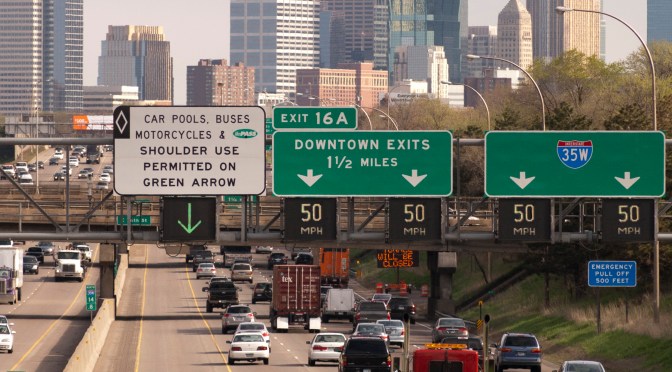
In an effort to combat congestion in our country’s urban areas, the United States Department of Transportation launched the Urban Partnership Agreement (UPA) program in 2007. The program infused nearly $900 million into transportation-related projects in four cities nationwide, including the Twin Cities metropolitan area. Minnesota’s projects—which include the installation of MnPASS dynamic toll lanes and variable message signs—focused on improving traffic flow in the I-35W corridor between Minneapolis and the city’s southern suburbs.

To understand the effectiveness of measures implemented under the UPA program, a team of University of Minnesota researchers examined three separate but related areas: the effects of a new variable speed limit (VSL) system, the impact of severe weather conditions on road safety, and the behavior and traffic impacts of bus rapid transit operations. Their work was funded by the Intelligent Transportation Systems Institute, a part of CTS.

Key findings included:

  • Drivers don’t typically comply with advisory speed limits posted on VSL signs along the I-35W corridor during congested conditions, but they may use them to help gauge and prepare for downstream congestion—resulting in a smoother and possibly safer traffic flow
  • Some parts of the corridor’s shoulder lanes—which are opened to traffic during specific times of the day as part of the UPA program—contain low areas that can flood during heavy rains
  • Buses traveling on the corridor underuse the MnPASS lane. In addition, bus lane changes (from stations located in the median to those located on the right side of the highway) can generate visible disturbances during moderate and heavy congestion, but they don’t seem to contribute to the breakdown of traffic flow

For more information, read the full article in the September issue of Catalyst.

New LRRB videos focus on work zone safety

The Minnesota Local Road Research Board is a major source of funding for transportation research in the state. Occasionally, it also produces educational videos designed to raise public awareness of important transportation topics.

Two new video offerings from the LRRB (embedded above and below) are focused on save driving in work zones. While not directly research-related, they might prove a useful resource to transportation professionals. More importantly, they serve to remind us all of the very real and dramatic consequences of work zone crashes, of which there are approximately 2,000 per year in Minnesota.

You might want to also check out some of their other recent YouTube offerings, including explanations of why we need stop signs and speed limits, as well as a fascinating look at how potholes are patched.

Minnesota's transportation research blog