Patching pavement with microwaves and magnetite

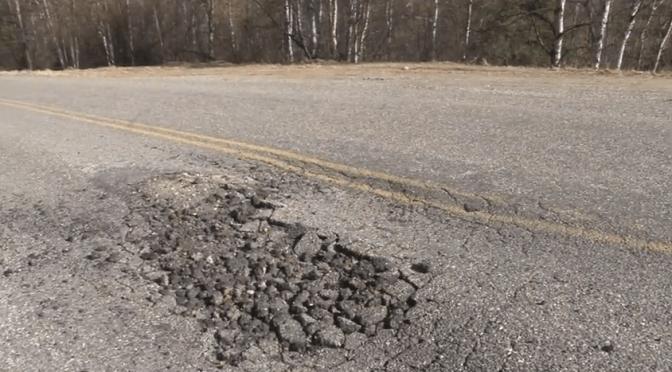
On Wednesday, I had a chance to watch a demonstration of a uniquely Minnesotan pavement patching technology that combines an industrial-strength microwave with a special asphalt mix. What makes it “uniquely Minnesotan?” In addition to having been developed by University of Minnesota researchers and a Monticello-based company (and with some funding from MnDOT), this innovative method involves a special asphalt mix using magnetite, a mineral that abounds on Minnesota’s Iron Range.

It also addresses a very Minnesotan transportation problem: winter pavement repair. In the video above, Kirk Kjellberg of Microwave Utilities, Inc., highlights some of the benefits of using the 50,000-watt microwave to heat the pavement during patching. In addition to creating a longer-lasting patch, the microwave is considerably faster than many alternative techniques. The technology is still relatively new, but its supporters claim it allows for pavement repairs in the middle of winter that are as strong and durable as the ones road crews do in the summer.

The demonstration, which was organized for members of the Local Road Research Board, took place at MnDOT’s District 3 training facility in St. Cloud.

See also:

New report: NEMT Coordinators in Minnesota

Under Minnesota’s fee-for-service Medical Assistance (MA) program, Minnesota counties are responsible for providing transportation assistance to MA recipients so they can obtain health-care services. This assistance is commonly referred to as non-emergency medical transportation (NEMT).

NEMT_cover_screenshot.jpgA new report, NEMT Coordinators in Minnesota: A Survey of How Minnesota Counties Use Coordinators to Deliver Non-Emergency Medical Transportation, published by the Minnesota Council on Transportation Access based on research conducted by researchers at the University of Minnesota’s Humphrey School of Public Affairs documents how select Minnesota counties use transportation coordinators in providing and administering NEMT under the state’s fee-for-service MA program.

In the surveyed counties, the use of a coordinator generally made the delivery of NEMT more efficient and streamlined than it had been with previous approaches. Coordinators have increased efficiency principally by centralizing both transportation expertise and the ride arrangement processes, either internally within the county government or externally with an outside coordinator.

About the Council

The Minnesota Council on Transportation Access (MCOTA) serves as a clearinghouse to address transportation coordination topics from a statewide perspective. The Minnesota State Legislature established the group in 2010 (MN Statute 2010 174.285). The group includes member representatives from thirteen agencies.

MCOTA’s work focuses on increasing capacity to serve unmet transportation needs, improving quality of transit service, improving understanding and access to these services by the public, and achieving more cost-effective service delivery. In addition, fostering communication and cooperation between transportation agencies and social service organizations leads to the creation of new ideas and innovative strategies for transportation coordination and funding.

Learn more at www.CoordinateMNTransit.org.

Congestion-reduction measures on I-35W: How well do they work?

In an effort to combat congestion in our country’s urban areas, the United States Department of Transportation launched the Urban Partnership Agreement (UPA) program in 2007. The program infused nearly $900 million into transportation-related projects in four cities nationwide, including the Twin Cities metropolitan area. Minnesota’s projects—which include the installation of MnPASS dynamic toll lanes and variable message signs—focused on improving traffic flow in the I-35W corridor between Minneapolis and the city’s southern suburbs.

To understand the effectiveness of measures implemented under the UPA program, a team of University of Minnesota researchers examined three separate but related areas: the effects of a new variable speed limit (VSL) system, the impact of severe weather conditions on road safety, and the behavior and traffic impacts of bus rapid transit operations. Their work was funded by the Intelligent Transportation Systems Institute, a part of CTS.

Key findings included:

  • Drivers don’t typically comply with advisory speed limits posted on VSL signs along the I-35W corridor during congested conditions, but they may use them to help gauge and prepare for downstream congestion—resulting in a smoother and possibly safer traffic flow
  • Some parts of the corridor’s shoulder lanes—which are opened to traffic during specific times of the day as part of the UPA program—contain low areas that can flood during heavy rains
  • Buses traveling on the corridor underuse the MnPASS lane. In addition, bus lane changes (from stations located in the median to those located on the right side of the highway) can generate visible disturbances during moderate and heavy congestion, but they don’t seem to contribute to the breakdown of traffic flow

For more information, read the full article in the September issue of Catalyst.

New LRRB videos focus on work zone safety

The Minnesota Local Road Research Board is a major source of funding for transportation research in the state. Occasionally, it also produces educational videos designed to raise public awareness of important transportation topics.

Two new video offerings from the LRRB (embedded above and below) are focused on save driving in work zones. While not directly research-related, they might prove a useful resource to transportation professionals. More importantly, they serve to remind us all of the very real and dramatic consequences of work zone crashes, of which there are approximately 2,000 per year in Minnesota.

You might want to also check out some of their other recent YouTube offerings, including explanations of why we need stop signs and speed limits, as well as a fascinating look at how potholes are patched.

Testing the waters for mileage-based user fees

MBUF 2013 Workshop logoFor the fourth year in a row, the State and Local Policy Program of the University of Minnesota’s Humphrey School has partnered with the Texas Transportation Institute (TTI) in sponsoring a Symposium on Mileage-based User Fees (MBUF). This year’s symposium, held in conjunction with the ITS America Conference in Nashville, TN, focused on the technologies involved in charging drivers a fee to use roads based on mileage as well as public concerns such as privacy and implementation challenges. As an indicator of the interest in this issue, the International Bridge, Tolling and Turnpike Association (IBTTA) also held a Transportation Finance and Mileage-Based User Fee Symposium just a week before in Philadelphia, PA, in partnership with the Mileage-Based User Fee Alliance (MBUFA), the Transportation Research Board, and the Humphrey School.

So is the public clamoring for MBUF? Not really. In fact, the public still needs to be convinced that the gas tax will not support our transportation system in the long-run, and that a new user-based system will be required to replace the gas tax in the future if we are to maintain our U.S. transportation infrastructure. The Minnesota Legislature funded an MBUF technology test with 500 Minnesota drivers as well as a policy study and task force to identify issues that must be addressed before an MBUF system could be implemented. The Mileage-Based User Fee Alliance has set up a web page to address five misconceptions about MBUF.

While Minnesota is one of several states that are studying and testing MBUF options, the State of Oregon took the first step toward implementation of a Road Usage Charging system by passing legislation in July 2013. The first step in Oregon will be to recruit 5,000 volunteers for the new Road Usage Charging System. The volunteers will have several option for how to pay the new charge, ranging from simple odometer readings to more advanced technology options that may be combined with other services for drivers. Stay tuned…

Related Links

This post was written by Lee Munnich, director of the State and Local Policy Program at the University of Minnesota’s Humphrey School of Public Affairs, and originally published on the CTS Conversations blog.

MnDOT tests new technologies to monitor bridge scour

A research implementation project could provide MnDOT with a new set of tools to help combat a major source of bridge failure.

The MnDOT Bridge Office is testing several new methods of monitoring bridge scour — erosion that occurs around bridge piers and abutments during high water-flow events like floods. Acting Waterway Engineer Nicole Danielson-Bartelt said the project’s goal is to be able to monitor scour-critical bridges remotely rather than sending maintenance personnel out on the water during difficult or hazardous conditions.

“There are a number of bridges that are pretty difficult to monitor, especially during high water events,” she said. “Typically, you need to get out on a boat and do either sonar readings or drop weights. It’s dangerous work to be out on the water during those types of events unless you have the right training.”

The project will evaluate several different monitoring technologies, including continuous monitoring equipment like tilt meters and active sonar. The sonar systems, which allows continuous stream bed and water surface elevation data to be transmitted to a website for graphical display, could provide benefits that go beyond monitoring individual bridges.

“The ability to collect continuous, long-term data could help engineers understand short term scour-fill and long term aggradation-degradation cycles,” said Solomon Woldeamlak, a Bridge Office hydraulic engineer. He added that the data can be used to calibrate existing methods of estimating scour at bridges.

Other devices being tested include “float-out” devices, which are buried in the sand around the abutment and send out a signal only if washed to the surface by a scour. Danielson-Bartelt said these non-continuous monitoring devices might be appropriate for bridges where installing permanent sonar is not advisable due to the presence of debris that could damage the equipment.

Monitoring equipment has been installed at two locations: the Highway 43 Winona bridge over the Mississippi River and the Highway 14 Mankato bridge over the Minnesota River. A final report on the project is expected in late 2014/early 2015. You can learn more about some of the products that are being tested on the website of ETI Instrument Systems, Inc., which provided the equipment.

‘Intelligent’ traffic drum could help prevent work-zone tragedies

2012-26 Image
A prototype of the Intelligent Drum Line system.

Work-zone safety is a serious, ongoing challenge for transportation agencies. According to MnDOT, the current three-year average for Minnesota work zones is 1,819 crashes and seven fatalities per year. And that’s not counting near-misses: just talk to anyone who has worked as a flagger, and they will likely have a story about diving into a ditch to avoid being hit by a distracted driver. Consequently, MnDOT is constantly exploring ways to make work zones safer — which brings me to the photo above.

What you’re looking at is no ordinary traffic cone. It’s a prototype of a new warning device called the Intelligent Drum Line system — basically a modified orange traffic drum packed with electronics that can detect speeding drivers and blast them with audiovisual cues to let them know they’re entering the work zone too fast.

Our new technical summary explains the details of the new system, which was developed at the University of Minnesota, with funding and in-kind assistance from MnDOT:

The prototype design uses two modified traffic drums placed 1 to 3 feet from the shoulder of the road and 300 to 400 feet apart. Sensors in the first drum detect vehicles, measure their speed and distance, and communicate this information to the second drum…

When the IDL system detects an oncoming vehicle traveling faster than a threshold speed, the system activates visual warning systems in both drums and initiates a countdown. When the speeding vehicle is approximately 1 second away from the first drum, the system activates an air horn to warn the driver.

As the vehicle passes the first drum, the audible alarm terminates and the system transmits a command to the second drum to start another countdown. When the vehicle is approximately 1 second away from the second drum, the system activates another audible alarm.

Testing of the IDL system at MnROAD has been successful; however, researchers still need to study how drivers react to the system in real-world conditions. Before they can do that, the design will have to be refined so that it can pass Federal Highway Administration crashworthiness tests. On a related note, MnDOT is currently funding a separate University of Minnesota study into which technologies are most effective at capturing drivers’ attention in work zones. The study will include visual and auditory cues similar to the ones used in the IDL prototype.

Learn more:

Using an infrared camera to inspect a bridge deck

Over the last several years, MnDOT has been participating in a national pooled-fund study on using infrared cameras to spot subsurface damage on bridge decks. These damaged areas just below the deck surface are called “delaminations,” and they’re what causes potholes and cracks on the surface. Detecting them is a key part of what MnDOT bridge inspectors do, and it’s huge challenge.

Currently, one of the primary methods of locating delaminations is “chain-dragging” — literally, dragging chains across the surface of a bridge deck. Using this method, inspectors can listen for evidence of hollowed-out areas beneath the surface, which produce a different sound than solid areas. While it works, this practice forces bridge crews to close down lanes and work near moving traffic. These issues have led Minnesota and other states to look for alternatives, and infrared or “thermographic” imaging is one of the top contenders.

In the video above, MnDOT bridge inspector Eric Evens demonstrates how to inspect a bridge deck using an infrared camera (specifically, a FLIR T620 — the model selected for the study). The delaminated areas appear as white or “hot” spots in the image. Evens does a nice job of explaining some of the benefits and potential uses of the camera, including minimizing traffic delays. He also demonstrates the camera’s ability to simultaneously capture photos and infrared images, which could be useful for cataloging the conditions of bridge decks and programming schedules for repairs.

However, as Evens pointed out during the filming, there are both pros and cons to using infrared thermography. One downside is it’s really only effective as the bridge deck warms up in the morning. Another is that it takes some practice to be able to identify which of the “hot spots” are actual delaminations and which are merely dirt or debris on the deck surface, or some other kind of false positive.

U of M Research: Spurring private-sector development along transit corridors

developmentA new research study is recommending ways to make it easier for developers and employers to select sites that encourage living-wage jobs and mixed-income housing near transit.

A key finding of the study, which was based on interviews with developers and business leaders, revealed a pent-up demand for transit access in the Twin Cities metropolitan region.

A team led by University of Minnesota researchers Yingling Fan and Andrew Guthrie found that providing a great work location is critical for employers in recruiting highly skilled young professionals who are likely to desire—or demand—urban living and access to transit.

They also found that multifamily residential developers, redevelopment specialists, and large corporate office tenants have a strong interest in transit-accessible sites, but regulatory barriers, cost issues, and uncertainty surrounding future development of transit often discourage both developers and businesses from selecting such sites.

More details about the study and key recommendations

Minnesota's transportation research blog