MnDOT saves time, money with new contracting method

Thanks to a flexible new contracting method, the cost and time of delivering small highway projects in Minnesota should go down.

The Minnesota Department of Transportation is now able to put road construction contractors on standby for certain types of projects, rather than bid each project individually, due to the adoption of Indefinite Delivery/Indefinite Quantity (IDIQ) contracts.

“IDIQ contracts give MnDOT more flexibility and the ability to get to the field quicker for work that we need repeated routinely, such as culvert repairs, overlays and seal coats,” said Kevin Kosobud, project development engineer with MnDOT’s Office of Construction and Innovative Contracting.

IDIQs also provide flexibility when needs are uncertain.  Contracts are often used for multiple small projects that are similar in scope, but difficult to quantify in cost and timing.

For instance, the state of Florida awards IDIQs for hurricane debris removal, activating and paying contractors only when a hurricane necessitates the service.

Although IDIQs showed great promise, MnDOT had to develop a framework to implement them.

The federal government has used IDIQ contracts since the 1980s, but only a small number of state DOTS have used them to procure construction services. No standard procedures existed for their use by state DOTs, and federal procedures are not always applicable at the state level.

MnDOT hired Iowa State University researchers to examine IDIQ usage across the country and develop implementation procedures for Minnesota. (Read a summary of their research here.)

Researchers examined contracting practices at 14 different transportation agencies to  recommend guidelines for Minnesota to follow, which allowed MnDOT to begin awarding IDIQ contracts in April 2013.

Case study analyses show clear benefits where IDIQ has been used: acceleration of the project delivery period, reduced construction costs and flexible delivery scheduling.

“IDIQs can help DOTs get better prices for routine services via an economy of scale, for instance, by awarding a contract for a larger number of culvert repairs rather than awarding a single contract for each repair,” explained Doug Gransberg, professor of construction engineering at the Iowa State University Institute of Transportation.

Agencies can award IDIQ contracts individually or collectively.

With a single-award contract, a single contractor is awarded task orders based on the pricing furnished in the initial bid package; multiple-award contracts determine a pool of qualified contractors who may subsequently bid on task orders.

*Editor’s note: This article was adapted from the September-October 2014 issue of our Accelerator newsletter. Read it online or sign up for your free subscription.

Related Resources
  • Leveraging the Advantages of Indefinite Delivery/Indefinite Quantity Contracts – Technical Summary (1 MB, 2 pages); Final Report (expected Fall 2014)

Why is all the colored concrete deteriorating so fast?

There’s nothing like colored concrete to make a crosswalk, sidewalk or breezeway look snazzy.

But the extra touch that many cities are putting into their downtown streetscapes may not be so pretty in just a few short years.

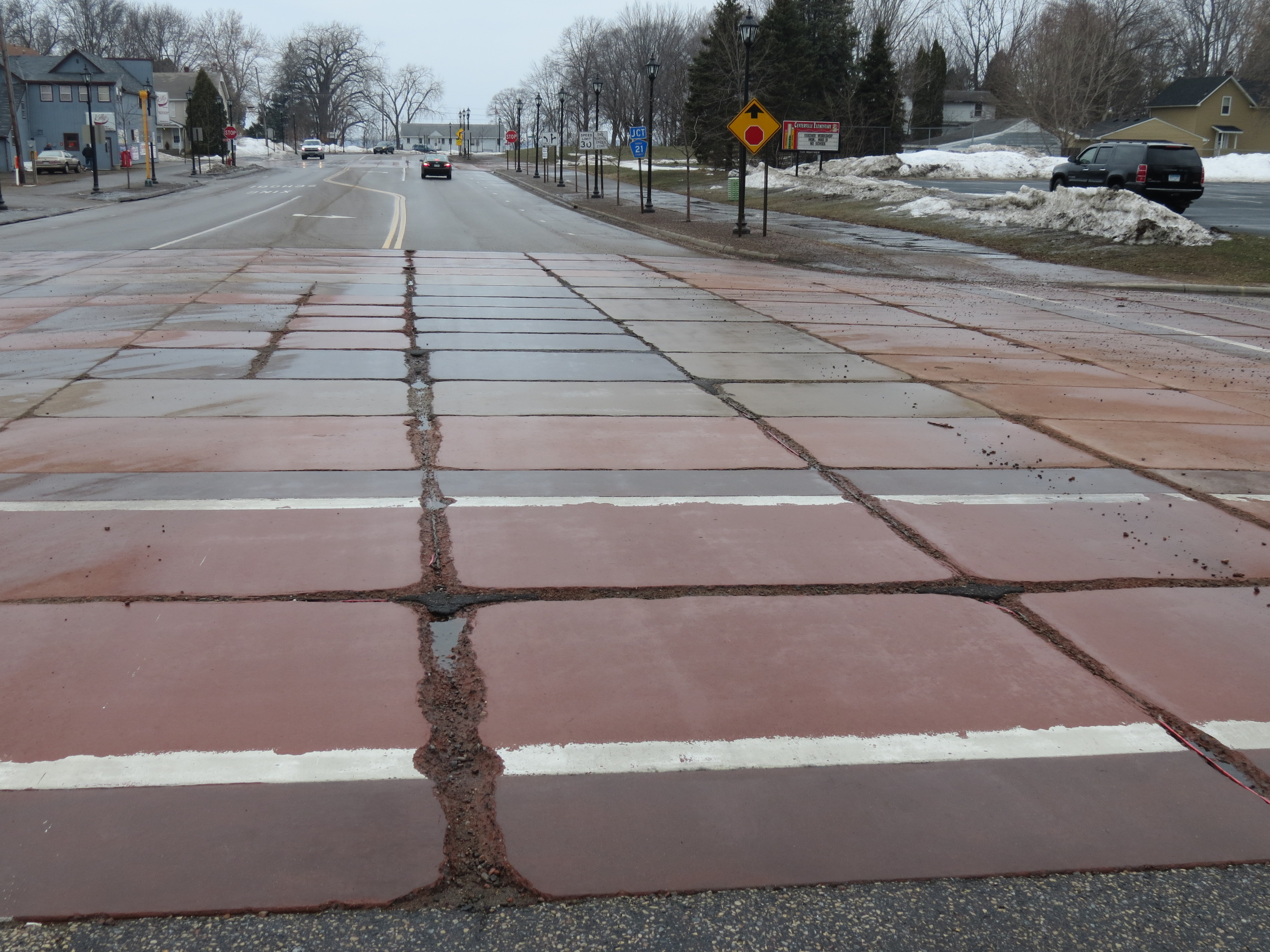
Early cracking has prompted the city of Vadnais Heights to tear up its colored concrete, and the city of Centerville — which installed colored concrete only six years ago — plans to follow suit, said MnDOT’s Senior Road Research Engineer Tom Burnham.

Both cities participated in a recent study, sponsored by the Local Road Research Board and conducted by MnDOT, to determine what is causing the early deterioration.

Across Minnesota, many of the estimated 45 colored concrete projects have experienced early deterioration, particularly microcracking near contraction joints. While this type of distress also occurs with regular concrete, it appears to be accelerated in the colored concrete projects, within five years in some instances.

Although the newly released study identifies likely causes for the failing colored concrete, further research is needed to evaluate proposed solutions.

Findings

Researchers determined that the colored concrete mixtures have likely been too porous for Minnesota winters, allowing deicing chemicals to leach in and wreak havoc. Although not quite as problematic for sidewalks and medians — which aren’t salted as heavily — it is especially bad for colored crosswalks.

A denser concrete mixture (one formed with less water) is recommended; however, constructing the concrete panels this way will require extra steps.

“There are chemicals that can be added to the mixture to artificially lower that water-to-concrete ratio,” Burnham said. “This will allow a  denser mixture to be more easily placed.”

The city of Centerville plans to tear up its colored concrete. This photo shows early joint deterioration.
Color in vogue

Although there was a spate of colored concrete construction in Ramsey County in the late 1990s, it has only come into fashion in the rest of the state within the last five to six years, according to Burnham.

“You go to almost any community and they’re installing it — on their sidewalk and medians and also crosswalks,” said Burnham, who coordinated the research study.

Because of the added expense, cities may be very disappointed in the results.

The city of Stillwater, which installed a colored concrete panel crosswalk on its main street just two years ago (see top photo), is already experiencing cracking and deterioration in several panels.

Possible remedies

Although reducing the porosity of the colored concrete mixture should help,  it won’t solve everything.

Another issue is the curing. The typical white curing product can’t be applied like it is with standard concrete, so curing the colored panels is more challenging, Burnham explained.

There are possible remedies, however, to assist with the curing, such as wet burlap or curing blankets.

Adding complexity to the issue are the new deicing chemicals on the market, which are also impacting regular road materials.

Several test samples showed evidence of chemical attack of the cement paste and fine aggregates, as well as an alkali-silica reaction, which can cause cracking or spalling and isn’t normally seen in regular concrete.

“Is there anything unique with the coloring that would accelerate the observed chemical reactions? We didn’t feel we had enough samples and knowledge at this point to conclusively say,” Burnham said.

Different construction techniques could go a long way toward increasing the livelihood of colored concrete; however, it could take several years of observation to determine if other methods work.

MnROAD is considering adding colored concrete panels to its facility for testing.

Until more questions are answered, MnDOT researchers are recommending repair techniques and alternative streetscaping ideas to cities, such concrete stains, pavers or colored high friction surface treatments.

In addition to sharing the findings with cities and counties, Burnham wants to educate contractors.

“We hope this research is a wake-up call for the colored concrete industry too because we don’t want the industry to die in Minnesota,” he said. “If it can work, we want cities and counties to be able to use it.”

*Editor’s Note: This story was updated 09/04/2014 to specify that this research project was funded entirely by the Local Road Research Board, and that MnDOT conducted the research.

Related Resources
  • Investigation and Assessment of Colored Concrete Pavement — Final Report (PDF, 20 MB, 368 pages); Technical Summary (forthcoming)

Parking availability system takes aim at truck driver fatigue

MnDOT, in partnership with the Federal Highway Administration, is test-deploying a high-tech system to help combat drowsy driving and keep truck drivers in compliance with federal hours-of-service regulations.

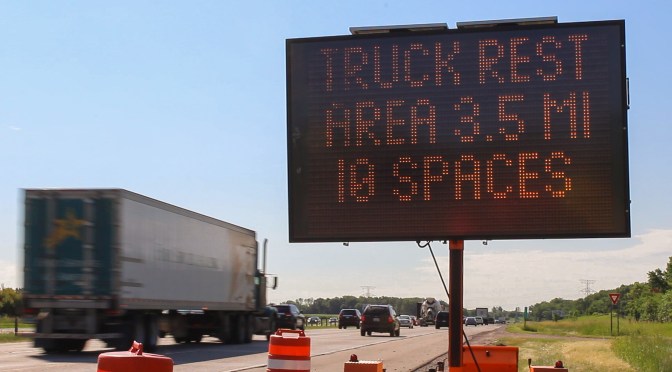
Developed by researchers at the University of Minnesota, the prototype system lets  drivers know when parking spaces are available at rest stops ahead. It has been deployed at several locations along the heavily traveled I-94 corridor between Minneapolis and St. Cloud.

From today’s MnDOT news release:

ST. PAUL, Minn. – New technology along the I-94 corridor west and northwest of the Twin Cities is helping truckers find safe places to park. Three Minnesota Department of Transportation rest areas are now equipped with automated truck stop management systems that tell truck drivers when parking spaces are available.

The technology will improve safety, lead to better trip and operations management by drivers and carriers and help MnDOT and private truck stop owners manage their facilities more effectively, according to John Tompkins, MnDOT project manager.

“So far, the results have been positive. We’ve had 95 percent accuracy in determining the availability of spaces,” he said.

Federal hours of service rules require truck drivers to stop and rest after 11 hours of driving. Tompkins said if drivers continue to drive beyond 11 hours, they could become fatigued and be forced to park in unsafe locations such as freeway ramps. They could also face legal penalties.

The problem of truck driver fatigue recently took the national spotlight when an allegedly drowsy driver slammed his semitrailer into a limousine carrying actor-comedian Tracy Morgan and six others. One passenger died in the crash.

The parking availability project is led by MnDOT Freight Project Manager John Tompkins and University of Minnesota professor Nikolaos Papanikolopoulos. MnDOT Research Services & Library produced the video above, which demonstrates the system in action. You can learn more about the project on the Center for Transportation Studies website.

Five Innovative Ways to Make Bicyclists and Pedestrians Safer

Last year, 41 people were killed while walking or biking on Minnesota roads and nearly 1,700 were injured.

Dozens of measures are available, however, for making roads safer for pedestrians and cyclists. Minnesota Department of Transportation Pedestrian and Bicycle Safety Engineer Melissa Barnes reviewed some of these design techniques in a recent presentation to city and state transportation engineers. (Watch the full webinar.)

We asked Barnes to highlight her favorite bike and pedestrian safety countermeasures used in Minnesota.

Rectangular Rapid Flashing Beacon RRFB

An unusually effective new pedestrian warning device, called the Rectangular Rapid Flashing Beacon, has become quite popular.

User-activated, the device alerts drivers to a pedestrian’s presence with a bright flashing beacon that “looks kind of like an ambulance or fire truck light,” Barnes said. (RRFBs can also be activated passively by a pedestrian’s presence.)

Studies have shown that the number of motorists stopping for pedestrians increases from 18 to 81 percent with the RRFB. Another plus: the device doesn’t appear to lose its effectiveness over time. After two years, compliance has been shown to still be more than 80 percent.

Advanced Stop Lines

It’s not uncommon for a motorist to stop for someone in a crosswalk, only for the vehicle following them to not see the pedestrian and veer around, driving through the crosswalk.

But an advanced stop line, placed 20 to 50 feet prior to a crosswalk, is effective at making both vehicles stop and see the person in the crosswalk.

“They are a really good option at an unsignalized, mid-block crossing,” said Barnes, although the stop line may not be a good option for a two-way stop.

Advanced stop lines have been shown to reduce pedestrian-vehicle conflict up to 90 percent; however, stop lines shouldn’t be placed too far in advance of the crossing, because motorists might then ignore them.

Leading Protected Interval

An innovative treatment called the Leading Protected Interval minimizes conflict by allowing pedestrians to enter a signalized intersection before vehicles do.

The walk signal begins three to seven seconds before the parallel street turns green by extending the time all lights are red.

A right turn on red can be prohibited with this device; however, even without the prohibition, the Leading Protected Interval has been shown to reduce crashes by 5 percent.

Protected Bike Lanes

Protected Bike Lanes

Bike lanes buffered from  traffic with some sort of physical barrier, even parked cars, will reduce all types of crashes. They also increase comfort levels for cyclists, helping keep bikes off the sidewalk.

“A lot of people are much more comfortable biking in these than a regular bike lane,” Barnes said. “It can be a very effective solution for places with lots of cyclists.”

Protected bike lanes, also called cycle tracks, also have a traffic-calming effect.

In New York City, the cycle track reduced all types of crashes an average of 40 percent and up to 80 percent on some roads.

“The challenge is how to design these at intersections,” Barns said. “It’s hard to get the turns right and get everybody visible. It’s pretty important to design these carefully at intersections.”

For those reasons, two-way cycle tracks work best on one-way streets, she said.

Flexible Bollards
Flexiblebollard
Photo courtesy of Reliance Foundry

Flexible bollards create temporary curb lines that encourage vehicles to slow down. They can be installed easily and inexpensively.

Flexible bollards bend up to 90 degrees when struck by an errant vehicle. They do not physically stop a car, but encourage vehicles to stay within their lane. Although they can create additional maintenance, they are a good interim solution at locations that need an immediate fix, but have no funding to do so.

Program offers funding for “homegrown” road maintenance ideas

Attention Minnesota road maintenance staff:

Have you ever dreamed that all of your tinkering, fussing, and fiddling in the shop and on the road could help improve every road in Minnesota? Do you need funding to improve your sign maintenance and installation process? Or maybe you’ve come up with an idea for a new tool for controlling roadside vegetation or a design for a more effective work-zone safety product. Whatever it is, the Local Operational Research Assistance (OPERA) Program wants to hear about it.

Funding for 2015 OPERA projects is now available, and it’s easy to submit a proposal. Simply fill out the brief proposal application (50 KB DOC) and submit it via e-mail to Mindy Carlson at Minnesota LTAP. There isn’t a deadline to submit your proposal, but FY15 funds are limited and they often go quickly.

The maximum funding per project is $10,000, and local agencies are welcome to submit more than one proposal.

Project Guidelines

Your proposed research project should focus on the timely development of relevant ideas or methods that improve transportation or maintenance operations. Our goal is to collect and disseminate homegrown, innovative solutions to the everyday challenges our transportation workforce faces on the job. Counties, cities, and townships, this is your opportunity to encourage your maintenance staff to become actively involved in researching and testing their ideas.

To see what other local agencies have done with OPERA funding, check out our fact sheets and annual reports, or watch these videos highlighting previous OPERA projects:

Program Sponsors

The Local OPERA Program is funded by the Minnesota Local Road Research Board and administered by the Minnesota Local Technical Assistance Program.

Six effective low-cost safety improvements for roads

For the past 10 years, Minnesota and 37 other states have pooled their resources to test the effectiveness of roadway safety improvement strategies. The project, appropriately titled “Evaluation of Low-Cost Safety Improvements,” evaluates key strategies laid out in a national guidebook aimed at reducing the number of annual highway deaths.

Participating states say the project, which has now been extended a total of eight times beyond its original scope, has been a resounding success. MnDOT Safety Engineer Brad Estochen said the pooled-fund study has provided state DOTs much-needed evidence to gain support for implementing new safety improvements.

“Some states want to do a certain strategy, but don’t have the institutional support,” Estochen said. “Through the collaboration of the Peer Exchange, they have national results they can point to.”

We asked Estochen, MnDOT’s technical liaison for the pooled fund, to name his top strategies to come out of the study.

Traffic calming measures

Roadway

One phase of the study used simulated driving scenes to examine methods of traffic calming (i.e., getting drivers to slow down) in  rural towns. The research found that drivers were most impacted by chicanes — extra curves in the road — and the presence of parked cars on the street. An alternative strategy, curb extensions (also called “bulb-outs”), was found to offer only a small potential safety benefit or no benefit at all.

(Read more about this phase of the study.)

Nighttime visibility improvements

DSC_6498

Researchers also looked at ways of improving nighttime driver visibility on rural roads. Edge lines and post-mounted delineators were selected as the best alternatives for improving curve visibility at night, with curve detection improving 12 percent to 70 percent due to enhanced edge lines. The results are significant, since horizontal curve sections of two-lane rural roads are a major source of roadway fatalities.

(Read more about this phase of the study.)

Flashing beacons at stop-controlled intersections

One way to make drivers aware that they’re approaching a stop sign is to add a flashing beacon to the intersection. Researchers installed various configurations of flashing beacons at more than 100 sites in North and South Carolina and examined the crash data before and after installation.

Courtesy of K-Kystems

Results indicate that standard flashing beacons, as well as some “actuated” beacons (i.e. those that only turn on when traffic is approaching the intersection), are not only effective at reducing crashes, but also economically justifiable based on cost-benefit calculations.This research helped pave the way for more widespread adoption of Minnesota’s Rural Intersection Conflict Warning Systems (RICWS).

(Read more about this phase of the study.)

Edgeline rumble strips

DSC_4106pse

Edgeline rumble strips on curves were shown to significantly improve safety in the third phase of the study, which tested a variety of techniques.

Whereas rumble strips are traditionally ground into centerline or on the shoulder, Kentucky and Florida experimented with placing rumble strips right along the white edgeline of curved sections of road. This method was shown to reduce overall crashes by 29 percent.

(Watch the FHWA website for updates on this phase of the study.)

Red light enforcement devices

Red light indicator
In Florida, crashes due to people running the red light fell by 33 percent thanks to a small light that turns on when the signal turns red. This little light bulb, which is placed on top of a signal, allows for a police officer to sit at the other end of the intersection rather than pursue a car right through the intersection. Not only is it safer, but motorists are also more likely to obey the signal if they know police might be watching on  the other side.

Researchers are also still collecting data on the other techniques studied in phase three, including surface friction treatments on curves and ramps and larger curve warning signs (called chevrons). Watch the FHWA website for updates.

Wider roads in rural areas

manufacturing

Could simply shifting the edge lines of a rural road reduce the number of accidental drive-offs?

Yes, according to this study, which evaluated the effectiveness of various lane-shoulder width configurations on rural, two-lane undivided roads using data from Pennsylvania and Washington.

In general, results were consistent with previous research, showing crash reductions for wider paved widths, lanes and shoulders. For specific lane-shoulder combinations, the study found a general safety benefit associated with wider lanes and narrower shoulders for a fixed pavement width; however, there are exceptions. The report has a chart that shows the optimal lane-shoulder combinations for different sizes of roads.

In theory, there should be no additional cost for these strategies, as an edgeline can be re-striped as part of an existing resurfacing project.

Chip sealing: not just for local roads anymore (video)

Chip-sealing — spraying an asphalt emulsion over existing pavement and then covering it with fine aggregate — is a cost-effective alternative to resurfacing asphalt pavements. Traditionally, however, it has only been used on rural and low-volume urban roadways.

During a recent visit to MnROAD, we filmed a road crew chip-sealing a test section on I-94 and spoke with MnDOT Research Project Supervisor Tom Wood, who explained why chip sealing can also be an effective treatment for high-volume roadways.

*Note: This story was updated on 08/12/2014 to clarify that the chip sealing shown in the video involves spraying an “asphalt emulsion” rather than “hot liquid asphalt,” as stated in an earlier version of this post.

Reducing construction pollution by skimming stormwater ponds

Soil carried away in stormwater runoff from road construction sites can pollute lakes and rivers.

Stormwater settling ponds provide a place for this sediment to settle before the water is discharged into local bodies of water. However, since stormwater ponds have limited space, a mechanism is needed to remove clean water from the pond to prevent the overflow of sediment-laden water.

MnDOT-funded researchers have designed temporary stormwater ponds with floating head skimmers that can remove clean water from the surface of the settling pond, using gravity to discharge water into a ditch or receiving body.

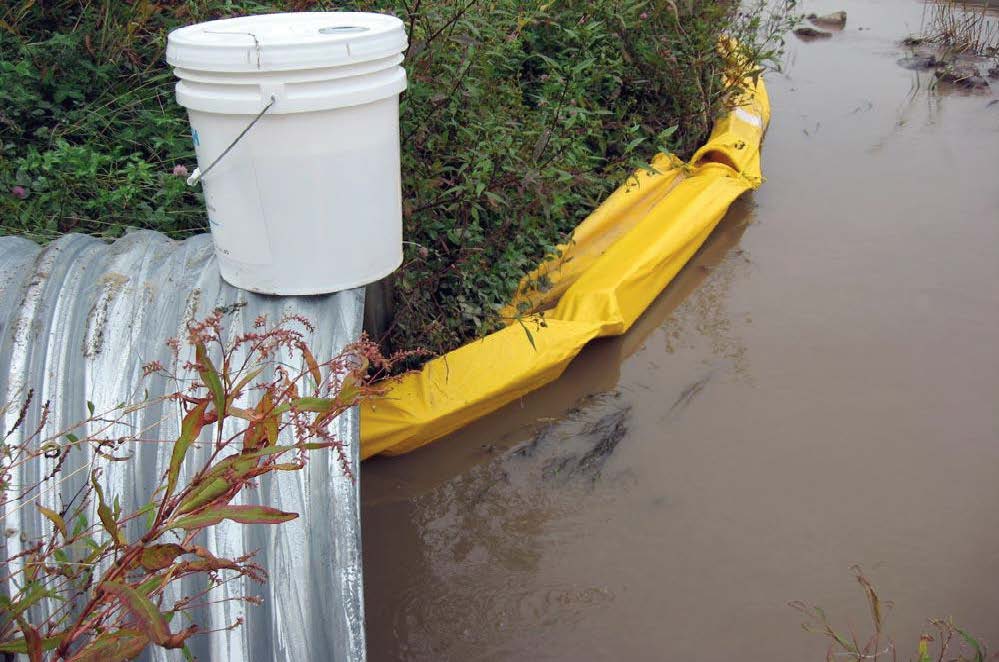
The Marlee Float from the SW Fee Saver is one of five currently available floating-head skimmers that researchers identified.
The Marlee Float from the SW Fee Saver is one of five available floating-head skimmers that researchers identified.

This is a new approach for MnDOT and Minnesota cities and counties, so research was needed to provide practical guidance for how to use these devices on construction sites.

“This was a small-scope implementation project for professionals to use as they design temporary stormwater ponds that meet state parameters,” said Dwayne Stenlund, MnDOT Erosion Control Engineering Specialist.

A new MnDOT study identifies five methods for “skimming” stormwater ponds that can improve a pond’s effectiveness by 10 percent. MnDOT researchers also created designs for temporary stormwater ponds on construction sites with the capacity to remove approximately 80 percent of suspended solids.

These designs will help contractors meet federal requirements for stormwater pond dewatering. Researchers also determined how often a pond’s deadpool must be cleaned, based on watershed size and pool dimensions.

“When sediment settles, it’s hard to determine when to clean out a pond. Based on the density of the sediments in the Minnesota River and the loading rates we computed, we were able to calculate how often we need to clean out a pond so sediment doesn’t reach the height of the skimmer,” said Joel Toso, principal of Wenck Associates and a consultant for the project.

Resources

Reducing Construction Pollution by Skimming Stormwater Ponds – Technical Summary (PDF, 2 MB, 2 pages); Final Report (PDF, 3 MB, 43 pages)

What it’s like to drive a 40-ton truck in circles for science (video)

The only way to test pavements is to destroy them — slowly and painstakingly, one moving vehicle at a time. At MnROAD, the state’s world-renowned pavement research facility, the bulk of this monotonous-but-necessary work is performed by live traffic passing through Albertville on I-94. But on the facility’s 2.5-mile low volume road test track, which simulates rural road conditions, more controlled methods are preferred.

Doug Lindenfelser is one of several MnROAD employees who take turns driving an 80,000-pound semi tractor trailer in laps around the closed-loop low-volume track. The truck is loaded to the maximum allowable weight limit on Minnesota roadways. As it passes over the facility’s 23 distinct low-volume test cells, an array of sensors capture data on the pavement’s performance, which researchers then use to design stronger, longer-lasting roads. The truck only drives on the inside lane; that way, the outside lane can be used as an “environmental lane” to compare  damage caused by loading  vs. damage caused by environmental factors.

He has other duties as well, but on a given day, Doug might drive the truck 60 or 70 times around the low-volume road test track. It might not sound very exciting, but as Doug explains, some days his job can be quite interesting. We interviewed him on camera during a recent visit to MnROAD. The resulting video is available above and on our YouTube channel.

For those who might be wondering, all this diligent destruction of pavement has paid off. It is estimated that MnROAD’s first phase of research (from 1994-2006) has resulted in cost savings of $33 million each year in Minnesota and $749 million nationally. Cost savings from its second phase (2007-2015) are being calculated, and the facility is scheduled to enter its third phase in 2016.

Learn More:

LRRB web tool tracks research projects around the state

As public works employees come and go, past research efforts — and the valuable knowledge gained — often goes with them.

But a recently launched web application allows users to track innovative pavement projects for a lifetime.

“It’s something everyone has always said we need to have,” said MnDOT Research Operations Engineer Jerry Geib, who worked on the project for the Minnesota Local Road Research Board.

Using an online map, city and county engineers can enter road test sections that they want to observe for many years due to a particular construction method or material that was used. Too often, the knowledge about such projects is lost when a particular staff person leaves an agency.

Not only will the lessons learned be remembered within the organization, but the results can also be shared with others.

More than 1,400 projects (including some on state roads) previously identified by MnDOT have been entered into the system. Search fields allow users to look for a particular type of project anywhere in the state or they can zero the map in on a particular area of the state.

The website is still in beta form, but functional.

“It’s complete, we just want people to use it so we can improve it,” said MnDOT Research Project Engineer Melissa Cole, who began planning the site two years ago.

One featured project is a 1.8-mile section of dirt road in Wabasha County that had an Otta seal applied in 2007 (photo below). It is one of only a handful of lightly surfaced roads in the state (an improvement over a gravel road, but less expensive than asphalt ) so there is great interest in watching how it performs.

One of the projects being tracked is Wabasha County Road 73, one of only a couple lightly surfaced (Otta seal) roads in the state.
One of the projects being tracked is Wabasha County Road 73, one of only a handful of lightly surfaced (Otta seal) roads in the state.
More to come

The LRRB initiated the project in 2009, but it was put on the back burner for a while due to funding constraints. MnDOT ‘s technology staff began development of the current site about 11 months ago.

Anyone can look at the website, but cities and counties require permission to post projects (contact ResearchTracking.DOT@state.mn.us for credentials). They  can upload photos, plans and weblinks relating to a particular project.

“We want to track anything that is worthy of looking at a few years from now,” Geib said.

Because the website uses Google maps, users can also view archived satellite and ground-level 360-degree imagery of the roads and bridges.

The website is viewable on a tablet, but it still must be tested on smart phones. Developers hope that crews will be able to submit information right from the field.

“We’re pretty happy with it,” said MnDOT software developer John Jones. “We think we’re headed in the right direction.”

The website might eventually be expanded for other areas, such as geotechnical (foundation work), whose practitioners have already expressed an interest.

A rumble strip applied to a center line on Highway 14 near New Ulm in 2004 is being tracked.
A rumble strip applied to a center line on Highway 14 near New Ulm in 2004 is one of the projects being tracked.

Minnesota's transportation research blog