

While roundabouts improve traffic efficiency and reduce accidents, pedestrian safety concerns linger. A study of driver–pedestrian interactions at roundabouts produced guidance for local agencies to increase driver yielding and enhance the pedestrian experience.
Continue reading Enhancing Pedestrian Experiences at Roundabouts
New revenues needed to fill transportation funding gap
What’s next in transportation?
The Future of Mobility series collects the perspectives of top U researchers and other national experts. In 17 articles, the authors scan the horizon and reflect on critical transportation topics. Each article recommends action steps for public officials and policymakers.
Continue reading New revenues needed to fill transportation funding gapRefocusing Transportation Decision Making
Monday, May 1, 2023
9:30 a.m.–11:30 a.m. Central
Center for Transportation Studies
AI Johnson Room
McNamara Alumni Center
Minneapolis, MN

Using Signal Phasing and Timing Data to Reduce Fuel Use
Fuel consumption increases when vehicles stop and start at traffic signals. Transmitting traffic signal data to connected vehicles could control vehicles’ driving speed and limit unnecessary stopping and starting, potentially lowering fossil fuel use. A recent study looked at the benefits and costs of deploying more signal messaging technology to inform future infrastructure investments.
Continue reading Using Signal Phasing and Timing Data to Reduce Fuel Use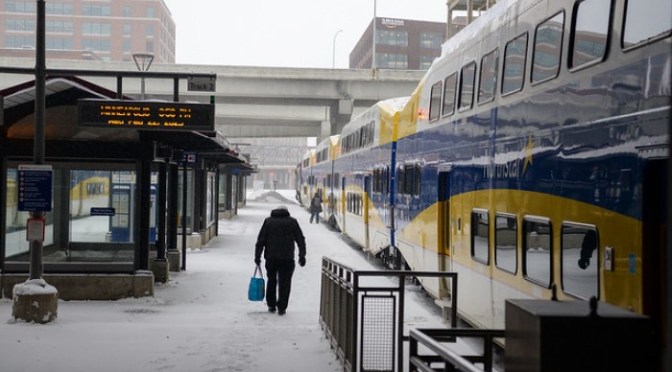
COVID’s Effects on Public Transportation Use and Perceptions
How has the pandemic affected downtown commuters’ travel behavior and perceptions of public transportation?
The COVID-19 pandemic has taken a major toll on public transit ridership—raising questions for the future. Will people associate public transportation with health and safety risks and avoid using it? Will they see public transportation as a less desirable transportation alternative?
Continue reading COVID’s Effects on Public Transportation Use and PerceptionsGuidance to Help Local Agencies Address Deferred Maintenance
Local government budgets are continually inadequate to meet increasing transportation maintenance needs. In a recent study, researchers analyzed maintenance investment decision-making in local governments across Minnesota, identifying the fiscal conditions that impact road repair spending, recommending steps to close maintenance funding gaps and providing context to inform communications with decision-makers.
Continue reading Guidance to Help Local Agencies Address Deferred Maintenance
EV System Impacts
Model helps analyze EV system impacts, evaluate policies for subsidies and charging
Electric vehicles (EVs) are expected to capture a substantial portion of the future vehicle market. In the short term, however, technology and infrastructure limitations—such as driving range and charging availability—will prevent transition on a large scale. Because EVs will share the road network with gasoline vehicles (GVs), says Alireza Khani, “it’s crucial to understand how EVs and GVs will coexist.”
Continue reading EV System Impacts
Are we ready for CAVs?
Thousand-mile trek collects data on Minnesota’s readiness for automated vehicles
How ready is Minnesota for connected and automated vehicles (CAVs)? Last August, researchers took a four-day, 1,086-mile trip around the state to find out. A newly published report details the team’s findings for transportation professionals and agencies as they consider how to make improvements to our transportation infrastructure for automated vehicles and driving.
Continue reading Are we ready for CAVs?
Commodity Flow Data for Freight Network Infrastructure Planning
Minnesota’s economy depends on efficient freight movement across the state. To ensure that infrastructure can accommodate cargo transport by all modes, MnDOT needs commodity flow data to plan improvements and minimize supply chain disruptions. An analysis of existing resources and needs will support new tools to optimize investments in freight transport.
Continue reading Commodity Flow Data for Freight Network Infrastructure Planning
MnDOT Library launches digital library
The MnDOT Library recently got a request for a copy of Minnesota Standard Specifications for Highway Construction from 1938. It might seem obscure, but the request was easy to fulfill because a digitized version of the manual was readily available in the newly launched MnDOT Digital Library.
Continue reading MnDOT Library launches digital library Crossroads