Category Archives: Policy and Planning

Bike to Work Day: progress in Minnesota, but miles to go

By Greg Lindsey

This blog post by University of Minnesota Professor Greg Lindsey was originally posted on the CTS Conversations blog.

April 9 is national Bike to Work Day, a day to celebrate those who choose bicycling as their principal mode of transportation for commuting, and a time to encourage more people to consider this healthy, efficient transportation option. Minnesota has much to celebrate in terms of bicycle commuting. Bike-Walk Twin Cities and Transit for Livable Communities are wrapping up the National Non-Motorized Pilot Program, a federally funded program to demonstrate the potential to increase biking and walking through focused investment in infrastructure and other interventions. Bicycle commuting rates in Minneapolis have climbed to 4.5%, and Minneapolis now ranks 20th in the nation in bicycle commute share. This is a noteworthy achievement, especially considering our notorious winter weather. These achievements, along with others such as the success of Nice Ride, our pioneering bike share program, have contributed to Minneapolis being named America’s most bike-friendly city by Bicycling Magazine. Celebration of these achievements – which represent hard work by hundreds of individuals and thousands of commuters – certainly is warranted.

But we only need look across municipal boundaries to know we had better put more energy into encouraging bicycling than into celebration. Bicycle commute rates in St. Paul remain below 2% less than half the Minneapolis rate, and rates in most suburban, exurban, and rural communities remain even lower. And the story remains essentially the same for all types of bicycle trips. Jessi Schoner, a doctoral candidate in the Department of Civil Engineering, is analyzing non-motorized mode shares for all trips recorded the Metropolitan Council’s recent Travel Behavior Inventory. Her analyses show that bicycling remains an urban phenomenon, with the share of all trips taken by bicycling highest in Minneapolis, followed by St. Paul, and then suburban and outlying communities. Why is this so? Better infrastructure no doubt is part of the reason, but there likely are other reasons, including housing patterns, access to employment, socio-demographic factors, and culture. Additional research is needed.

But this leads to additional reasons to be optimistic this Bike to Work Day: the commitments made by the Minnesota Department of Transportation (MnDOT) to foster multi-modal transportation systems and the agency’s investments in research to increase understanding of bicycle traffic patterns. In 2013, as part of the Minnesota Bicycle and Pedestrian Counting Initiative, MnDOT funded the installation of the state’s first two automated, continuous in-street bicycle counters. These counters, which monitor bicycle traffic around the clock, 365 days per year, will provide new insights into the bicycle traffic volumes and their daily and seasonal patterns. While bicycle traffic monitoring in Minnesota is only in its infancy, it represents progress towards establishing the evidence base we need to determine how to make bicycling safer and to invest in bicycle infrastructure.

And so celebrate this Bike to Work Day and thank your fellow Minnesotans for all they have accomplished. But also take time to reflect on the work that needs to be done to improve opportunities for cycling throughout the state, for we have miles to go.

Greg Lindsey is a professor at the University of Minnesota Humphrey School of Public Affairs. His areas of specialty include environmental planning, policy, and management. His current research involves studies of the relationship between the built environment and physical activity, specifically factors that affect the use of pedestrian and cycling infrastructure. Lindsey presented some of his bicycle and pedestrian data collection research at the 2014 Minnesota Transportation Conference held March 4-6.

Funding highway projects with value capture could speed project completion

There’s broad agreement that the U.S. transportation system cannot continue to be funded with existing financing and revenue-generation methods. What’s unclear, however, is how to pay for highway projects in the future. The current transportation funding system emphasizes user fees, but there is growing interest in alternative funding strategies. One promising strategy is value capture, which aims to recover the value of benefits received by property owners and developers as a result of infrastructure improvements.

In recent years, University of Minnesota researchers have helped lead the way in value capture research with a series of reports identifying value capture strategies. In a newly published study, the research team applied their previous work to a real-world scenario, with impressive results.

The new research, sponsored by the Minnesota Department of Transportation, focused on the planned development of Trunk Highway 610 (TH 610) in Maple Grove, Minnesota—a stretch of planned state highway delayed for years by state transportation funding shortages. Researchers set out to discover how the value of the enhanced accessibility provided by the planned improvements could be predicted and captured to help fund the project’s completion.

To accomplish their goal, researchers first defined a study area of about 10 square miles surrounding the unfinished highway segment. Then, they modeled property values based on five factors using parcel-level data. This model was designed to isolate the so-called “highway premium” by controlling for other factors that affect land value including water views, open space, railroads, transit stops, and existing highway exits. Using this model, researchers found significant evidence that the completion of the highway could lead to an over $17 million increase in property value.

Researchers expect these findings to have significant benefits for the TH 610 project and beyond.

Read the full article in the March issue of Catalyst.

Photo courtesy of SRF Consulting Group, Inc.

Value capture alternative finance model tested on Highway 610

Those who use the roads in Minnesota are generally those who pay for them — through gasoline and vehicle taxes.

But motorists aren’t the only ones who benefit when a new interchange is built or a highway is improved. Home and business values along the corridor go up and the price of undeveloped land can skyrocket.

With highway funds strapped, a new method of funding road expansion, called “real estate value capture,” is garnering attention.

This emerging technique strives to identify beneficiaries of transportation improvements beyond just the highway user, so they provide their fair share of the costs — a concept not dissimilar from residential street assessment.

For instance, a local government might dedicate the additional property tax revenue generated due to a new highway to offset some construction costs, or collect fees on land that is developed near an interchange.

However, value capture is a relatively new technique that has been used primarily for transit projects. To be considered for roads or bridges, questions need to be addressed about potential revenue, impacts and public acceptability.

In a new case study, researchers use a long-delayed planned extension of Highway 610 in Maple Grove to model the impact of a completed highway on nearby property values, and, for the first time, quantify the potential revenues from several value capture strategies.

With properties near new highway exits worth an additional $65,450 more per acre, researchers calculated that $37.1 million in revenue could be generated through assessments on existing development and impact fees for future development.

Other strategies explored include tax-increment financing and private-public development of undeveloped parcels, in which revenue generated by that development is split.

“This research demonstrates a way to estimate the value of transportation improvement and to communicate that to the public,” said principal investigator Jerry Zhao, an associate professor of public administration at the University of Minnesota’s Humphrey School of Public Affairs.

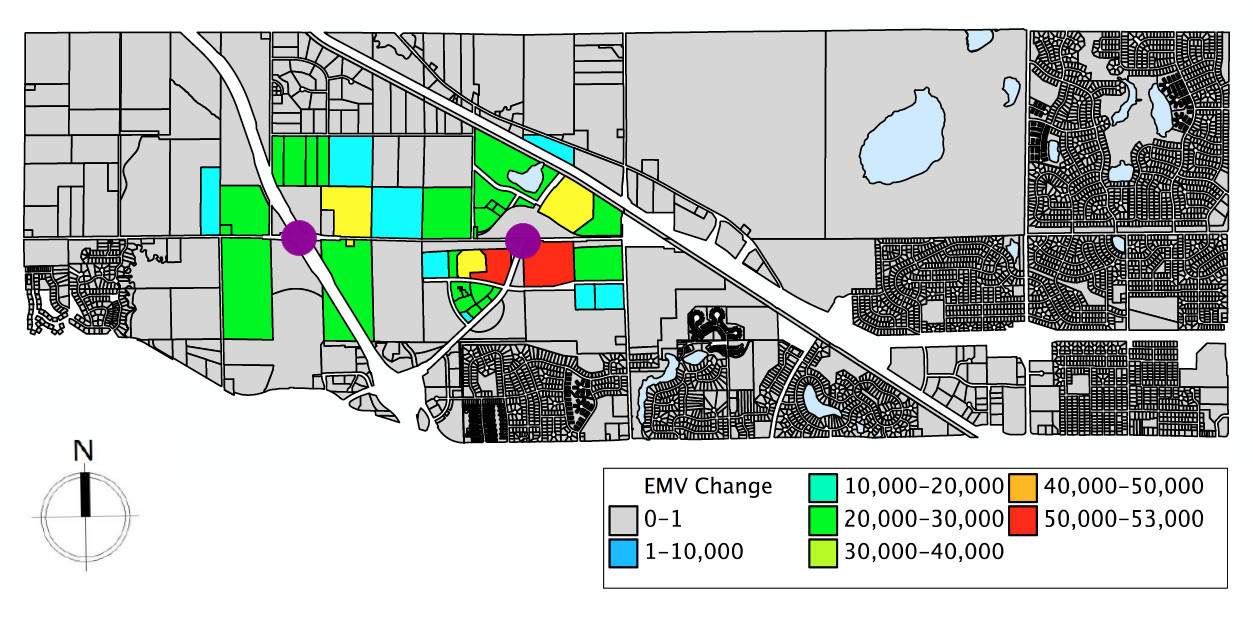
This map projects the anticipated increase in estimated market value (EMV Change) of parcels near Highway 610 that will result from completion of the highway and construction of exits at the two locations marked in purple. The impacted parcels are currently vacant, farmland or residential.
Study links:
    • Real Estate Value Capture: An Emerging Strategy to Pay for New Transportation Infrastructure – Technical Summary (PDF, 1 MB, 2 pages);  Final Report (PDF, 5 MB, 36 pages).

Do streetcars support commercial development? New Orleans results say yes

New streetcar lines are in the planning stages in Minneapolis and St. Paul. Proponents cite not only the lines’ ability to strengthen the transit system, but also their potential as catalysts for development. Estimating the impacts of streetcars is challenging, however, as most U.S. lines operate in downtown areas with many interrelated factors at play. A recent U of M research project examined the issue through the prism of one city’s experience: post-Katrina New Orleans.

The team—research fellow Andrew Guthrie and Assistant Professor Yingling Fan of the Humphrey School of Public Affairs—analyzed building permits near streetcar stops in the downtown business district and in several urban neighborhoods.

“Hurricane Katrina allowed—or required—more redevelopment to occur at a faster pace than 
normal, potentially allowing existing streetcar lines’ latent development impacts to appear,” Guthrie says. “This created an unfortunate yet rare opportunity for study.”

streetcars

The researchers estimated how the frequency of commercial and residential permits changed with distance from streetcar stops, controlling for hurricane damage, proximity to existing commercial areas, and pre-Katrina demographics.

They found that throughout the system, building permits strongly reflect the distance to stops—and that commercial and residential permits move
 in opposite directions within the first 750 feet.

Commercial permits declined the further away the location was from a stop. In residential areas, commercial permits show variation depending on neighborhood characteristics. The number of neighborhood residential permits rose about 24 percent with every 100 feet from a stop.

Based on their results, Guthrie and Fan conclude that traditional streetcar lines can help increase commercial development not just in downtown business districts, but in other urban areas as well. The findings also indicate that streetcars
 shape development in urban neighborhoods in
 a fundamentally different fashion than light rail.

Read the full article in the January issue of Catalyst.

Exploring Nice Ride job accessibility and station choice

Although bike share systems are becoming more popular across the United States, little is known about how people make decisions when integrating these systems into their daily travel.

In a study funded by CTS, researchers from the U of M’s civil engineering department investigated how people use the Nice Ride bike share system in Minneapolis and St. Paul. The researchers examined how Nice Ride affects accessibility to jobs and developed a model to predict station choice.

In the first part of the study, the researchers created maps showing accessibility to jobs by census block for both Nice Ride and walking—as well as the difference between the two—at time thresholds ranging from 5 to 55 minutes.

Overall, in blocks with both Nice Ride and walking job accessibility, Nice Ride provides access to 0.5 to 3.21 times as many jobs as walking.

By comparing Nice Ride to walking, the study demonstrated that walking can successfully be used as a baseline to show how a bike share system improves job accessibility. The results also pinpointed when and where Nice Ride had the strongest accessibility advantage over walking.

“This type of information can be used by bike share system planners to identify where new stations could be built to maximize their impact on job accessibility,” says grad student Jessica Schoner, a member of the research team.

In addition, the team developed a theoretical model for bike share station choice. The model considers users’ choice of a station based on their preference 
for the amount of time spent walking, deviation from the shortest path (the closest station may not be in the direct path of the person’s destination), and station amenities and neighborhood characteristics.

Findings show that people generally prefer to use stations that don’t require long detours to reach, but a station’s surroundings also play an important role. Results also indicate that commuters value shorter trips and tend to choose stations that minimize overall travel time.

According to Schoner, understanding people’s station preference can help provide guidance to planners that want to expand or optimize a bike share system.

Read the full article in the January issue of Catalyst.

New guidelines developed for counting bike, pedestrian traffic

Image
Manual field counts require more labor than automatic technologies, but they can collect deeper data about demographics and helmet use. Both forms of monitoring are necessary to give a complete picture of bicycle and pedestrian traffic in the state.

To prepare for a multimodal future, state agencies must be able to plan and engineer a transportation system for all modes of transportation, including bicycle and pedestrian traffic.

The Minnesota Bicycle and Pedestrian Counting Initiative was launched to develop consistent methods for monitoring non-motorized traffic across the state. Researchers developed guidelines for manual counts using state and national examples, and they also created methods for extrapolating annual traffic volumes from short-duration automated counts, for integration into MnDOT’s vehicular count database program.

The guidance developed for manual counts includes forms, training materials, public information for passers-by, links to smartphone applications that provide counting locations and spreadsheets for reporting results.

MnDOT hosted six workshops and a webinar to introduce local officials to the initiative and recruit participants for pilot field counts. Researchers then analyzed how these field counts could be used with existing automated counts to extrapolate daily or annual data.

MnDOT has installed some of the very first automated counting equipment on a state road — Central Avenue NE in Minneapolis (on the bike lane) and Highway 13 in Eagan (on a shoulder). As of 2012, six agencies in Minnesota counted non-motorized traffic (annual reports are available from the city of Minneapolis and Transit for Livable Communities), and even though comprehensive data is not yet available, Minnesota is a leader in this type of monitoring with more than 1,000 manual count locations and 32 automatic count sites.

Because of Minnesota’s experience, researchers collaborated with the National Cooperative Highway Research Program’s national Methodologies and Technologies for Collecting Pedestrian and Bicycle Volume Data research project, due for release in 2014, and contributed to the Federal Highway Administration’s effort to update its Traffic Monitoring Guide to include a chapter on non-motorized traffic.

Learn more:

Uncovering manufacturers’ perspectives on the transportation system

It’s no secret that manufacturing plays a key role in driving economic growth, or that transportation is essential for the success of any manufacturing operation.

While the relationships among manufacturing, transportation, and economic growth have been studied on a large scale, there is often little dialogue between transportation organizations and the manufacturers themselves. A recently completed pilot study conducted jointly by the Minnesota Department of Transportation (MnDOT), the University of Minnesota Humphrey School of Public Affairs, and University of Minnesota Extension aims to address this communication gap.

The pilot project focused on 12 counties in southwest Minnesota, where more than 172 regional businesses were contacted for participation and 75 in-person interviews were completed with manufacturers, shippers, and carriers. During the interviews, participants were encouraged to focus their comments on high-value, low-cost improvements that MnDOT can address in the short term without over-promising projects that currently cannot be funded.

Participants identified the need for smooth pavements and wide shoulders, the value of advance warning lights at intersections with traffic signals, the importance of highway safety, and the challenges of maneuvering oversized vehicles through roundabouts, among others.

The research team is compiling the pilot study’s findings into a final report. In the meantime, MnDOT is working to address a number of the challenges and suggestions uncovered through the pilot program.

Read the full article in the December issue of Catalyst.

Transitways spurring economic growth and development, improving mobility, and supporting equity

Landmark regional investments such as the transit expansion underway in the greater Minneapolis-Saint Paul metropolitan area have the potential to significantly change long-term land-use patterns and travel behavior. They also raise important questions for policymakers and elected officials regarding the potential return on investment.

ImageA new synthesis report from the Transitway Impacts Research Program (TIRP) pulls together seven years of research conducted by University of Minnesota researchers to help answer these questions. The report summarizes the actual and projected impacts of transitways on the Twin Cities region, offering lessons learned to help guide the build-out of the rest of the network most effectively. It concludes with a set of implications for policymakers.

The Twin Cities metro region is in the midst of a transit build-out. The Metro Blue Line (formerly known as Hiawatha), Red Line (Cedar Avenue Bus Rapid Transit), and Northstar Commuter Rail are in operation, and the Green Line (Central Corridor) opens next year. All are part of an expanding regional transit network.

Under the TIRP program, which was launched in 2006, University of Minnesota researchers provide an objective analysis of data, public perceptions, and complex impacts resulting from transitway investments. Their research is unique in its breadth, scope, and ability to provide real-time analysis of the changes experienced when a region introduces high-quality transit service.

“This body of research and objective analysis confirm the many positive ways that expanding our transit network supports economic competitiveness, greater accessibility to jobs, opportunities for populations with low incomes, and enhanced livability for our whole region,” says Kate Wolford, president of The McKnight Foundation, the synthesis sponsor. “This report undergirds why the accelerated build-out of our transit system is so important for the future prosperity of our region and its residents.”

More information about the synthesis and key findings

U of M Research: Spurring private-sector development along transit corridors

developmentA new research study is recommending ways to make it easier for developers and employers to select sites that encourage living-wage jobs and mixed-income housing near transit.

A key finding of the study, which was based on interviews with developers and business leaders, revealed a pent-up demand for transit access in the Twin Cities metropolitan region.

A team led by University of Minnesota researchers Yingling Fan and Andrew Guthrie found that providing a great work location is critical for employers in recruiting highly skilled young professionals who are likely to desire—or demand—urban living and access to transit.

They also found that multifamily residential developers, redevelopment specialists, and large corporate office tenants have a strong interest in transit-accessible sites, but regulatory barriers, cost issues, and uncertainty surrounding future development of transit often discourage both developers and businesses from selecting such sites.

More details about the study and key recommendations

New Complete Streets materials highlight best practices

Complete Streets scene
Photo courtesy Carissa Schively Slotterback

A new study from researchers at the U of M’s Humphrey School of Public Affairs aims to help Minnesota practitioners get Complete Streets projects on the ground.

“The goal was to look at what it takes to move a community from Complete Streets concept to Complete Streets project,” says Carissa Schively Slotterback, one of the project’s lead investigators.

As part of the study, Slotterback teamed with her Humphrey School colleague Cindy Zerger to investigate what’s working well in a variety of Complete Streets implementation efforts across the country. The study was sponsored by MnDOT and the Minnesota Local Road Research Board.

Slotterback and Zerger investigated six best practices areas related to Complete Streets: framing and positioning, institutionalizing, analysis and evaluation, project delivery and construction, promotion and education, and funding. Project findings stressed the importance of project context, the need for institutional and cultural changes, and the benefits of engaging advocates and project champions.

Based on the findings, Slotterback and Zerger are creating 11 case studies and a guidebook to help practitioners apply best practices and lessons learned from other communities to their own projects. The materials are set for completion this fall.

To learn more, read an article about the project in the August issue of CTS Catalyst.