In the video, Jennifer Zink, MnDOT state bridge inspection engineer, explains the project, along with Tara Kalar, MnDOT associate legal counsel; Cassandra Isackson, director of MnDOT Aeronautics; and Bruce Holdhusen, MnDOT Research program engineer.
The initial drone project drew significant media coverage and a lot of attention from other state departments of transportation from all over the country.
A second phase of the project was approved year and is currently underway. A third phase is already in the planning stages.
As the flying electronic devices became easier to use and less expensive, all sorts of individuals, businesses, nonprofit groups and government organizations – including the Minnesota Department of Transportation (MnDOT) – are exploring ways to use them.
This past summer, MnDOT began researching how to employ these unmanned aerial vehicles, or UAVs, to someday help inspect the state’s many bridges.
“That day may still be far off, but our initial project was an encouraging first step,” said Jennifer Zink, MnDOT bridge inspection engineer. “Phase 2 of the project will better provide details as to methods, criteria and cost effectiveness for how to apply drone technology best to bridge inspection.”
Project goal
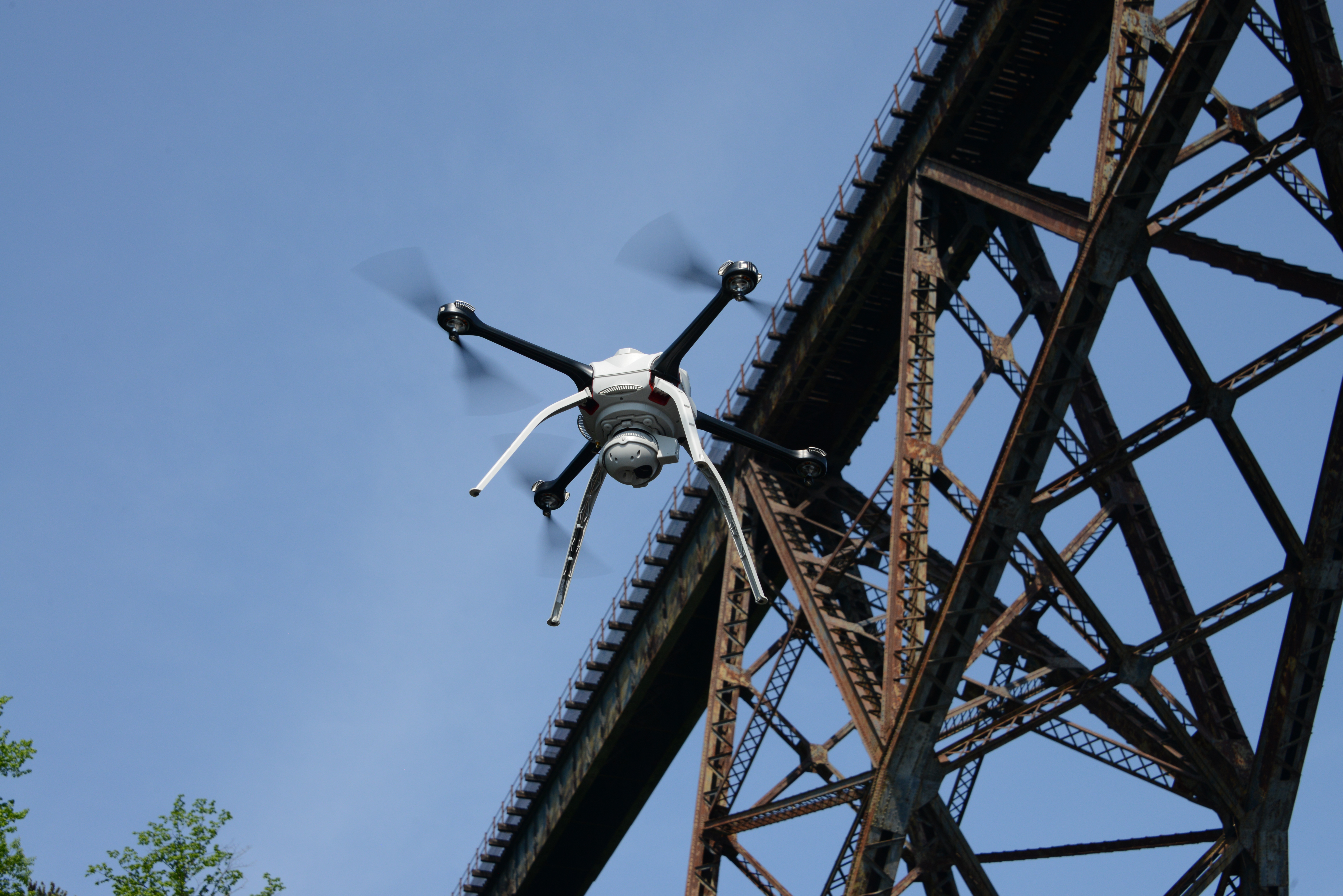
Using drones could help minimize risks associated with current bridge inspection methods, which include rope systems and special inspection vehicles. (Photo by D.R. Gonzalez, MnDOT)
The research team tested drones this past summer while inspecting four Minnesota bridges (in Chisago County, Olmsted County, Morrison County and near Stillwater) specifically selected for the study after an extensive evaluation and FAA approval.
Zink and her colleagues wanted to investigate whether drones could help MnDOT decrease the rising costs of bridge inspections and collect more detailed information. Drones could also minimize the risks for bridge inspectors, who currently use rope systems and special inspection vehicles to access hard-to-reach areas. Using a drone to gather images could keep inspectors out of harm’s way and inspection vehicles out of active traffic lanes.
“The goal of the project was to study the effectiveness and possibilities of using UAVs to aid in bridge inspection work, typically in gathering images without the use of an under-bridge inspection vehicle and in areas where access is difficult or not safe for an inspector,” Zink said. “There is no substantive guidance in existence for this application of this evolving technology. This initial effort was to gain a better understanding of potential capabilities, processes and planning best practices.”
FAA approval
Before simply launching drones and collecting bridge data, the research team reviewed current FAA rules and applied for the necessary exemptions. Approval was granted, but only for the use of an Aeryon Skyranger drone. Even though exemptions for several models were submitted to the FAA, none were approved in time for the field study.
Once in the air, the drone suitably performed a variety of inspection functions that didn’t require a hands-on physical inspection. Researchers tested the drone’s ability to gather high-quality still images and video footage of bridges. They also collected data from infrared cameras. In addition, the drone provided the ability to capture data needed to construct maps of bridge areas and 3D models of bridge elements.
“The images, including infrared images to detect deck trouble spots, obtained from the drone correlate to the findings in the bridge inspection reports for specific bridge elements,” Zink said.
Missing from the research were images of the underside of bridges. The drone model used in the study wasn’t able to shoot images upward from beneath a bridge, and inspectors identified that as a key feature along with the ability to operate without a GPS signal.
“The drone we used in this project was not completely ideal for an entire gathering of imagery for all bridge inspection elements as it was limited to GPS signal capability,” Zink said. “However, it did give us an idea of what a drone could provide, what the limitations were, and what features we would like to see on newly available UAV models. Unfortunately, our hands were tied with obtaining FAA exemptions only for the particular model used in this project within the funding timeframe.”
Conclusions and recommendations
The project’s final report listed several conclusions, including that drones can be used safely during bridge inspections and that risk to both the inspectors and public is minimal.
“Due to the successful outcome of the initial project, we have a better understanding of the drone capabilities we would like to use during an actual scheduled bridge inspection,” Zink said. “The drone that will be used in Phase 2 is specifically designed for inspection of structures. Several goals exist for the Phase 2 research project, and if we can accomplish them, they will decrease MnDOT’s costs and increase bridge inspection abilities. It could improve inspection data collection for local agencies as well.”
The researchers recently were notified that they received funding for Phase 2 of their project, which is expected to start later this fall.
Roadways for humans can sometimes create roadblocks for fish, but researchers hope to establish a set of culvert design practices to help aquatic creatures get where they’re going.
Many fish depend on mobility along a river for feeding and spawning. Where roads meet rivers, however, culverts can block fish and other aquatic organisms that can’t navigate changes in current, lighting and other factors.
Waterway barriers threaten an already endangered species of minnow known as the Topeka shiner (pictured above). It can also be a big problem for economically important fish such as trout or northern pike. That’s why the Minnesota Department of Natural Resources prefers building bridges to culverts.
However, bridges are not always economically feasible, and so MnDOT is working closely with the DNR to develop culverts that protect both public safety and the environment.
Culverts allow water to pass under roads. Occasionally, they can harm a stream’s fish habitat by inadvertently acting as a barrier to fish passage or migration. There are nearly 11,000 culverts in Minnesota.
Sediment Content
Recent research suggests that installing boxed culverts differently could greatly improve fish passage.
Culverts are typically placed a little below the streambed with the expectation that the stream flow will naturally fill them with sediment. Researchers tested that assumption and found it to not always be accurate.
“We found that pre-filling the culvert with sediment that replicates the streambed as part of the installation process helped prevent upstream erosion and the development of vertical drops that can become barriers to aquatic movement,” said Jessica Kozarek, a University of Minnesota research associate. “In addition, pre-filling the culvert helped ensure the sediment remained inside the culvert flows were high and water moved quickly during rainstorms.”
MnDOT has been working with the DNR to identify the conditions that determine whether a newly installed culvert will naturally fill with sediment, replicating surrounding streambed conditions, or whether a stream’s water flow will transport sediment out of a culvert.
Using an experimental flume at the University of Minnesota’s St. Anthony Falls Laboratory, researchers tested MnDOT’s standard box culvert design under a variety of stream conditions.
Laboratory simulations suggest that filling a culvert with sediment at installation, rather than allowing it to fill over time is, with some exceptions, generally the best approach for low- and moderate-grade streams. Additionally, steep, fast-moving waters require a filled culvert with structures such as larger rocks to keep sediment in place. These structures also create steps, pools and riffles that enable fish to rest as they move upstream.
MnDOT will use this latest research, along with conclusions from other recent studies, to create a guide for fish-friendly culvert designs.
“Of all the things we’ve studied, there are maybe three or four research projects. This manual will pull it all together,” said Petra DeWall, state waterway engineer at the Minnesota Department of Transportation.
Further research is underway to determine whether aquatic organisms are deterred by low light conditions in long, dark culverts. Researchers are also looking into whether mussel spat rope could be used to create a rough bottom to reduce water speed in culverts with no sediment.
Bridges over Minnesota waterways need to be protected from currents by a field of interlocking angular rocks called riprap. Without these rocks along the abutment, moving water could wear away the soil that supports a bridge’s foundation. The faster the water, the larger the riprap must be to provide adequate protection.
While some parts of Minnesota have quarries rich with angular rock, other parts don’t – particularly the northwest and western regions. Bridge projects in those areas sometimes resort to the expensive practice of trucking in stones. Other times field stones are used, but they are less effective and must be replaced more often.
There soon could be a better option thanks to research coordinated by the Minnesota Department of Transportation and funded by the Minnesota Local Road Research Board.
At a few test sites around the state, researchers have used a grout mixture to cement smaller, rounded rocks together at a bridge abutment. Once applied to the rocks, the mixture forms what is called “matrix riprap.” The concept is in use in Europe for many bridge piers, but MnDOT was more interested in learning how it could be used on bridge abutments.
Matrix riprap is currently in use in Minnesota at the following bridges:
Highway 23 over the Rum River in Milaca
Highway 8 over Lake Lindstrom channel in Lindstrom
Prairie Road over Coon Creek in Andover
A MnDOT crew applies grout to rounded rocks at a bridge abutment in Milaca in May 2012. The grout cements the rocks together to form matrix riprap, which has shown to be significantly stronger than conventional riprap.
In May 2012, matrix riprap was placed at the Milaca bridge, which sits alongside a high school. Researchers hoped the use of matrix riprap would prevent vandals from removing the riprap rock and throwing it into the river. According to Nicki Bartelt, a MnDOT assistant waterway engineer, the matrix riprap has proven to be extremely strong and effective.
“Not only is matrix riprap significantly stronger than regular riprap, but it helps prevent vandalism as well,” Bartelt said. “The Milaca installation has been in place for three years now. It looks pretty good and it’s weathering well.”
In the lab, matrix riprap held up extremely well on mechanical pull tests and hydraulic flume tests. In fact, researchers were unable to determine the matrix riprap fail point on many tests, even after applying 10 times the shear stress that regular riprap can withstand. Matrix riprap was tested with both angular and round rock with no change in performance.
A new matrix riprap installation recently went in on the Highway 95 bridge over the Rum River in Cambridge. Later this summer, plans call for an installation on the Highway 60 bridge over the north fork of the Zumbro River in Mazeppa.
“The Highway 60 bridge is being replaced, and the river there has extremely high velocities, so we’re using the matrix riprap instead of regular riprap just because of the size of rocks that would be needed,” Bartelt said.
At least two more installations are planned for 2016. In the future, researchers plan to determine the fail point for matrix riprap. They also hope to study potential environmental effects the grout may have underwater.
MnDOT has also worked with local governments that have tried matrix riprap for themselves. One municipality is trying it as a heavy duty erosion control measure. The concept is catching on outside Minnesota as well.
“We have gotten a lot of inquiries from other states, and we have lent out the spec a lot,” Bartelt said. “Iowa, New Hampshire, Maine, Indiana, Wisconsin and Illinois are among the states to express interest. We have talked to a lot of people about it, so they tend to use our research.”
Just how long will it be before a bridge deck needs to be rehabilitated? Why not look to history to find out?
Researchers have put several decades of MnDOT bridge inspection records to good use by analyzing old bridge deck condition reports to calculate how quickly similar bridge decks will deteriorate.
MnDOT inspects bridges regularly, but had never used this historical data to help determine the rate of bridge deck deterioration and what factors influence it.
“We’re always trying to improve the timing of bridge deck repair projects and improve our understanding of what contributors affect the way our bridge decks deteriorate,” said Dustin Thomas, MnDOT’s South Region Bridge Construction Engineer.
Data-Crunching
From their analysis, researchers created deterioration tables that can be used to better predict the timing and costs of repairs and maintenance.
Researchers looked at the inspection history and construction details of 2,601 bridges to determine the impact of factors such as type of deck reinforcement, depth of reinforcement below the driving surface, traffic levels and bridge location.
Using the inspection data, researchers developed curves that show how long a bridge deck is likely to stay at a given condition before dropping to the next. They developed separate curves for each variable that had a significant impact on deck deterioration rates.
What They Found
Several factors were found to have a notable impact on how quickly bridge decks deteriorate:
Decks without epoxy-coated bars built between 1975 and 1989 deteriorate more quickly than other bridge decks.
Bridges with less traffic showed slightly slower rates of deterioration than highly traveled bridges.
Metro area bridges drop to a condition code of 7 (good) more quickly than bridges in other parts of the state. This may be due to increased chemical deicer usage or because maintenance activities like crack-sealing are more likely to be delayed on larger metro bridges because of the difficulty accessing middle lanes.
When a new deck is installed on an existing bridge, the deck performs like a brand-new bridge and so MnDOT should use the deterioration table for the re-decking year, rather than the year the bridge was originally constructed.
MnDOT plans to incorporate future bridge inspections into the dataset to enhance the predictive value of the deterioration tables.
The impact of overlays on bridge deck deterioration in Minnesota was not clear, but redecked bridges were found to perform similarly as brand-new decks.
A leading cause of bridge failure is bridge scour, which occurs when rapidly moving water erodes riverbed soil around abutments or piers.
Monitoring bridge scour with traditional inspection methods can be dangerous and difficult, so MnDOT has been working with researchers from the University of Minnesota’s St. Anthony Falls Laboratory to develop a continuous monitoring system to test certain bridges more safely and efficiently.
MnDOT currently monitors 45 scour-critical bridges — and local Minnesota agencies monitor 360 more — using visual inspections or water data websites during flooding events. Once a predetermined threshold is exceeded, portable scour monitoring equipment is deployed to measure scour depth. If scour has undermined the foundations of a bridge, inspectors close it for repair.
But portable scour monitoring systems can be difficult and dangerous to deploy from the bridge deck or boat in fast-moving water. It can also be difficult to get inspectors to sites quickly enough in areas subject to flash flooding.
A better alternative for such situations are fixed scour monitoring devices that continuously monitor scour and send data wirelessly to bridge personnel, alerting them when scour reaches a dangerous level.
The Highway 43 Bridge in Winona was affixed with continuous bridge scour monitoring equipment.
New technology
MnDOT has not historically made use of fixed scour monitoring equipment, but as advances in technology have made these devices more affordable and reliable, the agency became interested in exploring the use of fixed monitoring equipment at locations where the use of portable equipment is problematic. ( A major concern for fixed scour monitoring is damage from debris and ice.)
Researchers have installed fixed remote monitoring stations on four such bridges.
Stations on the first two bridges (Highway 14 over the Minnesota River in Mankato and Highway 43 at the Mississippi River in Winona, pictured at top) ran successfully for three years, with outages due to primarily to power and communication issues.
Researchers learned valuable lessons from these bridges and have now installed monitoring equipment on two more: The Old Hastings Bridge (Highway 61 over the Mississippi River), on which float-outs were installed; and the Dresbach Bridge (Interstate-90 over the Mississippi River), which had a tilt meter and underwater sonar device installed.
“The less familiar personnel are with technical equipment, the less they tend to use it,” said Andrea Hendrickson, State Hydraulics Engineer, MnDOT Office of Bridges and Structures. “This research project gave us the familiarity and technical information we need to be comfortable using fixed scour monitoring equipment on bridges that warrant it.”
*Editor’s note: This article was adapted from an article in the latest issue of our newsletter, Accelerator. Read it online, or sign up to receive it by mail.
New video, below, shows how explosions are used to test the bedrock for the new Highway 43 bridge in Winona.
Bridge engineers use “pile load testing” to find out how much weight and resistance the ground will bear. It not only saves time and money, but helps design a bridge that will sit securely on the bedrock, below the river.
The statnamic test used in the video is one part of this process.
Winona Bridge Statnamic Test
How load testing works:
It begins with digging and pounding.
Two different kinds of piles are put into the ground:
A hollowed shaft, which is filled with rebar and concrete. It goes 30 to 50 feet below the bedrock to create a solid pillar that can assess how much weight and sway the ground will bear.
A steel pipe that is hammered into the ground. Since the bedrock is about 100 to 150 feet below the river, these pipes are welded together end-to-end to reach that length.
Once the piles are in, they’re tested two different ways.
Pile Dynamic Analysis, with gauges affixed to the top of the pile to read the pressure put on it when hit with a pile driver.
A Statnamic test (shown in videos), which involves accelerating a heavy weight by setting off a controlled combustion reaction. This shows how much resistance the pile can take.
Once the data is collected for the bridge design, the piles are cut off two feet below the river bed.
One of St. Paul’s most iconic landmarks is helping the Minnesota Department of Transportation find the most cost-effective methods of maintaining concrete bridge decks.
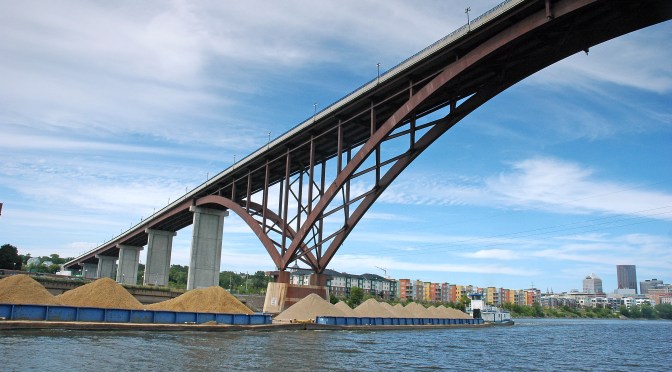
For the last three years, the Smith Avenue High Bridge, which connects downtown St. Paul with the city’s west side, has served as a test bed for a variety of products used to seal cracks on bridge decks. Through MnDOT-funded research, various sealant products have been applied on different areas of the bridge deck, with their performance tracked over time.
“This project will help MnDOT make cost-effective maintenance decisions to preserve its current bridge infrastructure,” said Sarah Sondag, a senior engineer with MnDOT Bridge Operations Support.
The bridge was chosen in part because of its large deck area, which allowed for the application of 12 sealant products and three control sections.
Sealing deck cracks is a routine preventive maintenance task for bridge crews. Left untreated, cracks can allow moisture and chlorides to penetrate the bridge deck, which can lead to the corrosion of reinforcing steel, deck deterioration and the need for early deck replacement.
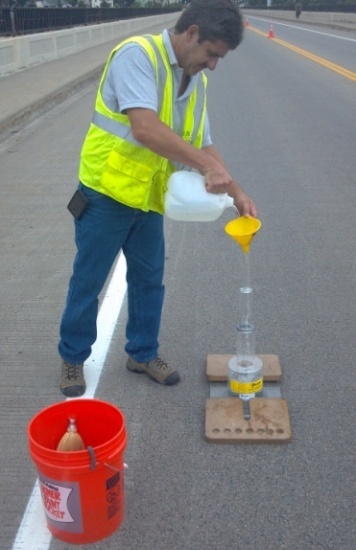
A researcher tests the permeability of a crack on the deck of the Smith Avenue High Bridge in St. Paul.
MnDOT maintains a list of approved bridge deck crack sealing products, but until now had little data on how well each one performs in the field. The recently published report also examined several products that are not currently on the Approved Products List.
Among the study’s findings: some of the products on MnDOT’s Approved Products List did not perform as well as other products that are not currently on the list. MnDOT is using the results of the study to update its qualification process for products to get on the approved list. Insights gained from studying application techniques will also be used to update MnDOT’s bridge maintenance manual.
*Note: This blog post was adapted from an article and technical summary that will be featured in the upcoming issue of the Accelerator newsletter.
Using Dawn dish soap to grease the rails, MnDOT crews inched the new Larpenteur Avenue Bridge into place two weeks ago using an innovative construction method.
As the bridge reopens to traffic tonight over I-35E, MnDOT celebrates the success of its first slide-in place bridge construction.
“The slide-in worked very well,” said David Herzog, MnDOT’s project manager for the I-35E Corridor – MnPass Project. “I think the process has given us the confidence to possibly use it again in the future.”
Slide-in technology
The slide-in method has been used in the past for railroad bridges and large bridges with high traffic and limited construction options. Now, state agencies and the Federal Highway Administration are applying the method to smaller, more routine bridges to minimize impacts to the traveling public.
Whereas the typical phased construction of a bridge builds one-half of the structure at a time, slide-in bridge technology allows the entire superstructure to be built at once, requiring just a brief, temporary closure of the highway.
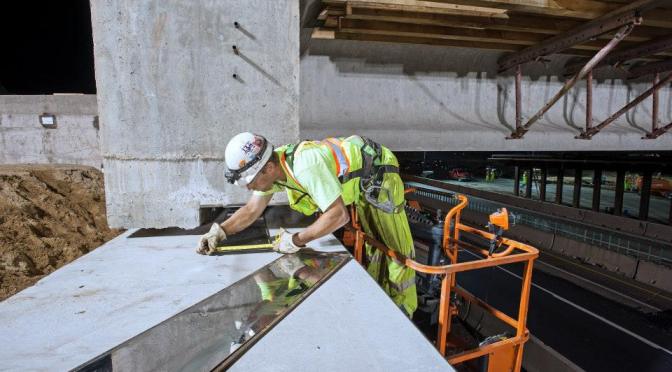
Crews constructed the 3.5-million-pound Larpenteur Bridge right next to the existing bridge and then slowly slid it into place during the course of two nights. This effectively sped up construction from 110 days to 47 and reduced traffic impacts to drivers. (Watch video of the slide.)
The quality of the bridge also improves with this method, since it eliminates the deck construction joints and girder camber problems associated with phased construction, according to the FHWA. The pressure to use faster concrete cure times is also reduced.
History
With a quarter of the nation’s bridges in need of repair or replacement, the FHWA is pushing the slide-in method as a cost-effective technique that can cut construction time in half. It has previously been used in Oregon, Utah, Missouri, Michigan, Colorado and Massachusetts.
The concept has been around for more than a century, but slide-in technology is relatively new for small or medium-sized bridges, and it’s the first time MnDOT has attempted it on a state bridge.
Although MnDOT staff had flown out to Utah to view a slide-in, it was Burnsville-based Ames Construction that proposed reconstructing the Larpenteur Avenue bridge that way when it made its successful bid for the corridor project.
The slide-in method is about 15 percent more expensive, Herzog said, but it allowed the bridge to re-open in 47 days, versus 110 days.
Earlier this summer, Ames replaced the Wheelock Parkway and Arlington Avenue bridges in conventional fashion, although they were only closed for 65 days because they were constructed on a very accelerated timetable.
“Larpenteur is more of a major thoroughfare and we thought shortening the duration of its closure would be more valuable to MnDOT,” said Steve McPherson of Ames Construction, who was brought in from Utah to oversee the corridor project.
The fast reconstructions will allow the company to complete the bridge replacements and highway reconstruction in just 120 days. Next year it’ll finish the other half of the corridor.
All three bridges are being replaced to make room for the new MnPASS lane on I-35E.
One of the drawbacks to slide-in technology is that it requires ample room to build the bridge on-site. An alternative is to construct off-site.
The new Maryland Avenue/I-35E bridge was built off-site, as was the Hastings Hwy. 61 bridge. It was then loaded onto a barge, floated down the Mississippi River and lifted into place.




 Crossroads