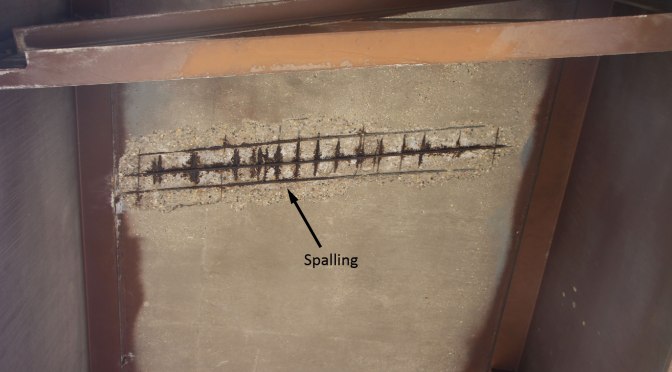
Reinforced concrete bridges are built to handle heavy loads and routine traffic for 75 years or more. But bridges in climates like Minnesota’s are exposed to moisture and chlorides from road salts that may penetrate these structures and corrode the steel.
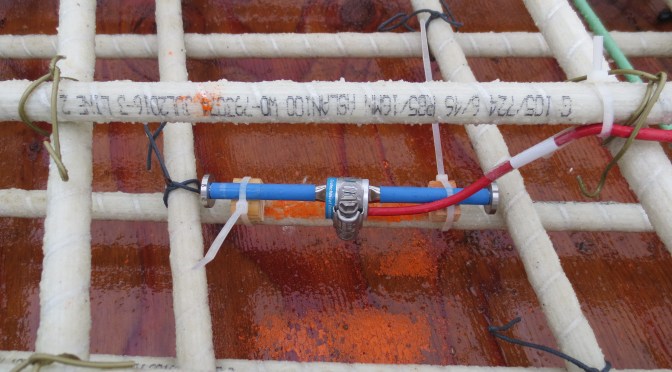
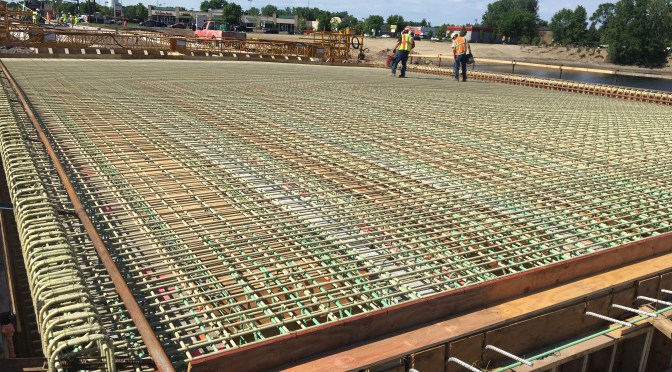
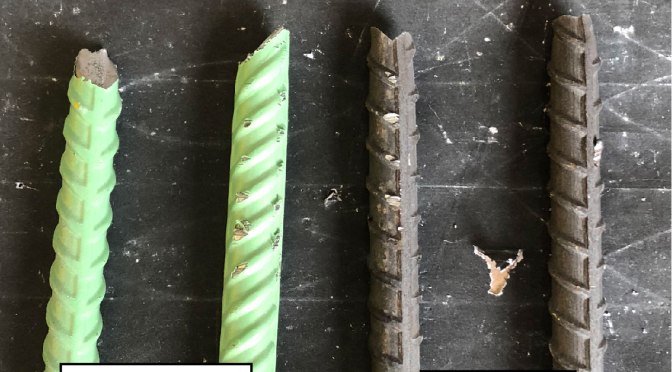
In a recently completed research project, funded by MnDOT and the Local Road Research Board, researchers studied a rural bridge built in 2017 near Elgin, MN, that used glass fiber–reinforced polymer (GFRP) rebar in the bridge deck. They found that GFRP performed well, proving sufficiently strong for use as an alternative to corrosion-susceptible steel rebar.
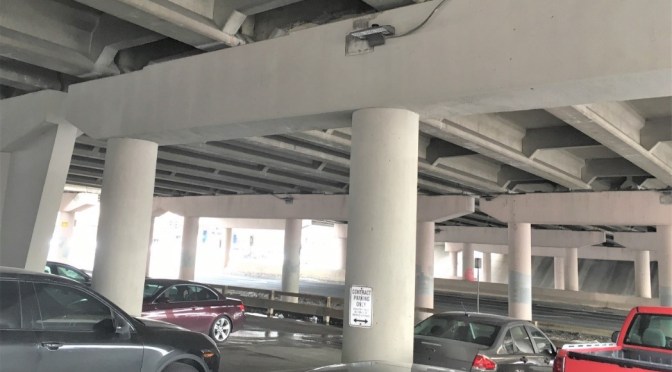
Well-documented efforts undertaken two decades ago to mitigate corrosion of a Highway 394 reinforced concrete bridge have given researchers the perfect scenario for evaluating the treatments’ long-term effectiveness. The test results are mixed: State-of-the-art methods for electrochemical chloride extraction and fiber-reinforced polymer wrapping of bridge elements performed well in combination, but poorly in isolation.
A new spreadsheet tool developed by the Minnesota Department of Transportation draws on historical data to help project engineers better estimate bridge construction time. The method allows users to project time-frames based on bridge design elements, work scheduling and other inputs, utilizing estimates from comparable projects in a 10-year database of bridge-building data.
A new MnDOT-funded research study has found that most agencies in states with weather similar to Minnesota’s use debonded strands in prestressed concrete bridge beams. MnDOT may begin piloting debonding as an alternative to draping, which manufacturers claim is time-consuming, challenging to worker safety and expensive.
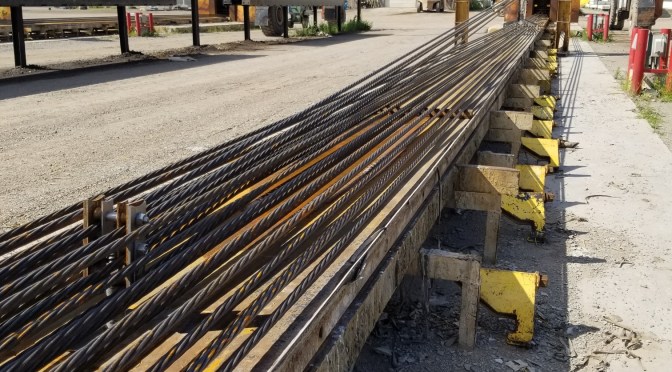
The Minnesota Department of Transportation (MnDOT) had suspended the use of post-installed epoxy-coated rebar for concrete barrier repairs as a precautionary measure because chemical adhesives used in the process are not designed for use with coated bars. But laboratory testing (conducted in a recent MnDOT-sponsored research study) has now shown that using these adhesives with coated rebar for post-installation works well and provides a safety level 200 to 300 times that predicted by manufacturer specifications. MnDOT is considering research recommendations to modify the installation process in order to resume using coated rebar in post-installed concrete crash barriers.
Bridge decks reinforced with one layer of epoxy-coated rebar and a bottom layer of uncoated steel rebar show corrosion damage sooner than decks constructed with all epoxy-coated rebar. Inspection methods should be enhanced to add a rating for cracking density on the underside of bridge decks. Repairs to mixed rebar decks should be conducted once a key deck surface inspection element has received a condition rating of two and held that rating for seven years, which is sooner than the average repair time of 8.5 years.
A Minnesota Department of Transportation research study has developed a new method for estimating vertical displacements on bridges using accelerometers installed on the Interstate 35W St. Anthony Falls Bridge in Minneapolis. The dual-model approach shows potential for using these sensors to measure vertical displacement on steel, cable-stayed and other less-stiff bridges where traffic generates higher vibration frequencies. The method expands the industry’s knowledge of how to use smart sensors in new ways.
What Was the Need?
Since September 2008, the I-35W St. Anthony Falls Bridge has carried traffic over the Mississippi River in Minneapolis and funneled sensor data to researchers and MnDOT bridge engineers. This smart bridge features over 500 sensors that monitor strain, load distribution, temperature, bridge movement, and other forces and functions.
Sensors help designers and bridge managers learn more about how bridges shift and flex over time. Concrete expands and contracts, and bearings shift; sensor systems continuously gather data about these minute changes, offering an alternative to time-consuming inspection.
Sensors attached to a steel beam to study vibrations in a laboratory.
Researchers continue to identify potential uses for sensor data and new ways to use such information to analyze bridge properties and performance. In a 2017 study about monitoring bridge health, researchers learned to distinguish and associate specific vibration frequencies with structural damage, weather conditions and other factors. These frequencies were gathered by accelerometers, which measure structural vibrations triggered by traffic and environmental conditions.
Decks, piers and other structural elements displace vertically under loads and environmental conditions. Researchers and bridge managers wanted to know if accelerometers could be used to measure vertical displacements and help monitor bridge health.
What Was Our Goal?
MnDOT needed a procedure for measuring and monitoring vertical displacement on bridges under traffic and environmental forces. Investigators would use the sensor systems on the I-35W St. Anthony Falls Bridge to design and analyze this procedure.
“We need to learn more about sensors because we don’t have a lot of experience with them. This study gave us valuable information about accelerometers and the information they provide,” said Benjamin Jilk, Complex Analysis and Modeling Design Leader, MnDOT Bridge Office.
What Did We Do?
Indirect analysis and measurement of vertical displacements rely on estimations obtained through modeling. Investigators evaluated the most well-developed approach for measuring vibration frequencies like those tracked by accelerometers and refined the method. The team developed a dual-model approach: One model estimates loads and the other estimates displacements.
In a laboratory, investigators evaluated the impact of loading on displacement and vibration frequencies on a girder with contact sensors and accelerometers under moving and stationary loads. Researchers applied the dual-model analysis to laboratory displacement readings to compare the effectiveness of the model with contact sensor responses to loading.
Using laboratory data, investigators tuned the dual-model approach to accelerometer data available from the I-35W St. Anthony Falls Bridge. The research team then applied its identified tuning approach to the data from the bridge’s 26 accelerometers to determine the procedure’s suitability for estimating vertical displacement from vibration response on this bridge and its potential for other structures in the MnDOT bridge system.
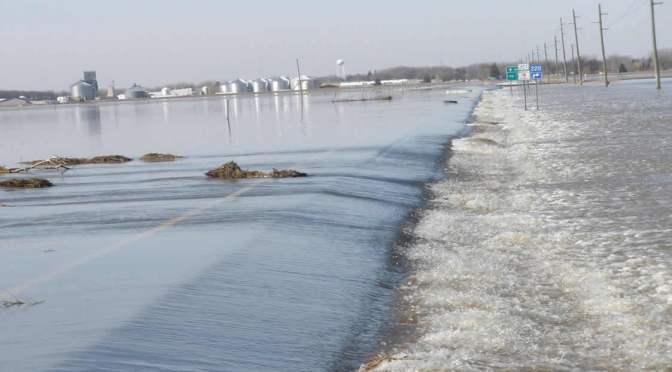
Extreme flooding is a threat to Minnesota’s transportation infrastructure and the safety and economic vitality of its communities. A spate of recent flooding events around the state has demonstrated this and heightened the level of concern. Furthermore, climate change — a factor not traditionally accounted for in the design of the state’s infrastructure — is projected to enhance precipitation and the threat of flooding in coming decades.
Given this, MnDOT is undertaking an effort to better predict the threat flooding poses to its bridges, large culverts and pipes, which may be increasingly called upon to convey higher, more frequent flood flows than they were designed for.
The state transportation research program recently launched a two-year extreme flood vulnerability analysis study, which will develop a methodology for characterizing the vulnerability of the state’s bridges, large culverts, and pipes to flooding.
The effort builds upon the previously completed Flash Flood Vulnerability and Adaptation Assessment Pilot Project (2014), which scored bridges, large culverts, and pipes in MnDOT Districts 1 and 6 for flood vulnerability, allowing detailed assessments of adaptation options for each of their facilities to be prioritized.
This new study, which will be conducted by WSP, aims to develop and test ways to enhance the vulnerability scoring techniques used in the previous study and ensure their applicability throughout the state. Researchers will not actually undertake the statewide assessment, but specify an approach that could be used for it. They will also explore how the outputs of the analysis can be incorporated into MnDOT’s asset management systems. The results of this work will be a clear path forward for MnDOT to use for prioritizing adaptation actions — a key step towards enhancing agency resilience and maintaining good fiscal stewardship.
Project scope
The primary intent of this study is to develop a methodology for characterizing the flood vulnerability of bridges, large culverts, and pipes statewide. As part of the development process, the methodology will be tested on a limited, but diverse, set of assets across the state. Following a successful proof of concept, recommendations will be made on how the outputs (i.e., the vulnerability scores) can be incorporated into the state’s asset management systems.
By determining which facilities are most vulnerable to flooding through the techniques developed on this project, MnDOT can prioritize where adaptation measures will make the biggest impact, ultimately decreasing asset life-cycle and road user costs. Without the development of assessment techniques, adaptation measures run the risk of being implemented in a more reactive and/or ad-hoc fashion, with less regard to where the biggest “bang for the buck” can be realized.
This project will produce several technical memorandums, and is expected to be completed in early 2021.
Transportation planners lack a method to directly compare bridge and road conditions. In a new MnDOT-funded study, University of Minnesota researchers have proposed a Percent Remaining Service Interval (PRSI) measure that can uniformly assess the condition of bridges and pavements, enabling planners to make the most efficient use of preservation and improvement funding.
Planners would like a condition measure similar to RSL that could be used to compare and prioritize needs for highway and bridge construction.
“Both the MnDOT Bridge Office and the Materials and Road Research Office have very good management systems in place,” says Mihai Marasteanu, a professor in the Department of Civil, Environmental, and Geo- Engineering (CEGE) and the study’s principal investigator. “There is a good potential to develop a new common metric that both offices could use.”
What Did We Do?
To begin developing this new measure, researchers conducted a literature review of current methods used in asset management and life-cycle cost analysis. The review of bridge research focused on performance measures and life expectancy assessment methods, while the study of pavement literature concentrated on performance measures as well as on the use of road service life measures.
Next, the research team, which included civil engineering bridge professor Arturo Schultz, surveyed both bridge management staff and pavement management staff from state transportation agencies. Team members then analyzed the asset management practices of MnDOT’s Office of Bridges and Structures and Office of Materials and Road Research to identify methods for assessing service lives and rehabilitation needs and to highlight the similarities and differences in approaches.
Based on the findings from the survey and analysis, researchers suggested the new method of PRSI that would serve both pavement and bridge needs and offered guidelines for the next steps in developing and implementing a unified PRSI procedure.
“Ultimately, funds for guardrail repairs are drawn from the same purse that pays to fill a pothole or repair a deck joint,” Marasteanu says. “With PRSI, planners could target average values across systems to optimize life-cycle costs and pursue an even distribution of PRSI values to make planning consistent from year to year.”
What’s Next?
In the next phase of the project, researchers will work with the pavement office to identify relevant data for calculating PRSI for pavements. “In addition, we plan to identify the time and costs required to reach the evenly distributed configuration of PRSIs necessary for planning consistency, assess how preservation activities impact funding efficiency, and calculate recommended metrics for asset sustainability,” Marasteanu says.