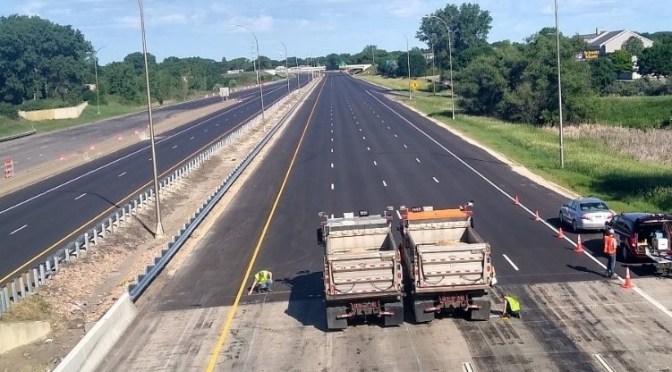
When transportation officials determine which route a heavy truck should take, their aim is maximizing efficiency while ensuring safety. Detours around bridges on critical freight routes increase fuel and labor costs for the trucking industry—and eventually hit consumer pocketbooks, too.
Detours around bridges in a critical freight transportation route create costs to the trucking industry, taxpayers and state economy. New load rating factors for the slab-span bridges across Shingle Creek will give MnDOT more flexibility in managing truck traffic and keeping freight moving efficiently.
Corrosion of steel reinforcement in bridge structures creates uncertainty in the structural capacity. A new prediction tool will help estimate rebar section loss to accurately plan for appropriate bridge maintenance repairs.
A new testing method will allow MnDOT to determine the underground foundation pile depths of high-mast light towers (HMLTs) without digging or dismantling. HMLTs need to meet design standards to ensure load-bearing stability. By using the new method to evaluate pile depth, MnDOT could avoid costly retrofits or replacements, and prioritize light towers in need of redesign.
MnDOT owns and maintains approximately 900 buildings across Minnesota, and the Building Services Section is responsible for planning repairs, renovations or expansions. Architects, engineers and other specialists involved in these activities require data regarding building and site conditions. Collecting this data is often a multidisciplinary and laborious effort that can be time-consuming and expensive. Alternative technologies, however, can gather and process large amounts of accurate information more comprehensively, safely and cost-effectively.
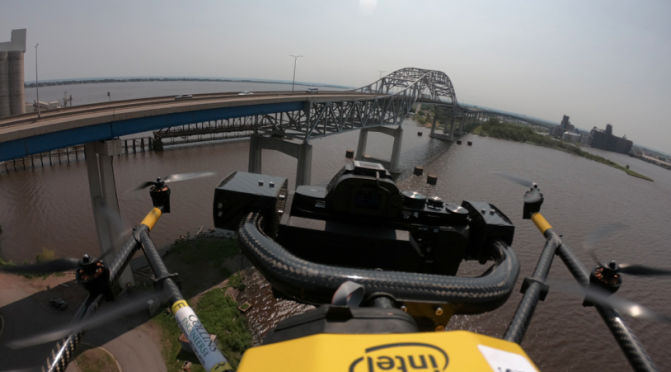
Using drones to inspect bridges allows MnDOT to collect very high quality data while exposing fewer inspectors to far less risk and reducing inconvenience to the public. A new fleet of UAS will be used to conduct inspections statewide.
In recent years, MnDOT has seen an increase in cracking of low slump overlays. Cracking of overlays allows chlorides to get into the bridge deck which leads to deterioration of the reinforcement and eventual delamination or spalling. This means that the bridge deck needs to be repaired or even replaced before the service life has been reached.
What is a low slump overlay? A low slump overlay is a technique used by DOTs to extend the life of bridge decks. They are typically 2″ thick and designed to provide low permeability.
A new field guide offers best practices for mitigating the impact of seasonal movement of soils at culverts and utilities. The user-friendly reference offers links to design drawings, plans, specifications and other resources.
In a recent study of inspection reports, design documents and other data to evaluate the safety performance of bridge barriers, investigators found that the most commonly used barrier designs meet newer safety requirements and keep Minnesota drivers safe.
This article was originally published in Catalyst, August 2020.
On August 1, 2007, the I-35W Saint Anthony Falls Bridge collapsed in Minneapolis. Its replacement, open to traffic just over a year later, was instrumented with more than 500 sensors to record the new structure’s behavior and evaluate the effectiveness of different monitoring strategies. A 10-year review of the bridge’s monitoring system is now available from U of M researchers.