
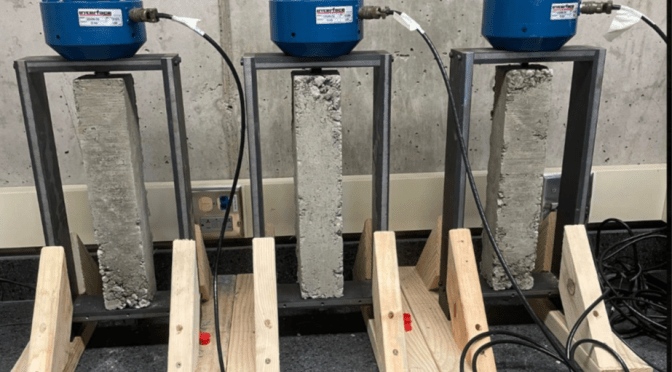
Premature cracking in reinforced concrete bridge decks is expensive to repair and may lead to rapid bridge deterioration. Despite changes to mix designs, transverse cracking after casting continues to be a problem in Minnesota. This project evaluated alternative concrete mix designs and reinforcement strategies to mitigate early-age bridge deck cracking, reduce maintenance costs and extend bridge deck service lives.
Continue reading Evaluating Strategies to Prevent Early-Age Bridge Deck CrackingCategory Archives: Bridges and Structures
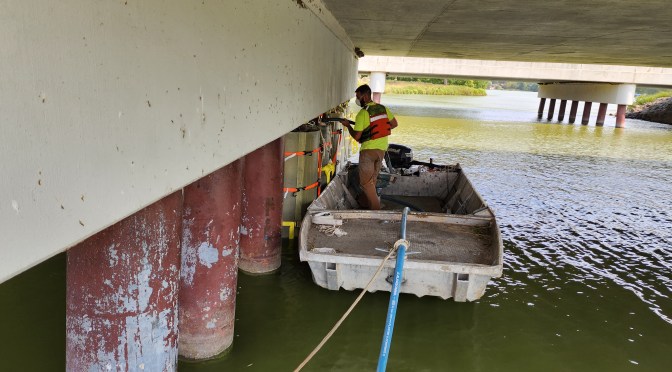
Repairing In-Water Bridge Supports Using Innovative Methods and Materials
In recent years, advancements in bridge repair techniques and technologies promise to offer more options for strengthening an existing bridge’s in-water piles, eliminating the need to reroute both water and traffic. This project investigated other states’ experiences with several products on the market and provided an opportunity for Minnesota’s engineers to evaluate two vendors’ systems on a bridge in need of restoration.
Continue reading Repairing In-Water Bridge Supports Using Innovative Methods and Materials
New Project: Species from Feces: A New Tool to Identify Bats in Culverts and on Bridges
Three bat species in Minnesota have been decimated due to white-nose syndrome. The northern long-eared bat is listed as endangered by the U.S. Fish and Wildlife Service, the tricolored bat listing is imminent, and the little brown bat listing is under consideration.
Continue reading New Project: Species from Feces: A New Tool to Identify Bats in Culverts and on Bridges
New Project: Develop Element Level Bridge Performance Measures and Targets
Currently, federal bridge performance measures in the United States and measures most commonly used by state transportation agencies for bridge management are based on National Bridge Inventory (NBI) General Condition Ratings that reflect bridge component conditions (deck, superstructure and substructure).
MnDOT also collects bridge element data that provides a more granular, objective and quantitative assessment of condition, and would like to have performance measures and targets based on the bridge element data that guides a data-driven methodology to select cost-effective treatments.
Continue reading New Project: Develop Element Level Bridge Performance Measures and TargetsAssessment of GFRP-Reinforced Bridge Deck Performance
A nonmetallic alternative to the steel rebars that reinforce concrete bridge decks has the potential to be longer lasting and more cost-effective in keeping bridges maintained in Minnesota’s harsh climate. Initial studies show that the performance of bridge decks built with glass fiber-reinforced polymer (GFRP) is comparable to—if not better than—conventionally built decks.
Continue reading Assessment of GFRP-Reinforced Bridge Deck Performance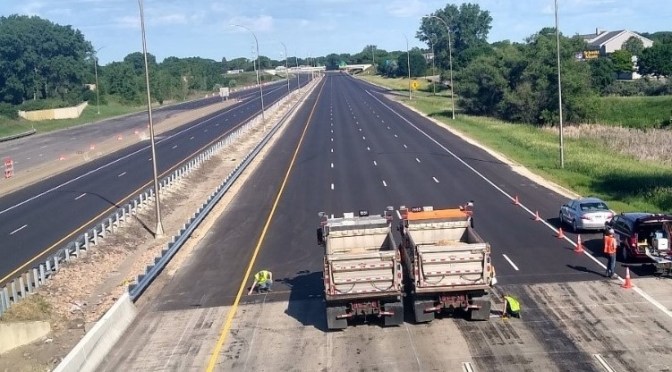
New methods to determine safe bridge loading will help keep Minnesota’s truck freight moving
April 10, 2023
When transportation officials determine which route a heavy truck should take, their aim is maximizing efficiency while ensuring safety. Detours around bridges on critical freight routes increase fuel and labor costs for the trucking industry—and eventually hit consumer pocketbooks, too.
Continue reading New methods to determine safe bridge loading will help keep Minnesota’s truck freight moving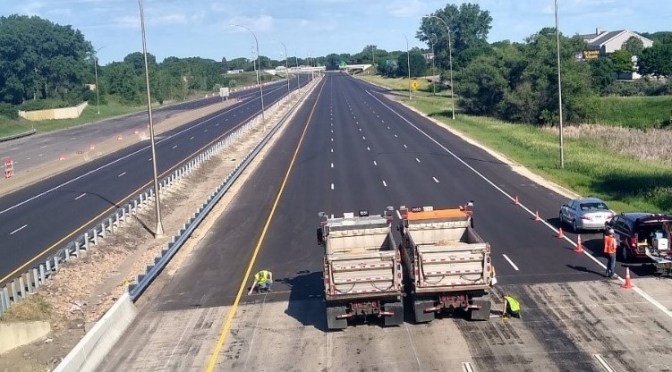
Updating Load Ratings for Shingle Creek Slab-Span Bridges
Detours around bridges in a critical freight transportation route create costs to the trucking industry, taxpayers and state economy. New load rating factors for the slab-span bridges across Shingle Creek will give MnDOT more flexibility in managing truck traffic and keeping freight moving efficiently.
Continue reading Updating Load Ratings for Shingle Creek Slab-Span Bridges
Estimating Corrosion of Embedded Steel Rebars in Bridge Structures
Corrosion of steel reinforcement in bridge structures creates uncertainty in the structural capacity. A new prediction tool will help estimate rebar section loss to accurately plan for appropriate bridge maintenance repairs.
Continue reading Estimating Corrosion of Embedded Steel Rebars in Bridge Structures
Nondestructive Detection of Pile Length for High-Mast Light Towers
A new testing method will allow MnDOT to determine the underground foundation pile depths of high-mast light towers (HMLTs) without digging or dismantling. HMLTs need to meet design standards to ensure load-bearing stability. By using the new method to evaluate pile depth, MnDOT could avoid costly retrofits or replacements, and prioritize light towers in need of redesign.
Continue reading Nondestructive Detection of Pile Length for High-Mast Light Towers
Managing Building Assets With Scanning and Reality Modeling
MnDOT owns and maintains approximately 900 buildings across Minnesota, and the Building Services Section is responsible for planning repairs, renovations or expansions. Architects, engineers and other specialists involved in these activities require data regarding building and site conditions. Collecting this data is often a multidisciplinary and laborious effort that can be time-consuming and expensive. Alternative technologies, however, can gather and process large amounts of accurate information more comprehensively, safely and cost-effectively.
Continue reading Managing Building Assets With Scanning and Reality Modeling Crossroads