A new research study is recommending ways to make it easier for developers and employers to select sites that encourage living-wage jobs and mixed-income housing near transit.
A key finding of the study, which was based on interviews with developers and business leaders, revealed a pent-up demand for transit access in the Twin Cities metropolitan region.
A team led by University of Minnesota researchers Yingling Fan and Andrew Guthrie found that providing a great work location is critical for employers in recruiting highly skilled young professionals who are likely to desire—or demand—urban living and access to transit.
They also found that multifamily residential developers, redevelopment specialists, and large corporate office tenants have a strong interest in transit-accessible sites, but regulatory barriers, cost issues, and uncertainty surrounding future development of transit often discourage both developers and businesses from selecting such sites.
In 2010, MnDOT began a three-year long, $67 million repair and upgrade project on I-35 in Duluth. Dubbed the “Mega Project,” it created a serious disruption for Duluth-area commuters. To help mitigate the impact, the Duluth Transit Authority stepped up its bus services, offering free rides in newly established bus-only express lanes as well as access to new park-and-ride lots and various other enticements. Perhaps not surprisingly, many area residents took advantage of their new transit options to avoid construction-related travel delays. But what’s really interesting is what happened after the construction ended.
As described in a recently published MnDOT/University of Minnesota study, commuters who started taking the bus to avoid traffic caused by the construction ended up continuing to ride the bus even after the construction ended. Researchers surveyed riders during and after the 2010 and 2011 construction seasons and found that, even after bus fares went back to normal levels, only 15 percent of the new bus users switched back to driving. Researchers concluded that once riders developed a habit of using transit, the habit tended to stick.
The report author sums up the phenomenon quite nicely in her executive summary:
Human beings are creatures of habit. Most of us travel the same route every day to the same destination. Sometimes, however, something comes along to push us to examine our habits and possibly change them. A major highway construction project can be such an event. (…) This provides a very good opportunity to examine our travel patterns and possibly change our habitual modes.
Of course, this change didn’t just happen on its own. As the technical summary notes, the DTA marketed its services aggressively during this period. (The above photo is just one example.) The study also noted that the elimination of expanded bus services in the winter had a negative impact on ridership.
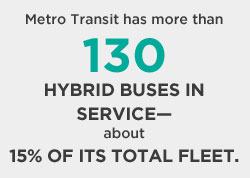
One of Metro Transit’s new advanced “super hybrid” buses—built in Minnesota and billed as the cleanest, most efficient diesel-electric hybrid buses in the United States—garnered national attention at the American Public Transportation Association’s Bus and Paratransit Conference May 5–8 in Indianapolis.
Photo: Metro Transit
Unique because of its all-electric accessory systems, the bus was featured at the event so that transit professionals from across the country could experience this new hybrid technology firsthand, says Chuck Wurzinger, assistant director of bus maintenance at Metro Transit. The bus is one of two advanced hybrids built for Metro Transit in 2012. They currently operate on local routes with frequent stops in downtown Minneapolis and its surrounding communities.
The decision to purchase the new hybrids was greatly influenced by the results of a University of Minnesota study aimed at improving fuel economy in diesel-electric hybrid buses, Wurzinger says. The “Superbus” study, led by mechanical engineering (ME) professor David Kittelson, included an energy audit of major accessory systems on a standard hybrid bus. The study was funded by Metro Transit, CTS, and the U of M’s Institute for Renewable Energy and the Environment (IREE).
Study findings indicated that up to half of the fuel consumed by hybrid buses is used to power accessory systems. According to the research team, powering these systems electrically could significantly improve fuel efficiency.
The new advanced hybrids do just that, using all-electric systems to power the heating, air conditioning, engine fans, power steering, and air compressor. These components improve fuel economy, reduce emissions, and allow the buses to be operated in electric-only mode for short periods.
Photo: Metro Transit
One of the buses also has start/stop capabilities, which allow the engine to shut down at bus stops and traffic lights. “This reduces engine idle time while maintaining all other bus functions, including passenger comfort and safety features,” Wurzinger says.
Although the buses have been in service for only a short time, they are already showing promising increases in fuel economy, Wurzinger says. “We have also operated them consistently on electric power inside the bus garage, which helps keep the air clean in the building. This reduces the amount of ventilation required in cold weather, which means less energy is used to heat the building.”
Along with a standard hybrid bus and a conventional diesel transit bus, one of the advanced hybrids will be monitored and evaluated in a new study conducted by U of M researchers in collaboration with Metro Transit. The multidisciplinary research team includes Kittelson, ME associate professor Will Northrop, ME research associate Winthrop Watts, and applied economics associate professor Steven Taff.
As part of the study, funded by IREE, the team will collect real-world, on-the-road data from the three buses in all seasons on a variety of route types. The researchers then plan to compare the efficiency and emissions of the buses and make recommendations to Metro Transit about which configuration is the best for a given application. Data collected from the study will also allow Metro Transit to work with bus manufacturers to optimize bus performance.
“We believe the results will be useful in writing bus technical specifications and also in determining if a certain type of bus is best suited to a certain type of bus route,” Wurzinger says.
Ultimately, this information could be used to determine which buses to assign to which routes as well as which type of bus to purchase given fleet replacement or expansion requirements.
In April, we posted about an innovative pothole-filling technology being developed by the Minnesota Department of Transportation and the University of Minnesota, Duluth. The technique involves zapping pothole patches and the surrounding pavement with a special truck-mounted, 50,000-watt microwave. Researchers have found that heating the base and the patch material at the same time creates a stronger, longer-lasting bond that provides for a more permanent pothole fix.
Last week, the MnDOT/UMD microwave technology found its way into a new MnDOT video (above) that also explores two other experimental pothole-patching methods. One involves using a large “electric oven”-type heating element instead of a microwave. The other utilizes a new exothermic (i.e. heat-generating) asphalt mixture containing taconite from northern Minnesota mines. The video compares the potential benefits of all three of the new technologies, which the department hopes will someday lead to “more pothole-patching power for the taxpayer dollar.”
Weigh-in-motion (WIM) systems consist of sensors placed in road pavements to measure the weight of vehicles passing over them, along with other data such as speed, axle load and spacing, and vehicle type. This data is used to enforce weight limits on trucks and is also useful in a wide range of other applications, such as pavement design and traffic analysis.
However, constructing and maintaining permanent roadside WIM stations is expensive, so these systems are installed primarily on roadways with heavy traffic, such as interstate and trunk highways, and rarely used for rural local roads. Meanwhile, heavy truck volumes on local roads are increasing, significantly shortening their lives. A less costly, portable WIM system is needed for such roads so that collected data can be used to better design these roads to accommodate heavy truck traffic.
One solution for bringing WIM technology to local roads is to implement a portable, reusable system similar to pneumatic tube counters used to conduct traffic counts. With funding and technical assistance from MnDOT and the Local Road Research Board, Professor Taek Kwon of the University of Minnesota—Duluth has developed a prototype system that has already proven to be nearly as accurate as the more expensive, permanent systems. MnDOT Research Services staff drove up to MnROAD this week to observe a live demonstration of the technology, and made this short video.
The research being conducted here is part of an implementation project based on Kwon’s original study, the results of which can be found in this research report and its accompanying two-page technical summary from MnDOT Research Services.
The White House named Minnesota Department of Transportation State Traffic Engineer Sue Groth one of its 12 transportation “Champions of Change” for her role in implementing life-saving technology to help prevent collisions at rural intersections. The rural intersection conflict warning systems, which use sensors and lights to give motorists real-time warnings about traffic conditions, were developed by MnDOT’s Office of Traffic, Safety and Technology.
It’s worth noting that MnDOT Research Services and the University of Minnesota are also currently working on a project to develop a low-cost version of these systems using LEDs and solar panels. The ongoing research, being conducted by University of Minnesota— Duluth Professor Taek Kwon, is a continuation of the Advanced Light-Emitting Diode Warning System project completed in 2010.
ST. PAUL, Minn. – On Wednesday, May 8, 2013, the White House honored Sue Groth, Minnesota Department of Transportation’s state traffic engineer, as one of 12 people who are Transportation “Champions of Change.” The Champions event, “Transportation Technology Solutions for the 21st Century,” focused on individuals or organizations that have provided exemplary leadership in developing or implementing transportation technology solutions to enhance performance, reduce congestion, improve safety and facilitate communication across the transportation industry at the local, state or national level.
“These Champions represent the very best in American leadership, innovation and progress,” said Secretary Ray LaHood. “I’m proud to recognize these transportation leaders who work every day to grow our economy and help us reach our destinations more quickly, efficiently and safely.”
The MnDOT Office of Traffic, Safety and Technology has been selected as a Champion of Change for their work to reduce fatal and life-changing crashes on Minnesota roadways, while enhancing mobility for all users. OTST is being honored for designing, testing and helping to deploy dozens of life-saving rural intersection conflict warning systems throughout Minnesota, while leading a national effort to do more of the same throughout rural America. These systems save lives at rural intersections that might otherwise not warrant or afford more traditional traffic control devices or geometric improvements.
As is painfully evident this time of year, Minnesota’s weather is highly destructive to our asphalt roadways. One of the biggest challenges for transportation practitioners in cold-climate states like ours is low-temperature cracking in asphalt pavements. The distress caused by our extreme weather variations and constant freeze-thaw cycles wreaks havoc on our asphalt streets and highways, causing decreased ride quality, increased maintenance costs and shorter pavement lifespans.
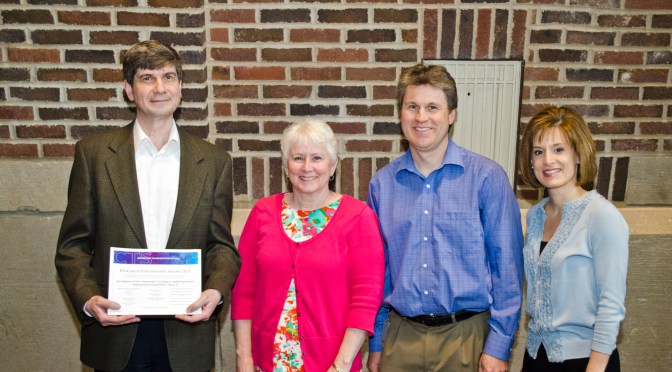
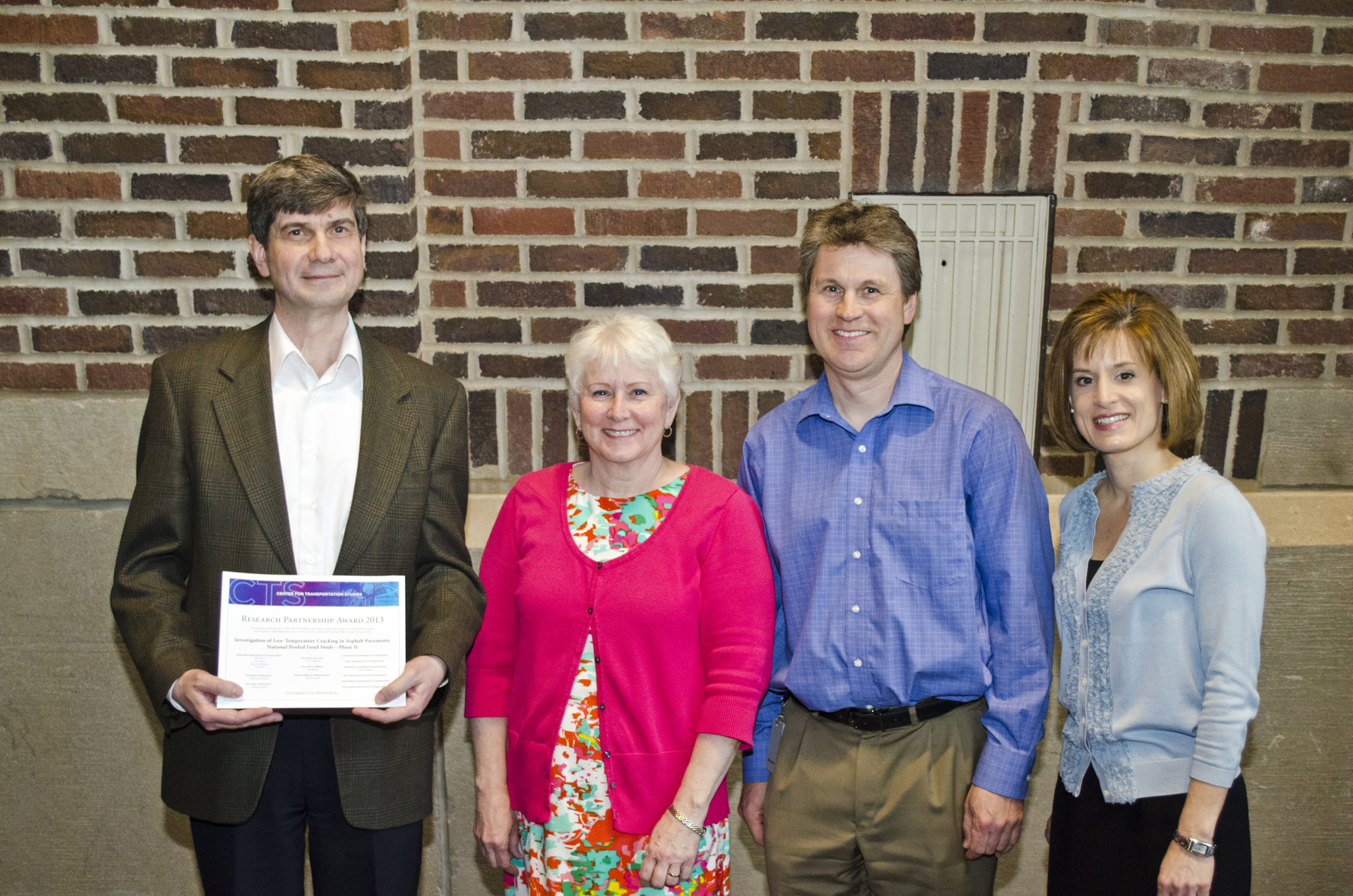
On April 17, the Center for Transportation Studies presented its 2013 Research Partnership Award to the team members of a multi-state, Minnesota-led study designed to combat the problem. The project, “Investigation of Low Temperature Cracking in Asphalt Pavements, Phase II,” was a national pooled-fund study involving six state DOTs, four universities, the Minnesota Local Road Research Board and the Federal Highway Administration. It resulted in a new set of tools — test methods, material specifications and predictive models — that will be used to build longer-lasting pavements.
The project is a prime example of the value and benefits of cooperative research. Each organization brought its own unique strengths and expertise to bear on the problem. The University of Minnesota, led by Professor Mihai Marasteanu, brought its strength in lab testing of binders and mixtures, for example; other universities leveraged their respective expertise in data analysis, statistics and modeling capabilities. MnDOT, as the lead state agency, controlled the finances and kept the research on track, guiding the process through technical advisory panels. MnDOT’s materials laboratory and its unique MnROAD pavement research facility also played a key role in the study.
The above video provides an excellent overview of the project and includes commentary from key MnDOT and University of Minnesota team members. MnDOT is already moving to implement the results. It plans to use the new test procedure on several road construction projects this year. Iowa and Connecticut are among the other states reportedly planning implementation projects.
From left: University of Minnesota Professor Mihai Marasteanu, the project’s principal investigator; MnDOT State Aid Director Julie Skallman; MnROAD Operations Engineer Ben Worel; and CTS Associate Director for Development and Finance Dawn Spanhake, who presented the award. (Photo by Cadie Adhikary, Center for Transportation Studies)


 A new research study is recommending ways to make it easier for developers and employers to select sites that encourage living-wage jobs and mixed-income housing near transit.


 Crossroads