

The use of channelized right-turn (CRT) lanes at intersections can improve driver safety and traffic mobility but can be challenging for bicyclists and pedestrians, particularly those with sight or other impairments. This project examines the current practice of CRTs to identify design solutions and mitigation strategies to better accommodate the safety and accessibility needs of all road users.
Continue reading Designing Channelized Right-Turn Lanes to Increase Pedestrian and Cyclist SafetyTag Archives: pedestrian safety

Improving Pedestrian Safety on Reservations in Minnesota
MnDOT has identified Native Americans as one of six priority populations in the state that experience disproportionate risks as pedestrians. To access everyday services such as grocery stores, workplaces and schools, pedestrians may have to cross a state or county roadway at unmarked crossings. Installing traffic safety countermeasures at these crossings is intended to reduce the risk faced by pedestrians. This project analyzed pedestrian safety at 23 locations within seven reservations and the effectiveness of countermeasures implemented at six locations.
Continue reading Improving Pedestrian Safety on Reservations in Minnesota
Tribal Pedestrian Safety
A new video developed by the Center for Transportation Studies highlights a multiyear study of pedestrian safety at reservations that was undertaken by U of M researchers and partners from seven Anishinaabe tribes. The work was sponsored by the Minnesota Department of Transportation (MnDOT).
Continue reading Tribal Pedestrian Safety
New Project: Roadside Feature Placement and Pedestrian Safety on Low and Intermediate Speed Roads
Guidelines for designing and placing roadside features have traditionally focused on automobile safety on higher-speed roads. Research has also shown feature placement can have safety benefits for pedestrians and bicyclists on lower-speed roads.
Continue reading New Project: Roadside Feature Placement and Pedestrian Safety on Low and Intermediate Speed Roads
Understanding Factors That Influence Driver Yielding to Pedestrians
Vehicle speeds, type of pedestrian, road characteristics and other variables can impact whether drivers yield to pedestrians attempting to cross a road at an unsignalized intersection. An analysis of data collected from 18 intersections identified human and site attributes that correlate to higher rates of driver yielding. Knowledge of these potentially influential factors will help local engineers build safer crossings at intersections.
Continue reading Understanding Factors That Influence Driver Yielding to Pedestrians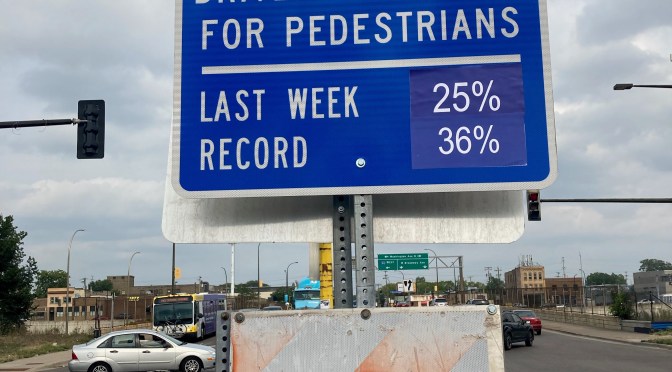
Improving Driver Yielding to Pedestrians at Intersections
Improving the rates of drivers yielding to pedestrians has been challenging despite crosswalk laws. Expanding on an earlier study, researchers further explored the effectiveness of engineering treatments at road crossings, giving agencies a deeper understanding of how to maximize pedestrian safety.
Continue reading Improving Driver Yielding to Pedestrians at Intersections
Designing Pedestrian Safety Features for Year-Round Maintenance
Pedestrian safety countermeasures near roadways require year-round maintenance to be effective. Clearing snow and ice has not generally been a design consideration for safety treatments, but new research has identified specific design criteria to help MnDOT and other agencies keep walkways clear without impeding maintenance efforts.
Continue reading Designing Pedestrian Safety Features for Year-Round Maintenance
Enhancing Pedestrian Experiences at Roundabouts
While roundabouts improve traffic efficiency and reduce accidents, pedestrian safety concerns linger. A study of driver–pedestrian interactions at roundabouts produced guidance for local agencies to increase driver yielding and enhance the pedestrian experience.
Continue reading Enhancing Pedestrian Experiences at Roundabouts
New Project: Assessment of Pedestrian Safety and Driver Behavior Near Automated Vehicles
With the number of automated vehicles increasing on our roadways it is important to understand their potential impacts and how other road users will interact with them. In the future, there will be a more pronounced shared levels-of-automation transportation network, with fully manual, partially automated, and fully automated vehicles sharing the same Minnesota roads. While planners and engineers have a reasonable idea of how humans drive around other humans, what is not as well-known is human driving behavior around automated vehicles.
Continue reading New Project: Assessment of Pedestrian Safety and Driver Behavior Near Automated Vehicles
More Saint Paul drivers stopping for pedestrians, thanks to pilot study
A two-year research project underway in the City of St. Paul is already improving pedestrian safety and driver behavior by applying lessons learned from a national award-winning pedestrian traffic study. The city began using the practices last fall with the “Stop for Me” campaign, and driver yield rates have already gone up by 9 percent.
Background
Each year, dozens of Saint Paul pedestrians legally crossing the street are struck by vehicles driven by motorists who fail to stop. In 2015, 40 pedestrians died in Minnesota after being hit by a motor vehicle; 900 were injured. In 2017, there were 192 vehicle-pedestrian crashes in Saint Paul, three of which proved deadly.
Pedestrian fatalities and injuries represent a growing percentage of traffic fatalities and injuries nationwide. For example, pedestrian fatalities comprised 10.9% of all traffic deaths nationwide in 2004, but 14.5% in 2013.
A recent study supported by the National Highway Traffic Safety Administration demonstrated that driver behavior can be changed on a city-wide basis. The introduction of highly-visible pedestrian right-of-way enforcement in Gainesville, Florida increased driver yield rates for pedestrians by 22% to 30%.
Objective
University of Minnesota researchers are charged with reviewing the City of St. Paul’s efforts to improve pedestrian safety and investigate whether a program similar to the one in Gainesville can change driver yielding for pedestrians and speed compliance. The activities in St. Paul are being planned together with city traffic engineers and enforcement officers and will include various educational, engineering and enforcement countermeasures and media campaigns.
Last fall, St. Paul began the “Stop for Me” campaign, which enforces pedestrian laws, increases driver and pedestrian education and works towards enhanced signage and other changes to crosswalks around the city.

On June 25, the St. Paul Police Department began the second phase of the campaign by ticketing drivers who fail to stop for pedestrians at crosswalks.
Additionally, police officers are ticketing drivers for “endangerment” if they pass a vehicle that is stopped for a pedestrian at a crosswalk. This citation leads to a mandatory court appearance for the driver.
Weekly stopping percentages can be viewed at eight intersections across the city from now until the end of fall.
Watch for new developments on this project (expected end date of August 2019) here. Another MnDOT study is looking at pedestrian traffic safety in rural and tribal communities. Other Minnesota research on pedestrian travel can be found at MnDOT.gov/research.
 Crossroads