The Future of Mobility series collects the perspectives of top U researchers and other national experts. In 17 articles, the authors scan the horizon and reflect on critical transportation topics. Each article recommends action steps for public officials and policymakers.
From a competitive pool of over 75 proposals, MnDOT and the Minnesota Local Road Research Board have funded 25 new research projects and are seeking volunteers to serve as Technical Advisory Panel members and help guide the research.
This article was originally published in Catalyst, July 2020.
The City of Ramsey is wearing down its roads faster than it can fund their maintenance and construction. In light of this, the city is investigating ways to fund road projects sustainably, and it partnered with the University of Minnesota’s Resilient Communities Project (RCP) to advance the investigation.
Have you ever dreamed that all of your tinkering, fussing, and fiddling in the shop and on the road could help improve every road in Minnesota? Do you need funding to improve your sign maintenance and installation process? Or maybe you’ve come up with an idea for a new tool for controlling roadside vegetation or a design for a more effective work-zone safety product. Whatever it is, the Local Operational Research Assistance (OPERA) Program wants to hear about it.
Funding for 2015 OPERA projects is now available, and it’s easy to submit a proposal. Simply fill out the brief proposal application (50 KB DOC) and submit it via e-mail to Mindy Carlson at Minnesota LTAP. There isn’t a deadline to submit your proposal, but FY15 funds are limited and they often go quickly.
The maximum funding per project is $10,000, and local agencies are welcome to submit more than one proposal.
Project Guidelines
Your proposed research project should focus on the timely development of relevant ideas or methods that improve transportation or maintenance operations. Our goal is to collect and disseminate homegrown, innovative solutions to the everyday challenges our transportation workforce faces on the job. Counties, cities, and townships, this is your opportunity to encourage your maintenance staff to become actively involved in researching and testing their ideas.
To see what other local agencies have done with OPERA funding, check out our fact sheets and annual reports, or watch these videos highlighting previous OPERA projects:
Aging roads and bridges, increased traffic and persistently constrained revenues put local road systems in peril, but the public is largely unaware of the pressures facing their communities, a Minnesota Local Road Research Board study has found.
The LRRB undertook the study to identify critical gaps in public knowledge about local road system challenges and to develop communication methods and tools to address these shortfalls.
Researchers found that even elected officials are unaware of the gap in funding needed to keep the road system going — in part because county engineers have been creative in a period of dwindling resources, and the cost of deferred maintenance has not been immediately visible.
In fact, only one Minnesota news outlet specifically covered the issue of local road system sustainability in a five-year period analyzed by researchers, with media coverage focused mainly on big events, like the collapse of the 35W bridge and the federal transportation funding bill.
There are multiple challenges to road system sustainability, including rising construction costs, declining tax revenues, heavier agricultural and industrial equipment and rising public expectations.
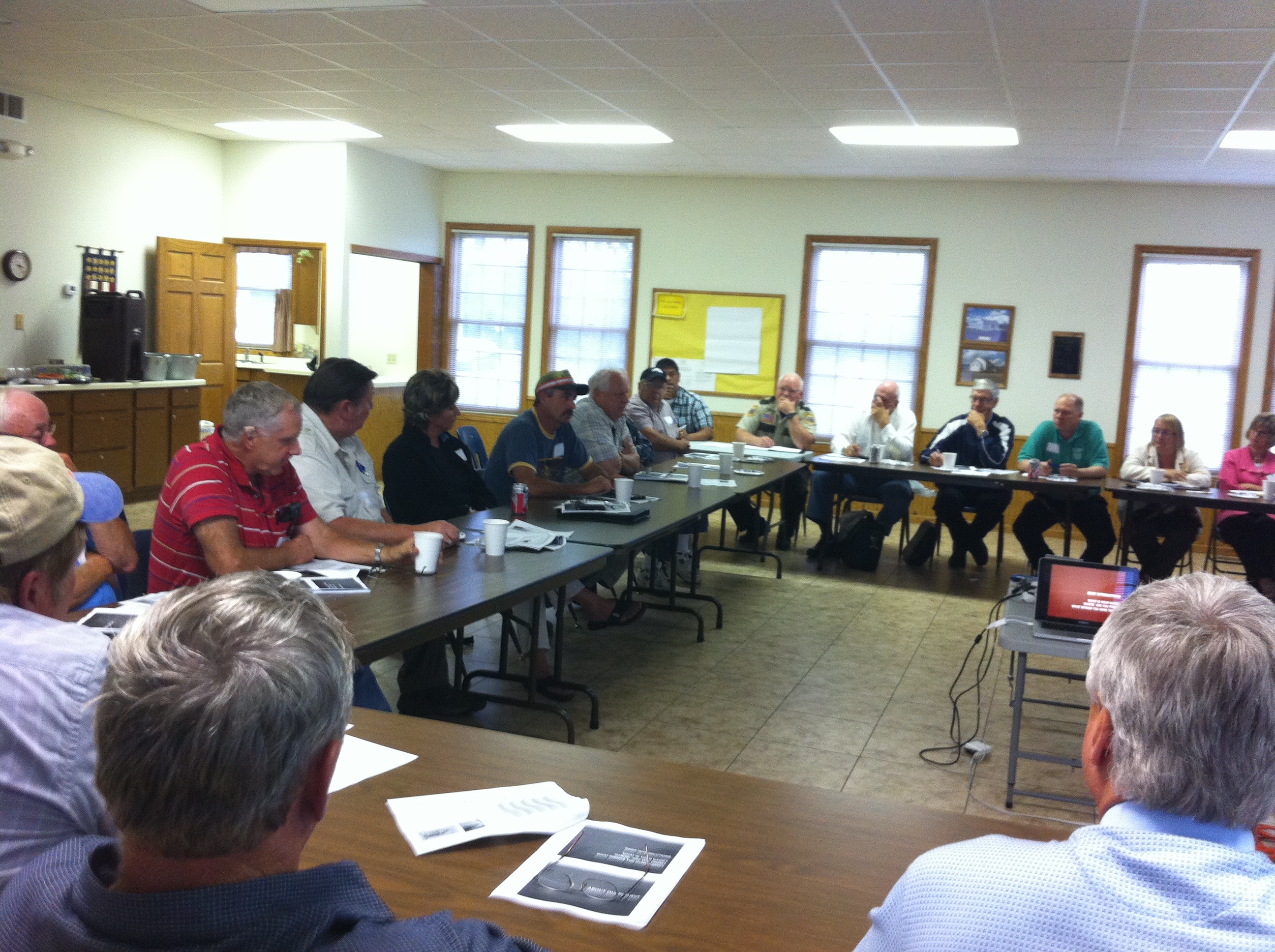
In Beltrami County, researchers facilitated focus groups and round-table discussions regarding competing alternatives for revitalizing the county’s road system. (Photo by Guillermo Narvaez)
Education needed
To help county engineers better educate the public, researchers looked at outreach strategies (such as open houses and focus groups) currently used in three Minnesota counties: Beltrami, Dakota and Jackson. The research team talked with county road managers to identify key issues and concerns and surveyed 91 residents who had participated in public engagement efforts.
The project revealed widespread confusion about local road system issues. For example, many participants erroneously believed that the gas tax covers (or was enacted to cover) the cost of maintaining local roads.
Researchers have produced a set of recommendations and tools for county engineers to use in designing effective public engagement processes that overcome confusion and a lack of information. A newly approved follow-up project will test the tools in three or four other Minnesota counties and cities.
Note: This article was adapted from the July-August 2014 issue of our Accelerator newsletter. Sign up for your free print or email subscription by clicking here.
There’s broad agreement that the U.S. transportation system cannot continue to be funded with existing financing and revenue-generation methods. What’s unclear, however, is how to pay for highway projects in the future. The current transportation funding system emphasizes user fees, but there is growing interest in alternative funding strategies. One promising strategy is value capture, which aims to recover the value of benefits received by property owners and developers as a result of infrastructure improvements.
In recent years, University of Minnesota researchers have helped lead the way in value capture research with a series of reports identifying value capture strategies. In a newly published study, the research team applied their previous work to a real-world scenario, with impressive results.
The new research, sponsored by the Minnesota Department of Transportation, focused on the planned development of Trunk Highway 610 (TH 610) in Maple Grove, Minnesota—a stretch of planned state highway delayed for years by state transportation funding shortages. Researchers set out to discover how the value of the enhanced accessibility provided by the planned improvements could be predicted and captured to help fund the project’s completion.
To accomplish their goal, researchers first defined a study area of about 10 square miles surrounding the unfinished highway segment. Then, they modeled property values based on five factors using parcel-level data. This model was designed to isolate the so-called “highway premium” by controlling for other factors that affect land value including water views, open space, railroads, transit stops, and existing highway exits. Using this model, researchers found significant evidence that the completion of the highway could lead to an over $17 million increase in property value.
Researchers expect these findings to have significant benefits for the TH 610 project and beyond.
Read the full article in the March issue of Catalyst.
MnDOT Research Services recently released its 2013 request for proposals. If you have any kind of direct interest in transportation research in Minnesota, chances are you might have known that already. But those with more of a general curiosity might be interested to see the list of research need statements from the RFP, as they provide a nice preview of the next round of potential MnDOT research projects.
As you can see, some are of a highly technical nature. (It’s safe to say that a study on “PCC Pavement Thickness Variation Versus Observed Pavement Distress” would be of interest mainly to engineers.) Others, however, like “The Economic Impact of Bicycling in Minnesota,” might have a broader appeal. In any case, it’s a fascinating glimpse at the myriad of issues that MnDOT is attempting to address through research and innovation.
Here’s the list of research need statements from the 2013 RFP, broken down by category:






 Crossroads