

Deer-vehicle collisions are a significant safety hazard on Minnesota roads. While MnDOT strives to employ safety measures on roads at high risk for these collisions, identifying these areas can be challenging. Numerous variables impact where deer are more likely to be present near roads, and many collisions go unreported. A new tool estimates the risk levels—based on road type, geographical features, deer population and other characteristics—for each road segment in the state. In addition, a new method of estimating reporting rates will help MnDOT understand the extent of deer-vehicle collisions in a specific area.
Continue reading Identifying Risk Factors for Deer-Vehicle CollisionsCategory Archives: Traffic and Safety

Measuring the Effects of Road Features on Driving Speeds
The Complete Streets approach to roadway design uses site characteristics to create a safer, more accessible environment for all road users. New research demonstrates that roadway design features have a measurable impact on driving speeds. The development of speed reduction factors (SRFs) that estimate the impact of road features on speed reduction provides a data-driven approach to highway design.
Continue reading Measuring the Effects of Road Features on Driving Speeds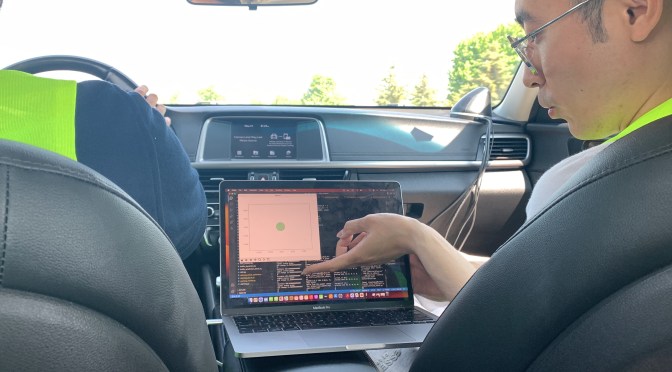
Introducing a New Red-Light Running Warning System that Can Potentially Reduce Human Errors at Intersections
Red light violations remain a prominent issue and high contributor to serious crashes and casualties at signalized intersections. An ongoing research project, funded by the Local Road Research Board, and Federal Highway Administration (FHWA) State Transportation Innovation Council (STIC) Incentive program, is developing and testing a warning system that signals drivers as they approach a red light and prompts them to decelerate.
Continue reading Introducing a New Red-Light Running Warning System that Can Potentially Reduce Human Errors at Intersections
Using Alternative Technologies to Detect Vehicles at Signalized Intersections
In Minnesota and across the country, the most common traffic signals are those that are actuated by a device embedded in the road that detects the presence of a vehicle at the intersection. While these embedded devices can last for decades, they don’t always detect modern vehicles, such as electric cars, or vulnerable road users, such as bicycles or motorcycles. New research evaluated the performance of video- and radar-based detection systems, which are becoming more readily available, under a variety of Minnesota weather conditions.
Continue reading Using Alternative Technologies to Detect Vehicles at Signalized Intersections
NCITE Webinar: LRRB Mini-Roundabout Guidance
Tuesday, August 6, 10-11 a.m., free to attend
Increasingly, local agencies are opting for mini-roundabouts for some locations instead of traditional roundabouts, which typically require a larger footprint than a standard four-way intersection. Mini-roundabouts are characterized by a small diameter and fully traversable islands (central island and splitter islands).
Join the Apex Engineering Group for a presentation on the Local Road Research Board project, Mini-Roundabout FAQs. Project team members Michael Marti and Zach Heimer with SRF Consulting Group and Jon Pratt with the City of Detroit Lakes will discuss this new guidance.
The guidebook defines mini and compact roundabouts and provides selection criteria on when to use them as well as details regarding the center treatment. The FAQ format provides easy navigation to technical information.
If you have difficulty accessing the meeting, use the meeting ID and passcode:
- Meeting ID: 251 050 866 163
- Passcode: tGP6ix

TZD Traffic Safety Hotdish: A Roadmap for Traffic Safety Culture Research and the Road Ahead
Wednesday, July 17, 2024
10:00 – 11:15 a.m. CDT
As states and localities adopt a vision of zero traffic fatalities, greater attention must be given to communication, collaboration, leveraging resources, and applying a systemic approach to traffic safety which requires a change in culture among road users and traffic safety agencies. This change in culture is tied to education, engineering, enforcement, and emergency services.
This free virtual event will highlight the Traffic Safety Culture Research Roadmap, recently released by the National Academies of Sciences, Engineering, and Medicine. The roadmap (Research Report 1091) presents a path forward to promote traffic safety culture among state departments of transportation and other transportation safety agencies.
Dr. Wes Kumfer, who led the creation of the roadmap, will review its development and contents. Jay Otto will share example projects and show how they fit into research on traffic safety culture. Join us to learn how you can identify traffic safety culture research needs and get insights to take back to your own organizational cultures!
The webinar is free to attend, but registration is required. Once you have registered, you will receive an email confirmation with a Zoom link. The link should not be shared with others; it is unique to you.

Augmented reality could make work zones safer—if the tech works for the workers
From catching Pokémon in the park to viewing a new IKEA chair in your living room, augmented reality (AR) often seems fun and low stakes. But what if wearable AR technology—such as safety glasses—could deliver warnings to roadway workers when they’re in danger? It’s an exciting possibility that hinges on one key question: Would this type of system meet the needs of workers?
Continue reading Augmented reality could make work zones safer—if the tech works for the workers
TZD Traffic Safety Hotdish: A Roadmap for Traffic Safety Culture Research and the Road Ahead
Wednesday, July 17, 2024
10:00 – 11:15 a.m. CDT
About the Event
This free virtual event will highlight the Traffic Safety Culture Research Roadmap, recently released by the National Academies of Sciences, Engineering, and Medicine.
Wes Kumfer, who led the creation of the roadmap, will review its development and contents. Jay Otto will share example projects and show how they fit into research on traffic safety culture. Join us to learn how you can identify traffic safety culture research needs and get insights to take back to your own organizational cultures!
Speakers
Dr. Wes Kumfer is an engineering research associate at the UNC Highway Safety Research Center (HSRC) with a focus on crash analysis and workforce development. His primary research interest is traffic safety management through a systems-oriented approach. While at HSRC, Kumfer has worked on pedestrian crash modeling, Safe System implementation, and engineering evaluation. He uses this experience as a member of the Road to Zero Coalition steering group and as an instructor for HSRC’s Road Safety Academy.
Jay Otto is a researcher and co-director for the Center for Health and Safety Culture at Montana State University. He received a bachelor’s and master’s degree in engineering and is fascinated by human behavior, how mindsets and systems influence behavior, and ways of growing cultures within communities and organizations that foster improved health and safety.
Registration
The webinar is free to attend, but registration is required. Once you have registered, you will receive an email confirmation with a Zoom link. The link should not be shared with others; it is unique to you.
Credit
Attendees are eligible for 1.25 Professional Development Hours (PDHs). Download the PDH credit form (PDF) for your records.
More Information
Contact Linda Dolan at ldolan@umn.edu.
Sponsors
This event is offered by the Minnesota Toward Zero Deaths Program and the Minnesota Departments of Health, Public Safety, and Transportation, with funding from the National Highway Traffic Safety Administration. It is hosted by the University of Minnesota’s Center for Transportation Studies.
Evaluating the Traffic Safety Benefits of J-Turns in Minnesota
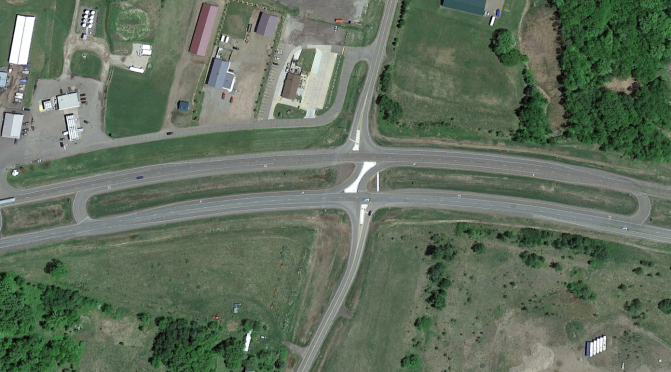
MnDOT traffic engineers are increasingly installing J-turn intersections on high-speed, multilane expressways to limit potential crash points. An analysis of crash data from intersections before and after the installation of J-turns demonstrated significant safety benefits from this alternative design. MnDOT researchers also explored crash history differences among J-turn intersections with varying characteristics. Consistent with the results from a previous study, this analysis found a clear decrease in fatal and other serious crashes after a J-turn was installed.
Continue reading Evaluating the Traffic Safety Benefits of J-Turns in Minnesota
Understanding Factors That Influence Driver Yielding to Pedestrians
Vehicle speeds, type of pedestrian, road characteristics and other variables can impact whether drivers yield to pedestrians attempting to cross a road at an unsignalized intersection. An analysis of data collected from 18 intersections identified human and site attributes that correlate to higher rates of driver yielding. Knowledge of these potentially influential factors will help local engineers build safer crossings at intersections.
Continue reading Understanding Factors That Influence Driver Yielding to Pedestrians Crossroads