Category Archives: Maintenance Operations

Beyond the border: Canadian studies consider permeable pavement, climate change impacts on deicing operations

Reprinted from MnLTAP News, November 17, 2025

The 2025 Salt Symposium highlighted two studies from Canada, one comparing salt applications on permeable and asphalt surfaces and another considering the impact of climate change on municipal operations. Hosted by Bolton & Menk, the August 5 Salt Symposium brought together professionals from throughout the world to share research, projects, and approaches for chloride management.

Continue reading Beyond the border: Canadian studies consider permeable pavement, climate change impacts on deicing operations

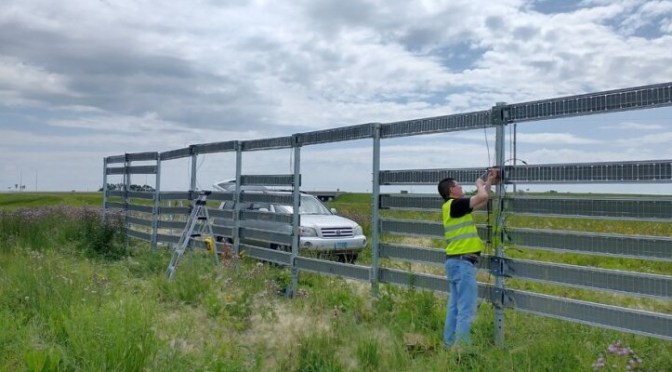
Solar Snow Fence Controls Drifting Snow While Generating Power

Solar snow fences not only retain the benefits of a traditional snow fence by controlling blowing and drifting snow in winter, they create green energy throughout the year. However, to be effective, the fence must withstand harsh weather elements and produce enough energy to justify the use and cost of solar panels. This project evaluated the installation and performance of a 100-foot solar snow fence for 18 months to determine its functionality and economic feasibility. 

Continue reading Solar Snow Fence Controls Drifting Snow While Generating Power

New Clear Roads Research: Understanding the Effects of Deicer Additives

Originally published in Clear Roads News April 7, 2025

items used in the freezing point determination test (ASTM D1177)
Items used in the freezing point determination test (ASTM D1177)

Combining road salt with common additives such as corrosion inhibitors, anticaking agents, cold temperature modifiers, thickeners and friction enhancers can increase the effectiveness of the deicer, allowing it to work more quickly or remain on the pavement longer.

To determine how well mixed salt products perform at lower temperatures and inform transportation agencies’ winter maintenance decisions, this Clear Roads project tested eight solids and prewet solids to evaluate the influence of additives on chloride-based deicer performance, including the freezing point or eutectic temperature, ice-melting capacity using the rocker test and pavement friction.

Download the final report and two-page briefCR 22-03 – Effects of Additives in Deicing Salts at Lower Temperatures, February 2025.

New Clear Roads Research: Dashboards for Improving Winter Operations

From Clear Roads, March 5, 2025

Transportation agencies collect vast amounts of data about their winter operations. Dashboards can help to summarize the information, measure performance, inform decision-making during winter weather events and improve planning for future storms.

This Clear Roads project examined the use of dashboards among transportation agencies to assess current strategies and identify innovative and effective practices. The results offer guidance to transportation agencies that are considering implementing or expanding their dashboard use to enhance winter maintenance operations.

Download the final report and two-page briefCR 22-05 – Use of Dashboards for Winter Operations, December 2024.

Updated stormwater guide reflects new research, experience

Reprinted from Catalyst, December 16, 2024

Effective stormwater management is essential for maintaining healthy urban environments, but it requires consistent monitoring and maintenance to prevent costly failures—something that municipalities across the state have struggled with for years.

At a recent CTS webinarAndy Erickson, research manager at the University of Minnesota’s St. Anthony Falls Laboratory and CTS scholar, guided more than 160 attendees through recent changes made to the Minnesota Stormwater Inspection and Maintenance Resource Guide. The original guide, published in 2009, has been revised to incorporate more than a decade’s worth of field applications, research, and practical experience. The updated resource aims to improve the inspection, operation, and maintenance of stormwater management practices across the state, providing practitioners with essential tools to optimize stormwater management and increase cost-effectiveness.

Stormwater management is crucial for controlling urban runoff, and systems such as green infrastructure and low-impact development reduce pollution before stormwater is sent to lakes, rivers, and streams. However, these systems require regular upkeep to remain effective, and maintenance challenges arise from their passive nature and logistical issues in large urban areas. One key problem is the lack of on-site staff for monitoring and making the proactive inspections vital for preventing failures. Regular maintenance can reduce costs by avoiding the need for major repairs, but municipalities may still struggle to stay within their maintenance budgets, as funding for upkeep is often inadequate compared to the cost of new infrastructure.

“Since there are no operating staff on-site to see when these things fail or see what’s causing them to fail, we have to be proactive in our inspections,” Erickson said. That means inspectors must travel multiple times to locations spread out across the metro region—which significantly increases costs. “Depending on the size of the practice, your total maintenance cost might become more than your original construction cost within five years of the life of that practice,” he said. 

The 2024 update to the Minnesota Stormwater BMP Maintenance Resource Guide aims to address this issue by offering detailed instructions for inspecting and maintaining various stormwater systems. The updated guide includes inspection checklists in the form of fillable PDF documents. These checklists should streamline the inspection and documentation process and help inspectors assess site conditions, including vegetation health, erosion, and drainage performance. And the forms can be easily updated and reused, providing a practical tool for ongoing stormwater management. “The forms are not static, but rather are intended to serve as a resource that can be used and adapted to fit a jurisdiction’s particular needs,” Erickson explained.

Following items from the checklist, the guide provides specific maintenance recommendations based on inspection findings, including how to address issues such as erosion, vegetation dieback, and structural failures. 

“You can go through these to really home in on what maintenance is needed and when the maintenance is needed,” Erickson said.

The updated Minnesota Stormwater BMP Maintenance Resource Guide is now available online for download.

—Emma McIntyre, CTS communications intern

Related Resources

Clear Roads: Winter Maintenance Research Roundup

New from clearroads.org on December 11, 2024

  • Performance of Ultra-Thin Bonded Wearing Course (UTBWC) During Winter Snow Ice Events in Maryland, Maryland DOT, August 2024. Research Summary.
  • ODOT‘s Snow and Ice Performance Evaluation Tools, Ohio DOT, August 2024.
  • Development of the Nebraska Department of Transportation Winter Severity Index – Phase II, Nebraska DOT, May 2024. Final Report.
  • Evaluation of Methods for UDOT Brine Tank Condition Assessment, Utah DOT, January 2024. Final Report.

Webinar: Enter the Minnesota Build a Better Mousetrap Competition

Wednesday, January 8, 2025, 10:00–10:30 am

Join the Minnesota Build a Better Mousetrap Competition for the chance to win prizes and share your ideas with others! Show off your creativity and help other agencies solve problems by submitting your local innovations! This webinar covers how to enter, how you and other local agencies can benefit, and gives you the chance to meet previous Minnesota winners. The webinar is free, but registration is required.

Continue reading Webinar: Enter the Minnesota Build a Better Mousetrap Competition

Clear Roads: Training Module Development for Evaluation of Storm Severity Index and Winter Severity Index Variables

Clear Roads project 18-03, Evaluation of SSI and WSI Variables, produced a step-by-step guide and flowchart tool to help agencies identify or develop severity index methods to fit their needs and available data sources.

As estimating the impact of weather on roadway maintenance resources is becoming an increasingly important issue for agencies across the country, a recently completed Clear Roads project, 21-04, Training Module Development for Evaluation of Storm Severity Index and Winter Severity Index Variables, produced additional training modules geared toward three key audiences: division directors, snow and ice managers, and supervisors.

Incorporating audiovisual materials, discussion topics, and interactive exercises, the training modules will help practitioners design and develop indexes to suit their agency’s particular needs.

Download the final report and two-page briefCR 21-04 – Training Module Development for Evaluation of Storm Severity Index and Winter Severity Index Variables, July 2024.

Resources

New Project: Alternative Deicer Performance Characterization: Know Before the Snow

MnDOT uses alternative deicer brines containing potassium chloride, magnesium chloride and calcium chloride for winter road maintenance. The alternatives are more effective in melting roadway ice than sodium chloride alone when temperatures are below 15 degrees Fahrenheit.

Continue reading New Project: Alternative Deicer Performance Characterization: Know Before the Snow