

Two county roads provided a testing ground for three combinations of aggregate bases and asphalt binders. Results from more than two decades of research and monitoring of pavement test sections validated previous conclusions. A larger gradation aggregate base showed superior performance over the pavement life cycle when compared with the standard aggregate base. Additionally, sections constructed without transverse joints to allow natural thermal cracking outperformed sections with sawn and sealed joints.
Continue reading Finding High-Performing Aggregate Bases for Long-Lasting PavementTag Archives: pavement

New Project: Improving and Developing Pavement Design Inputs and Performance Functions for Cold Recycled Pavement Layers
Local agencies in Minnesota use cold recycling technologies for flexible pavement rehabilitation because of their economic and environmental benefits. The three main methods are cold in-place recycling (CIR), cold central plant recycling (CCPR), and stabilized full-depth reclamation (SFDR).
Continue reading New Project: Improving and Developing Pavement Design Inputs and Performance Functions for Cold Recycled Pavement Layers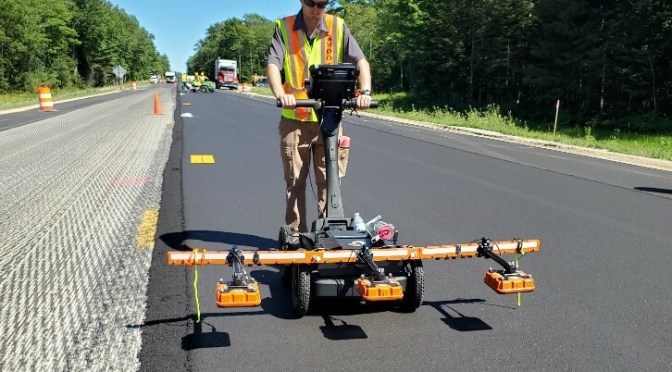
Measuring Pavement Density for Sustainable Centerline Joints
Longitudinal joints, created when lanes are paved sequentially, often need significant maintenance as the joints crack or deteriorate. While materials, construction methods and other factors may cause joint deterioration, insufficient pavement density is primarily responsible for weak joints, and measuring density has not traditionally been a widespread practice. New recommendations for joint construction and quick, nondestructive methods of measuring density during construction will support local agencies in laying longer-lasting pavement.
Continue reading Measuring Pavement Density for Sustainable Centerline Joints
Continuous Moisture Measurement During Pavement Foundation Construction
Accurate and timely moisture measurement of earthwork during compaction of foundation layers is crucial to proper construction and long-term durability of the pavement structures. Since the traditional methods for measuring moisture are point specific, expensive and/or time consuming. None of the existing methods have been able to deliver real-time, continuous moisture measurements that would aid engineers in delivering more durable pavement structures.
Continue reading Continuous Moisture Measurement During Pavement Foundation Construction
Effect of Low and Moderate Recycled Concrete Aggregate Replacement Levels on Concrete Properties
As the demand for aggregate in construction increases, recycling concrete waste as aggregate has been recognized as an environmentally sustainable solution with potential cost savings. It would allow recycling of construction and demolition waste and reduce some of the need to quarry and haul virgin aggregate. However, the use of recycled concrete aggregate (RCA) has been limited by concerns over its quality and performance, and by lack of uniform specifications as to what kind and how much of the aggregate to use in pavement construction. Studies and on-the-ground experience have shown that high levels of RCA reduce the durability of pavements. The effects of lower replacement levels have not been well documented, however.
Continue reading Effect of Low and Moderate Recycled Concrete Aggregate Replacement Levels on Concrete Properties
Comparing Additives Used in Stabilized Full-Depth Reclamation
Beltrami and Hubbard counties planned pavement rehabilitation on a shared road, presenting a unique opportunity to directly compare two stabilizers: engineered emulsion and Base One, a proprietary mix. While there were some variations in performance and cost, both met design values for pavement strength.
Continue reading Comparing Additives Used in Stabilized Full-Depth Reclamation
Putting Research Into Practice: Fog Sealing Chip Sealed Roads Can Improve Performance
Applying a protective surface—or chip seal—to existing asphalt on relatively low-traffic roads is a pavement preservation method used by many transportation agencies. Yet despite its popularity, chip seals can cause various issues. Some agencies have found that applying a fog seal following a chip seal is a cost-effective strategy for improving asphalt performance and public satisfaction.
Continue reading Putting Research Into Practice: Fog Sealing Chip Sealed Roads Can Improve Performance
Research Pays Off Webinar Series: Intelligent Compaction Technology as a Service and for Compliance
The National Road Research Alliance (NRRA) is hosting “Intelligent Compaction Technology as a Service and for Compliance – How ICT Research has led to the Removal of Technicians from Construction Sites in the UK” on July 19 at 10 a.m. CST, presented by Ruairi Charlesworth of Highway Data Systems.
Continue reading Research Pays Off Webinar Series: Intelligent Compaction Technology as a Service and for ComplianceResearch Pays Off Webinar Series: Intelligent Compaction Technology as a Service and for Compliance
The National Road Research Alliance (NRRA) is hosting “Intelligent Compaction Technology as a Service and for Compliance – How ICT Research has led to the Removal of Technicians from Construction Sites in the UK” on March 15 at 10 a.m. CST, presented by Ruairi Charlesworth of Highway Data Systems.
Continue reading Research Pays Off Webinar Series: Intelligent Compaction Technology as a Service and for ComplianceResearch Pays Off Webinar Series: Performance Benefits of Fiber-Reinforced Thin Concrete Pavement and Overlays
The National Road Research Alliance (NRRA) is hosting “Performance Benefits of Fiber-Reinforced Thin Concrete Pavement and Overlays” on September 21 at 10 a.m. CST, presented by Manik Barman, University of Minnesota Duluth.
Continue reading Research Pays Off Webinar Series: Performance Benefits of Fiber-Reinforced Thin Concrete Pavement and Overlays
