

In the early 1990s, Minnesota became the first state in the nation to prohibit discrimination based on a person’s sexual orientation and gender identity. Yet the state continues to use male-female categories when investigating the role of gender in transportation issues such as travel behavior and transportation accessibility. Since a person’s identity can have a significant influence on their own and others’ behavior and experiences, excluding gender diversity in this type of transportation research could result in an incomplete understanding of the issues and perceptions about quality of life.
Continue reading New Project: Advancing Equity in Accessibility and Travel Experiences: The Role of Gender and IdentityTag Archives: new project

New Project: Evaluation of Corrugated HDPE Pipes Manufactured with Recycled Content
Historically, federal regulations have required that MnDOT use pipes made with all-new materials in various applications, such as redirecting stormwater under roadways. However, recent changes to these regulations have made it possible for the agency to also consider pipes made with recycled materials, which could provide MnDOT with more options when choosing products for future projects.
Continue reading New Project: Evaluation of Corrugated HDPE Pipes Manufactured with Recycled Content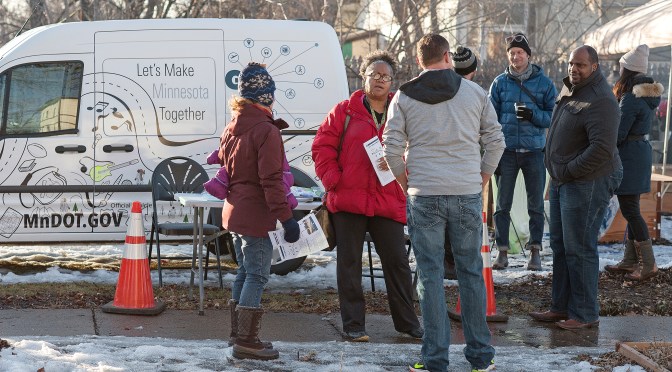
New Project: Maximizing Transportation Assets by Building Community Connection Through Innovative Development of Rights of Way and Airspace
Transportation agencies throughout the United States are focused on repairing the damage that highway construction has caused in communities.
MnDOT seeks partnerships with communities, businesses, and government entities to better utilize state highway lands and airspace.
These partnerships aim to enhance economic wellbeing and quality of life. Projects like highway caps and development of spaces underneath highways can increase equity, reduce disparities, and limit environmental impacts.
Continue reading New Project: Maximizing Transportation Assets by Building Community Connection Through Innovative Development of Rights of Way and Airspace
New Project: Enhancing Managed Lane Equity Analysis
Managed lanes, like Minnesota’s E-ZPass express lanes, are designed to improve mobility and travel time reliability for transit users, carpoolers and other motorists during peak travel hours. The lanes provide many societal benefits such as increased transit ridership, higher vehicle occupancies, more reliable travel options, and reduced traffic congestion and pollution.
However, because the lanes use pricing to deliver these benefits, they must be designed, constructed and operated equitably. The key is striking a balance that’s fair for everyone.
Continue reading New Project: Enhancing Managed Lane Equity Analysis
New Project: Improving Transportation Equity for All by Centering the Needs of Marginalized and Underserved Communities
Government policies often prioritize the needs of the dominant group or culture, resulting in systems and services that benefit some people more than others. To better address the transportation needs of underserved communities, transportation agencies must first understand people’s lived transportation experiences. Listening is a critical first step toward mitigating the effects of marginalization and discrimination in transportation.
Continue reading New Project: Improving Transportation Equity for All by Centering the Needs of Marginalized and Underserved Communities
New Project: Assessing the Effects of Highway Improvements on Adjacent Businesses
Highway improvement projects in metropolitan areas can offer a variety of benefits, including greater safety for travelers and increased activity for businesses near the roadway. However, improved roads may also negatively impact long-standing businesses as new retailers and chain stores displace them.
A greater understanding of the effects of highway improvements on businesses in the Twin Cities’ commercial corridors will help MnDOT deliver projects more successfully.
Continue reading New Project: Assessing the Effects of Highway Improvements on Adjacent Businesses
New Project: Evaluation of Proprietary Rejuvenators
A wide range of proprietary spray-on asphalt rejuvenators are available on the market. A National Road Research Alliance field study has been initiated to monitor the performance of some vendors’ materials on test sections over the next five to 10 years. Local agencies are interested in learning more about the many products on the market.
Continue reading New Project: Evaluation of Proprietary Rejuvenators
New Project: Comparison of Compost and Proprietary Soil Amendments for Vegetation Establishment
After road construction, the adjacent disturbed soil has a diminished capacity to sustain vegetation, overall soil health is compromised from soil disturbance and there is an increased risk for erosion.
Soil quality in these areas can be replenished by importing topsoil (the preferred choice) or using organic composts. If organic compost is not available, proprietary soil amendments provide a cost-effective alternative. But information regarding the effects, mix ratios and application techniques for these products is limited. Research is needed to better understand optimal organic compost ratios and how to integrate these amendments to improve soil quality.
Continue reading New Project: Comparison of Compost and Proprietary Soil Amendments for Vegetation Establishment
New Project: Tool to Estimate the Safety Impact of Vehicle Levels of Automation on Minnesota Roads
While commercially available self-driving vehicles may still be decades away, an increasing number of vehicles on the market offer advance driver assistance systems (ADAS). For example, ADAS features include adaptive cruise control, steering automation, and hands-free steering.
Continue reading New Project: Tool to Estimate the Safety Impact of Vehicle Levels of Automation on Minnesota Roads
New Project: MnDOT Haul and Detour Routes – Impacts on Local Roads
When local roads are temporarily used as haul roads or as detour routes, MnDOT compensates local agencies. However, local agencies believe the compensation model is outdated and inadequate, especially for local roads not built for large volumes of heavy vehicles. The methodology also has not been updated to reflect that local agencies have invested more local property and sales tax revenue into their systems beyond the gas tax.
Continue reading New Project: MnDOT Haul and Detour Routes – Impacts on Local Roads Crossroads