Tag Archives: maintenance

Road Surface Monitors Could Help Reduce Salt Usage

MnDOT is testing a mobile road condition monitor that uses infrared technology to detect hazardous ice, snow or wet conditions without even touching the pavement.

Maintenance crews hope the device, called the High Sierra Surface Sentinel, could help them better determine when it’s time to apply salt when they’re plowing. The mobile sensor reports air temperature, surface temperature and road friction data.

“The biggest reason we’re looking at this is for the friction reading,” said MnDOT Salt Solutions Coordinator Joe Huneke. “Typically, when operators are patrolling their route and the road looks like it’s getting icy, they’ll err on the side of caution and apply salt — and it may not need it.”

The device being tested by snow and ice crews in northern Minnesota would also provide real-time surface weather conditions. Currently, plow operators and supervisors must enter road conditions into a computer or relay them by phone, a time-consuming process that operators are not always able to perform in a timely manner.

The biggest potential benefit, however, is lower salt consumption.

“Sometimes you get a light cold snow event where it might look like there’s a little ice on the road, but, in fact, you have good friction numbers and you don’t need salt. Once you put chemical down, you’re committed to it,” Huneke said.

District 1 snow and ice crews are evaluating the unit pictured below for its accuracy and effectiveness in determining slippery conditions. It will be compared with another device tested in District 3 that also uses infrared technology to determine how slippery the road is, and technology being tested in District 6 that uses gravitational force to determine the road surface friction.

MnDOT it testing a mobile surface condition sensor that provides real-time surface weather condition of roadways.
MnDOT it testing this mobile road condition sensor, which provides real-time surface weather condition of roadways.

Related Research

MnDOT’s Office of Maintenance has its own research program designed to let maintenance personnel test innovative ideas to keep our roads smooth, snow-free and safe. They even put out a monthly bulletin featuring new ideas and technologies. (You can find the back issues here.)

Other winter maintenance research projects are featured in MnDOT’s 2011-2013 Maintenance Operations Research Report  (PDF, 9 MB, 98 pages)
MnDOT Plow Drivers Invent New, Hybrid Plow Design

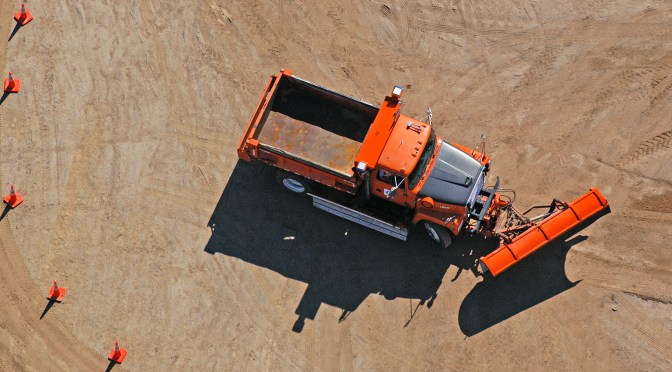
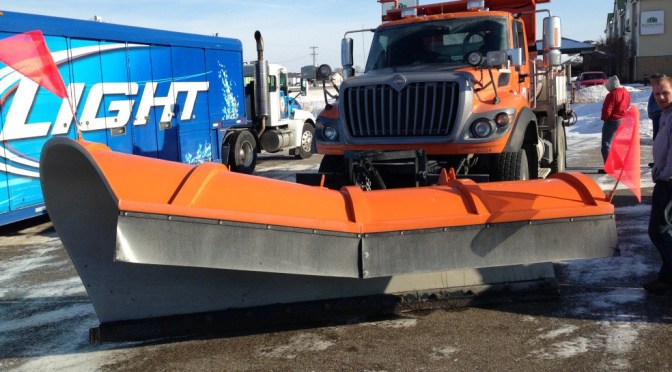
If the plow pictured above looks like two different plows welded together, it’s because they are.

Minnesota Department of Transportation snow plow operators in southwestern Minnesota have invented an experimental plow that uses the wind to cast snow from the road without impeding traffic or the operator’s view.

Manufactured for MnDOT by Fall Plows, the plow incorporates half of a traditional bull-dozer style plow with half of a Batwing-style plow.  It eliminates the large “ear” on the driver’s side of a Batwing style plow that can stick out into oncoming traffic during center-line snow removal.

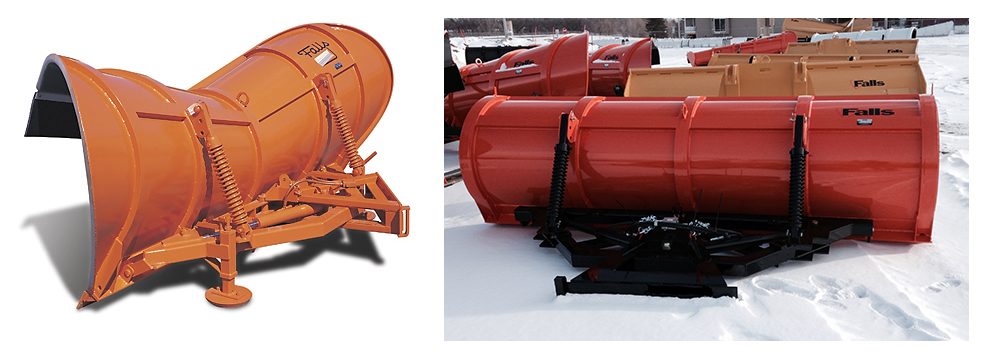
Half of the reversible batwing-style plow, pictured at left, was combined with half of the reversible bulldozer-style plow, pictured at right.
Half of the reversible batwing-style plow, pictured at left, was combined with half of the reversible bulldozer-style plow, at right.

District 8 Willmar Maintenance Supervisor Dennis Marty said he was looking for a reversible-style plow that could be used in the heavy winds and reduced visibility from blowing snow that are prevalent in western Minnesota.

When drivers are plowing against a northwest wind in rural Minnesota, the snow coming out of the chute will sweep across the truck and blind drivers, so operators needed a plow with a reversible system so they could throw the snow with the wind.

While an express plow with chutes on both ends (batwing-style), pictured above at left, was great for throwing snow to the right, when snow plow drivers took it down narrow two-lane roads, the plow stuck 2.5 feet into the oncoming lane and its big barrel partially blocked the headlights and the operator’s view.

So operators tried a regular one-way plow (pictured below), which resembles a funnel laid on it side, and put it on a reversible system that would allow operators to turn the plow both directions, so it could throw snow to the right or the left. However, this plow couldn’t blow snow high enough to the left, so snow piled in the left traffic lane.

One-way reversible plow.

Marty said he spent four to five years looking for a plow that combined the batwing and bull-dozer designs, but he couldn’t find anything sturdy and maintenance-free enough. Finally, he and Maintenance Research Program Administrator Ryan Otte sat down with Falls Plows in Little Falls, Minnesota and asked the company to build one.

The plow will be useful on low-volume roads that have little traffic during the middle of the night, which allows plow operators to cast the snow with the wind.

The Willmar office began using the experimental plow last winter and will be replacing all of its plows with it. Snow plow drivers from other areas of the state have been so impressed that at least two other maintenance districts have also ordered them.

Related Research

MnDOT’s Office of Maintenance has its own research program designed to let maintenance personnel test innovative ideas to keep our roads smooth, snow-free and safe. They even put out a monthly bulletin featuring new ideas and technologies. (You can find the back issues here.)

Other winter maintenance research projects are featured in MnDOT’s 2011-2013 Maintenance Operations Research Report  (PDF, 9 MB, 98 pages)
How roadside drainage ditches reduce pollution

Stormwater can pick up chemicals and sediments that pollute rivers and streams. Roadside drainage ditches, also known as swales, lessen this effect by absorbing water. But until recently, MnDOT didn’t know how to quantify this effect and incorporate it into pollution control mitigation measures.

In a recently completed study, researchers evaluated five Minnesota swales, measuring how well water flows through soil at up to 20 locations within each swale.

“There’s a big push in Minnesota, and probably everywhere, to do more infiltration,” Barbara Loida, MS4 Coordinator Engineer, MnDOT Metro District, said. “We know that our ditches are doing some of that, but we wanted to look at how much infiltration these ditches are providing.”

A key finding: grassed swales are significantly better at absorbing water than expected, which may reduce the need for other, more expensive stormwater management practices, such as ponds or infiltration basins.

This could save MnDOT and counties significant right-of-way and construction costs currently expended on more expensive stormwater management techniques. While swales were recognized in the Minnesota Pollution Control Agency’s new Minimal Impact Design Standards, there was a need to quantify the amount of water a swale can absorb so it could receive the appropriate MIDS credits.

Researchers also tested the ability of carbon, iron chips, steel wool and other materials to remove pollutants as ditch check filters—material put into swales to enhance removal of pollutants.

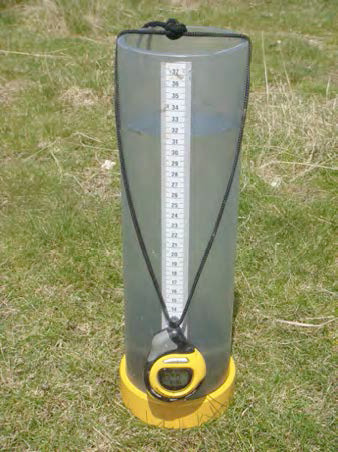
Gradations on a Modified Philip Dunne infiltrometer allow the measurement of stormwater infiltration.
What’s Next?

A follow-up project, which the MPCA is participating in, will seek to clarify the impact of swale roughness on infiltration rates. The goal is a calculator for real-world infiltration rates that MnDOT and local agencies would be able to implement.

MPCA, MnDOT and the city of Roseville are also partnering on a project to install and test the effectiveness of ditch check filters in real-world locations.

Maintenance recommendations should help MnDOT and local agencies ensure that swales operate at maximum efficiency. These recommendations should continue to be revised as knowledge evolves.

Related Resources

*Editor’s note: This article was adapted from our upcoming edition of the Accelerator. Read the newsletter online, or sign up to receive by mail. 

MnDOT Develops Best Practices Guide for Culvert Repair (Updated, with Video)

County engineers and MnDOT hydraulics engineers have to wear many hats. One of them is maintaining culverts — the channels beneath roadways that facilitate passage of water and wildlife.

But culvert maintenance is practically a field of knowledge unto itself. To help engineers identify and apply the best repair techniques for specific problems, MnDOT recently produced a best practices guide for culvert repair (links below).

“We wanted to develop a state-of-the practice and put it into one place so engineers could easily find the information they need,” said Lisa Sayler, MnDOT Assistant State Hydraulic Engineer.

It might not always be the most visible or exciting issue from the public’s perspective — although, as the video above illustrates, occasionally it can be very visible — but culvert repair is a critical issue for transportation professionals. In fact, MnDOT submitted the repair guidebook as one of its choices for the AASHTO-RAC’s 2014 high-value research publication.

“There are many different fixes and products available for failing or deteriorating  pipes,” explained District 4 Hydraulics Engineer Jane Butzer, who requested the guidebook. “This guide steps through the different products and practices, and further assists the hydraulics engineer by providing special provisions and standard detail drawings to include in project plans.”

Culvert repair practices have evolved significantly in recent years, so it can be difficult for individual engineers to keep abreast of new practices that come from a wide variety of sources. The guidebook draws from a wide range of sources, including the Federal Highway Administration, the National Cooperative Highway Research Program, AASHTO and numerous state DOTs.

“We synthesized previous work and expanded it from there to provide more details and more quantitative guidance for some specific repairs. We tried to provide more specific design procedures than what we found in previous documents,” said project manager Bruce Wagener of CNA Consulting Engineers.

In addition to providing detailed explanations of rehabilitation and repair methods, the guide includes a table that compares most methods of repair.

Researchers will next conduct a brief feasibility study to identify which culvert repair methods can be observed and tested to document the cost, longevity and effectiveness of repairs.

Sliplining, a common culvert rehabilitation method, involves inserting a fiberglass pipe liner (shown) or other material into a deteriorated culvert.
Resources

New Video: “Why Aren’t They Working on My Road?”

A new video produced by the Local Road Research Board helps the public understand why some bad roads aren’t always fixed first.

The seven-minute video explains what causes road pavements to deteriorate and why, like the saying, “throwing good money after bad,”  it may be more cost-effective to put maintenance dollars into roads that still have life left in them versus roads that are in the worst condition.

In it, city and county engineers discuss how they use a pavement management program to decide which roads to fix when, in order to stretch limited resources in the most effective way possible.

“We’ve learned that if we wait for things to break and fall apart, they’re much more costly to replace than if we put a little bit into it during its life cycle,” says Mark Maloney, City of Shoreview public works director.

GPS-equipped mowers to save money, reduce noxious weeds

Putting GPS units on MnDOT highway mowers is expected to speed mowing operations and cut herbicide usage by 50-percent in metro area ditches, reducing groundwater contamination.

MnDOT’s Metro District highway maintenance division will be one of the first — if not the first — state agencies in the country to equip the majority of its maintenance tractors with Automated Vehicle Location systems.

Not only will crews be able to effortlessly track their progress — reducing paperwork and freeing time for other maintenance activities — but the AVL’s live mapping software will help them avoid noxious weed patches, thereby reducing their spread.

Last year, MnDOT tested the GPS software on five mowers.

“AVL alone enables the tracking of vehicle positions, but when combined with equipment sensors and an on-board monitor with user interface, it becomes a very innovative way to reduce operation costs,” said MnDOT Project Engineer Trisha Stefanski, who applied for funding from MnDOT’s Transportation Research Innovation Group for the pilot project.

Vehicle tracking systems have been shown to reduce chemical usage by crop farmers, improve route efficiencies in truck driving and help cities and counties track snowplows.

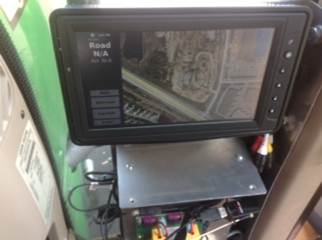
The on-screen mapping shows the location of weed patches, so mowers can avoid them, reducing their spread.

MnDOT Metro, which tested five AVL units last year, hopes to equip as much of its remaining fleet as possible.

In the grant application, Stefanski estimated the technology will pay for itself in about a year’s time, largely due to herbicide savings.

Noxious weeds

MnDOT is required by law to manage certain noxious weeds along its highways. Each year, weed inspectors survey one-quarter of metro ditches for weeds, which enables them to concentrate eradication efforts on the worst areas.

Touch-screen maps will contain the noxious weed locations so operators can see weed patches and mow around them.

Herbicide usage is estimated to drop an estimated $100,000 to $150,000 per year. (This estimate was based on the original funding request. Final numbers haven’t been released.)

Operators can use the on-screen map to mark the location of new patches of noxious weeds.

Noxious weeds like Wild Parsnip — which can cause painful skin boils — might even be eradicated, reducing the risk for field crews, such as construction workers and Adopt a Highway volunteers.

Until now, maintenance crews have relied on paper maps to identify weed locations, which is less effective.

“What’s better, looking at a live screen when you’re going down the road and seeing where weeds are coming up, or trying to refer to a piece of paper?” Stefanski said.

Other advantages

The AVL equipment will also allow for automated reporting.

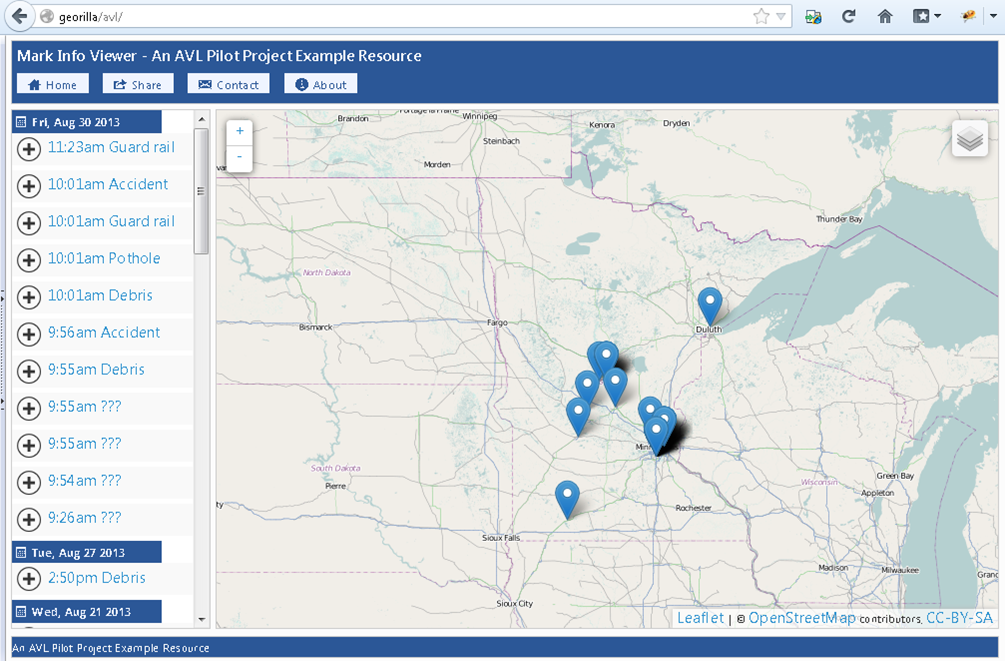
Mower operators can use the on-board AVL monitor to mark the location of guardrail hits, potholes, washed-out culverts, debris and unmarked noxious weeds.

Operators can electronically mark the location of guardrails, debris, potholes and more.

Currently, operators must track their activities using hand-written forms or spreadsheets in the office.

The AVL system will also automatically track their location history, allowing operators to optimize their routes based on how long it took to mow segments in the past.

It will also be easier to answer questions from the public, who want to know the last time a certain ditch was mowed.

“Making everything geographically located adds so much analysis opportunity,” Stefanski said.

MnDOT also has AVL technology on an herbicide applicator to better track where it’s sprayed. Other future potential applications including pothole patching and road sweeping operations, Stefanski said.