

Reprinted from CTS News, January 14, 2025
Freight transportation is evolving rapidly, and its future success will require managing increased residential demand, planning for equity, and incorporating micro-delivery options such as cargo e-bikes. At the 2024 CTS Transportation Research Conference, three experts shared their knowledge of these trending topics in a session focused on the future of urban freight.
In response to the increasing demand for residential package delivery spurred by the shift towards online shopping, U of M Department of Industrial and Systems Engineering PhD student Can Yin shared her research on mobile parcel locker scheduling. Yin explained that in the growing ecommerce market, last-mile delivery is the most expensive and time consuming. While door delivery is commonly used, it can be unsecure and inconvenient for customers.
“Parcel lockers are an alternative, but they come with the disadvantages of limited locations, expensive fixed cost, and the inability to adapt to varying demand,” Yin said.
A newer, more flexible alternative is the use of mobile, vehicle-based parcel lockers, which offer greater flexibility, higher accessibility, and lower fixed costs—particularly if autonomous vehicles eliminate the need for driver salaries. However, mobile parcel lockers also create challenges for e-commerce businesses such as estimating demand and customer choices.
To address these challenges, Yin’s research team developed a mobile parcel locker demand-estimation model. Additionally, the researchers found that compared with stationary lockers, mobile lockers offer a better value and demand fulfillment.
Another challenge surrounding the rapid growth of e-commerce and urban freight is racial equity in urban freight planning. In his presentation, University of Washington Urban Freight Lab researcher Travis Fried explained how his research is seeking to better understand these inequities and create a framework for mitigating them.
The past and present systems that perpetuate the segregation of people and neighborhoods have been well documented. However, Fried said there is little research exploring how these patterns play out in freight planning and their impacts on air quality, health, and road safety for people of color. Fried’s research looked at high-volume traffic exposure and found that low-income populations of color were disproportionately exposed to e-commerce traffic.
“By our most conservative estimate, BIPOC [Black, Indigenous, and people of color] populations were exposed to 35 percent more traffic related to last-mile home delivery on average, despite ordering less than half as many packages as white populations,” Fried said. That’s because delivery facilities and highways are disproportionately located near historically marginalized neighborhoods, he explained.
In light of this finding, Fried emphasized the importance of including equity considerations when prioritizing urban freight strategies. “Solutions focused on the upper end of the distribution chain have outsized benefits for marginalized communities, so we need to consider that in our cost-benefit evaluations and engagement strategies,” he added.
Using cargo e-bikes for last-mile freight delivery was the topic of the session’s final presentation from Marc Liu of Civilized Cycles. Liu explained how his company’s innovative semi-trike—which has as much cargo capacity as a small delivery van—can be used to move a significant amount of cargo over short distances, particularly within campus environments such as universities, hospitals, residential developments, and military bases.
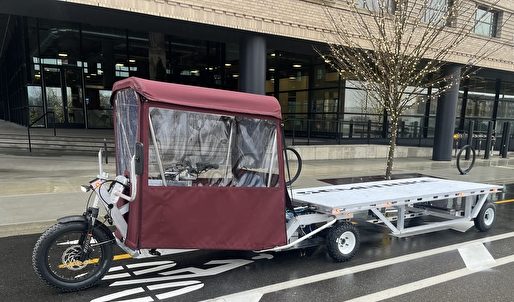
“Regardless of what these campuses are moving, they have the same core challenge of moving as much cargo as possible while keeping operating costs as low as possible,” Liu said. “On top of that, emissions and safety are key concerns because most of this happens in pedestrian-heavy areas.”
Liu explained that the first customers for the cargo e-bikes are micro-mobility fleet operators at the forefront of sustainable transportation including Lime, Net Zero Logistics, and Amazon. Moving forward, the company is targeting campus environments for expansion. Liu said that “economics drives adoption” and believes the key to adoption is offering an affordable, American-made product that reduces vehicle fleet costs, increases safety, improves efficiency, and reduces greenhouse gas emissions.
—Megan Tsai, contributing writer









 Crossroads