Category Archives: Materials and Construction

Construction kickoff at MnROAD, the state’s high-tech road research facility (updated)

*Editor’s note: This article was updated 6/11/13 with additional information provided by MnROAD engineers.

You’re probably aware that MnDOT recently kicked off its 2013 construction season, comprising $1.1 billion in new transportation investments in more than 300 projects across Minnesota. What you might not know is that another MnDOT construction season has begun at MnROAD, the department’s unique, high-tech pavement test facility located near Albertville, Minn.

MnROAD serves as a proving ground for innovative pavement designs, equipment and construction techniques that help transportation professionals all over the world strengthen roads, cut costs, and reduce construction times. It has a two test tracks — a 3.5- mile mainline carrying “live” traffic and a 2.5-mile closed-loop, low-volume roadway — that are used for state, university and private industry pavement research. These tracks are made up of dozens of individual “cells,” which are unique stretches of pavement each representing several research projects.

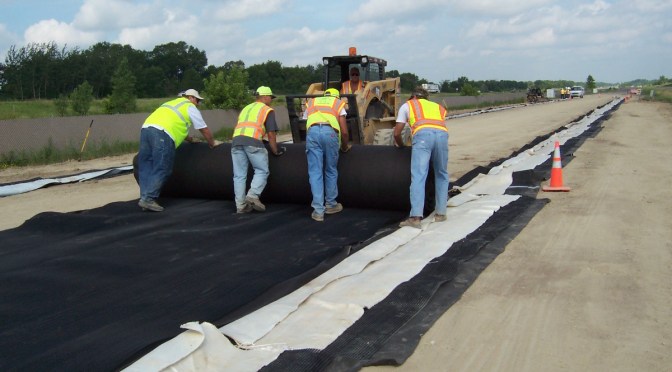
This summer, several test cells are being torn up and repaved. Cell 40, a 20-year-old concrete pavement, will receive an innovative 3-inch thick unbonded concrete overlay.  To increase the capacity of such a thin overlay , a fiber-reinforced concrete mixture will be used.  To separate and cushion the thin overlay from the existing concrete, two different thicknesses of nonwoven geotextile fabric will be laid.  This will help MnROAD researchers to understand how much cushioning is needed, as well as the drainage capacity of each fabric.  Fabric interlayers are gaining popularity as an alternative to asphalt interlayers.

Thin concrete overlays of asphalt, commonly known as whitetoppings, will also be used to reconstruct Cells 60-63.  Similar to Cell 40, fiber reinforced concrete will be used to test its benefit in supplementing load transfer at joints and across cracks.  Pavement built with this material will be strengthened by the fiber, prolonging a road’s lifespan, and potentially allowing for thinner concrete pavements.  Findings from Cells 40 and 60-63 support the ongoing development of improved design procedures for concrete overlays.

Cell 13 reconstruction is using recycled concrete aggregate provided by the contractor’s stockpile from other pavement projects. The concrete from the stockpile will be included in the concrete mix — a new practice to understand how to better recycle paving materials and ascertain the cost and benefits of this practice. Cell 13 will also be testing two innovative types of preformed joint sealants, and several joints drained by geotextile drains.

Construction updates are available on the MnROAD website as well as information regarding current research projects.

Image from MnROAD's 2013 construction kickoff.
Removing concrete in MnROAD Cell 13.

‘Three Ways to Cook a Pothole’

In April, we posted about an innovative pothole-filling technology being developed by the Minnesota Department of Transportation and the University of Minnesota, Duluth. The technique involves zapping pothole patches and the surrounding pavement with a special truck-mounted, 50,000-watt microwave. Researchers have found that heating the base and the patch material at the same time creates a stronger, longer-lasting bond that provides for a more permanent pothole fix.

Last week, the MnDOT/UMD microwave technology found its way into a new MnDOT video (above) that also explores two other experimental pothole-patching methods. One involves using a large “electric oven”-type heating element instead of a microwave. The other utilizes a new exothermic (i.e. heat-generating) asphalt mixture containing taconite from northern Minnesota mines. The video compares the potential benefits of all three of the new technologies, which the department hopes will someday lead to “more pothole-patching power for the taxpayer dollar.”

See also:

Portable weigh-in-motion system demonstration

Weigh-in-motion (WIM) systems consist of sensors placed in road pavements to measure the weight of vehicles passing over them, along with other data such as speed, axle load and spacing, and vehicle type. This data is used to enforce weight limits on trucks and is also useful in a wide range of other applications, such as pavement design and traffic analysis.

However, constructing and maintaining permanent roadside WIM stations is expensive, so these systems are installed primarily on roadways with heavy traffic, such as interstate and trunk highways, and rarely used for rural local roads. Meanwhile, heavy truck volumes on local roads are increasing, significantly shortening their lives. A less costly, portable WIM system is needed for such roads so that collected data can be used to better design these roads to accommodate heavy truck traffic.

One solution for bringing WIM technology to local roads is to implement a portable, reusable system similar to pneumatic tube counters used to conduct traffic counts. With funding and technical assistance from MnDOT and the Local Road Research Board, Professor Taek Kwon of the University of Minnesota—Duluth has developed a prototype system that has already proven to be nearly as accurate as the more expensive, permanent systems.  MnDOT Research Services staff drove up to MnROAD this week to observe a live demonstration of the technology, and made this short video.

The research being conducted here is part of an implementation project based on Kwon’s original study, the results of which can be found in this research report and its accompanying two-page technical summary from MnDOT Research Services.

Research partnerships create better pavements

As is painfully evident this time of year, Minnesota’s weather is highly destructive to our asphalt roadways.  One of the biggest challenges for transportation practitioners in cold-climate states like ours is low-temperature cracking in asphalt pavements. The distress caused by  our extreme weather variations and constant freeze-thaw cycles wreaks havoc on our asphalt streets and highways, causing decreased ride quality, increased maintenance costs and shorter pavement lifespans.

On April 17, the Center for Transportation Studies presented its 2013 Research Partnership Award to the team members of a multi-state, Minnesota-led study designed to combat the problem. The project, Investigation of Low Temperature Cracking in Asphalt Pavements, Phase II,” was a national pooled-fund study involving six state DOTs, four universities, the Minnesota Local Road Research Board and the Federal Highway Administration. It resulted in a new set of tools — test methods, material specifications and predictive models — that will be used to build longer-lasting pavements.

The project is a prime example of the value and benefits of cooperative research. Each organization brought its own unique strengths and expertise to bear on the problem. The University of Minnesota, led by Professor Mihai Marasteanu, brought its strength in lab testing of binders and mixtures, for example; other universities leveraged their respective expertise in data analysis, statistics and modeling capabilities. MnDOT, as the lead state agency, controlled the finances and kept the research on track, guiding the process through technical advisory panels. MnDOT’s materials laboratory and its unique MnROAD pavement research facility also played a key role in the study.

The above video provides an excellent overview of the project and includes commentary from key MnDOT and University of Minnesota team members. MnDOT is already moving to implement the results. It plans to use the new test procedure on several road construction projects this year. Iowa and Connecticut are among the other states reportedly planning implementation projects.

See also:

2013 Research Partnership Award winners

From left: University of Minnesota Professor Mihai Marasteanu, the project’s principal investigator; MnDOT State Aid Director Julie Skallman; MnROAD Operations Engineer Ben Worel; and CTS Associate Director for Development and Finance Dawn Spanhake, who presented the award. (Photo by Cadie Adhikary, Center for Transportation Studies)

In the news: innovative U of M and MnDOT pothole repair technology

Last night, KARE-11 News featured innovative pavement repair research sponsored by MnDOT. In a public-private partnership, Larry Zanko of the Natural Resources Research Institute at University of Minnesota Duluth connected with Krik Kjellberg’s company to microwave a mix of asphalt and magnetite in road holes, creating a long-lasting pothole fix.

The people (and machines) who fix Minnesota’s potholes

In Minnesota, with our often wildly unpredictable weather and constant freeze-thaw cycles, potholes are a fact of life. Anyone who’s climbed into a motor vehicle in the last month or so has doubtlessly encountered countless reminders of this dismal reality. Fortunately, we have a small army of public works professionals devoted to eradicating this perennial nuisance. The Minnesota Local Road Research Board recently produced this video, which nicely explains the various methods used to combat potholes in Minnesota.

Potholes form when water invades cracks in the pavement and infiltrates the soil beneath it. When that water freezes, it stretches the road surface, causing the fractures to expand. After a few cycles of freezing and thawing, the pavement begins to buckle and eventually collapses under the weight of passing traffic, creating disruptions in the road’s surface.

Road crews use a variety of methods to fill potholes. The simplest method is the “throw-and-go” procedure, in which workers simply shovel an asphalt mixture into the pothole and pack it down until the road’s surface is smooth. A related method is “throw-and-roll,” where the patch is compacted using an asphalt roller.

Other methods include:

  • “semi-permanent” patching, in which workers clear the pothole of moisture and debris and then square the edges with a pavement saw before applying the patch;
  • “spray injection,” which involves using specialized equipment to blast water and debris out of the pothole before spray-filling it with asphalt mix and finally applying a dust coat of dry aggregate on top; and
  • “slurry” or “microsurfacing” crack filling, in which a slurry of aggregate, asphalt emulsion and mineral filler is placed over a crack in the pavement and leveled off using a squeegee.

This Asphalt Pavement Maintenance Field Guide (PDF), co-funded by MnDOT and produced by CTS, provides a handy how-to guide to pothole patching and other types of pavement repairs commonly applied by public works professionals in Minnesota.

See also: