Category Archives: Environment

Flume research simulates Red River flooding to test road protections

Flooding in the Red River Valley is an almost annual occurrence, and the cost to roads, property and lives is huge.

Highway 1 gets torn up year after year, only to be rebuilt in time for next year’s flood, joke residents in the little town of Oslo, which becomes an island whenever the roads close.

While not much can be done to prevent swollen farm fields from overflowing, what if a road embankment itself could be bolstered to prevent physical damage to the underlying structure of the road?

“We can’t just raise the road because it would create backwater upstream,” explained JT Anderson, Assistant District 2 Engineer. “Our best bet is to let the water over-top the road and try to protect the road when it does.”

Researchers have built a flume inside the University of Minnesota’s St. Anthony Falls Laboratory to test six methods of embankment protection specific to the needs of towns like Oslo.

“It is not uncommon for one over-topping site to have a half-mile long stretch of road being damaged,” said university research engineer Craig Taylor. “One road being protected should cover the cost of the study and the cost of deploying the erosion control product for that road.”

Nationally, research of this kind has mostly been restricted to high-intensity flooding.

“Those really high-depth, short duration events, you can only protect an embankment with concrete and boulders,” Taylor said. “With longer duration, low-depth floods, we may be able to protect roads with soft armoring, like reinforced vegetation.”

The damage in northern Minnesota has been the worst on east-west roads, where the river flow runs perpendicular to the center of the road, causing the road to act like a dam and the water to jump at the edges.

“It eventually eats through that road embankment and makes the road collapse,” Anderson explained.

Researchers will examine how a cross-section of a road holds up under various erosion control methods at different levels and speeds of water-flow.
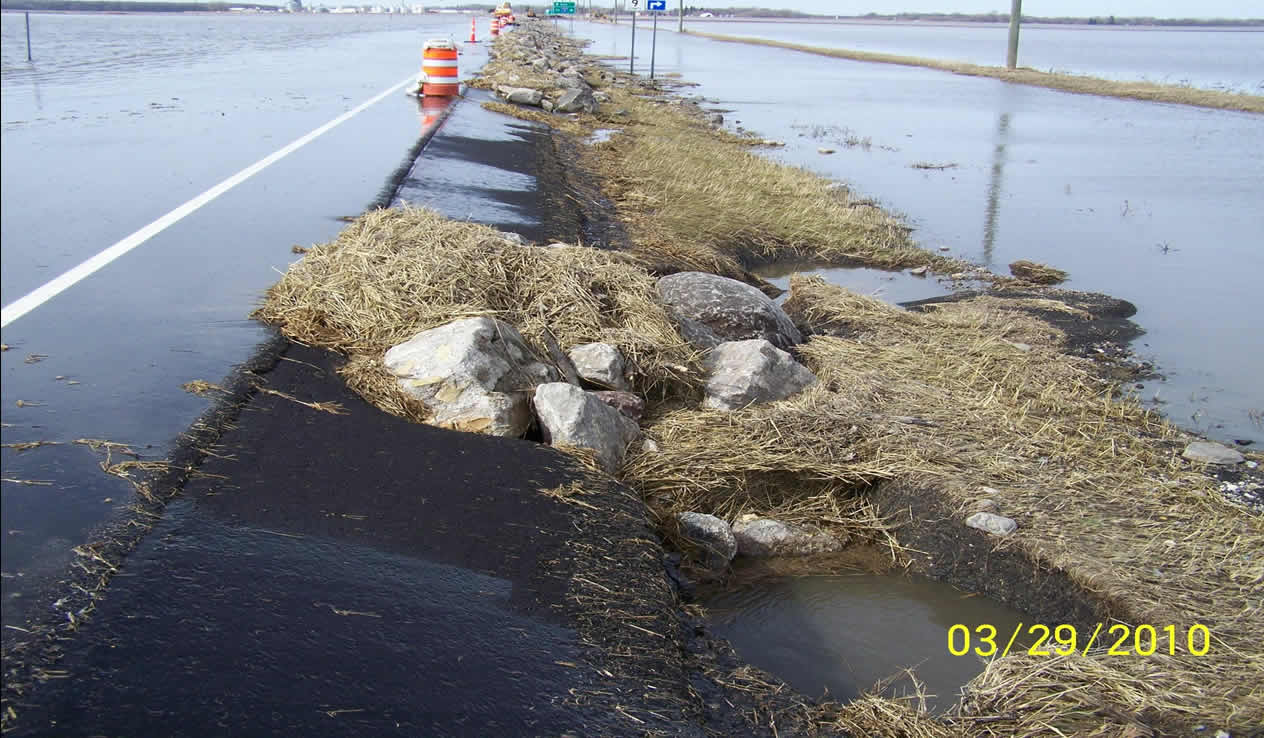
The damage from flooding was less in 2010 after engineers added rocks and vegetation to the side of Highway 9, near Ada.
The damage from flooding was less in 2010 after engineers added rocks to the side of Highway 9, near Ada, Minn.

One test will be to slow the flow of water by covering the road shoulder with a rubberized membrane and temporary water-filled tubes.

Permanent schemes — such as turf reinforcement mats and rocks — will also be tested.

“These methods have been deployed in the field, but you never really know under which conditions they survived or failed,” Taylor said.

In the Red River Valley, MnDOT engineers have tried a combination of vegetation and boulders, as well as concrete blocks covered with topsoil, to protect highways. Flattening a slope is another option.

“I expect that a single erosion protection technique will not cover every situation our road embankments may be exposed to at any given location,” Anderson said.  “Rather, I expect we would look at using several different techniques in concert to develop an effective erosion protection system for the expected velocities.”

Culvert research aims to protect endangered small fish

The Topeka shiner
The Topeka shiner, a small minnow that inhabits slow-moving prairie streams, was once widespread and abundant in portions of Iowa, Kansas, Minnesota, Missouri, Nebraska and South Dakota. It now inhabits less than 10 percent of its original geographic range.
(Photo courtesy of the Minnesota Department of Natural Resources)

In a new study funded by the Minnesota Department of Transportation, engineers are trying to ensure that new culverts do not degrade the habitat of an endangered fish in southern Minnesota.

The state has already researched how to better accommodate fish passage at river and stream crossings. Now it is looking at design guidelines for culverts that specifically impact the Topeka shiner, a small endangered fish found in five Midwestern states.

In Minnesota, the Topeka shiner is known to live in at least 57 streams, totaling 605 miles, within the Big Sioux and Rock River watersheds.

“The Topeka shiner is reported to have been erased from about 50 percent of its historic range in Iowa and much of its range in Minnesota, which is why Minnesota is so intent on doing what it can to help this fish thrive here,” said Alan Rindels, MnDOT’s project coordinator for the research.

The Topeka shiner is endangered due to the degradation of stream habitat, stream channelization, non-native predatory fishes and construction within waterways.

Culverts might impede the passage of this small minnow for a number of reasons, including that they might be too long, lack sufficient depth or carry water too fast.

Culverts allow water to pass under roads.
Culverts (also called small bridges) allow water to pass under roads. Occasionally, they can harm a stream’s fish habitat by inadvertently acting as a barrier to fish passage or migration. On the West Coast, large-scale efforts are under way to protect migratory salmon, and in Minnesota, culvert designers are concerned about fresh water species.

In addition, long culverts block sunlight, which possibly discourages fish from swimming through. Typically, older culverts are replaced with longer culverts to improve road safety and minimize maintenance costs. To eliminate or minimize impacts to the Topeka shiner, the state is trying to determine if light mitigation strategies are necessary.

Researchers from the University of Minnesota’s St. Anthony Falls Research Laboratory will monitor a newly installed culvert (110 feet in length) and a few other culverts in critical Topeka shiner habitat streams during spawning and fall movement.

Additionally, a laboratory-based light manipulation experiment will examine the behavior of the warm-water fish when presented with a dark culvert.

Guidelines for culvert design in Topeka shiner habitat will be developed based on these results, as well as examples from neighboring states. The state is also collaborating with the U.S. Fish and Wildlife Service and affected Minnesota counties.

Permeable pavements could protect the environment, save taxpayer dollars

KSTP has a nice story today on the Minnesota Department of Transportation’s ongoing research into permeable pavements at the MnROAD research facility. (The video isn’t embeddable on WordPress, but you can find a direct link here.)

Permeable pavements (also known as “porous” or “pervious” pavements) are designed to allow water to pass through roadways and infiltrate directly into the underlying aggregate and soil. Their primary effect is to reduce stormwater runoff, which carries harmful materials from the road’s surface out into waterways. Of course, reducing runoff also mitigates the need for the kinds of costly drainage structures that are normally required to manage stormwater. Permeable pavements also reduce noise and mitigate the potential for hydroplaning, among other documented benefits.

These types of pavements are already used in some areas in Minnesota — mainly in parking lots and city streets — and MnDOT has been studying their potential use for full-depth roadway pavements. As the video indicates, so far the results have been encouraging. (You can read more about MnDOT’s ongoing research on the MnROAD website.)

As a side note, the amount of water these pavements can absorb is quite impressive. Last month, we posted a new Local Road Research Board video on stormwater management. In one scene, a public works crew dumps what appears to be several hundred gallons of water onto a permeable pavement and watch as it disappears almost instantaneously. (Watch the clip here.)

Here are the results of some recent permeable pavement studies here in Minnesota:

Advanced hybrid buses have better fuel economy, fewer emissions

One of Metro Transit’s new advanced “super hybrid” buses—built in Minnesota and billed as the cleanest, most efficient diesel-electric hybrid buses in the United States—garnered national attention at the American Public Transportation Association’s Bus and Paratransit Conference May 5–8 in Indianapolis.

Photo of superbus
Photo: Metro Transit

Unique because of its all-electric accessory systems, the bus was featured at the event so that transit professionals from across the country could experience this new hybrid technology firsthand, says Chuck Wurzinger, assistant director of bus maintenance at Metro Transit. The bus is one of two advanced hybrids built for Metro Transit in 2012. They currently operate on local routes with frequent stops in downtown Minneapolis and its surrounding communities.

The decision to purchase the new hybrids was greatly influenced by the results of a University of Minnesota study aimed at improving fuel economy in diesel-electric hybrid buses, Wurzinger says. The “Superbus” study, led by mechanical engineering (ME) professor David Kittelson, included an energy audit of major accessory systems on a standard hybrid bus. The study was funded by Metro Transit, CTS, and the U of M’s Institute for Renewable Energy and the Environment (IREE).

Study findings indicated that up to half of the fuel consumed by hybrid buses is used to power accessory systems. According to the research team, powering these systems electrically could significantly improve fuel efficiency.

The new advanced hybrids do just that, using all-electric systems to power the heating, air conditioning, engine fans, power steering, and air compressor. These components improve fuel economy, reduce emissions, and allow the buses to be operated in electric-only mode for short periods.

Photo of Metro Transit diesel-electric bus
Photo: Metro Transit

One of the buses also has start/stop capabilities, which allow the engine to shut down at bus stops and traffic lights. “This reduces engine idle time while maintaining all other bus functions, including passenger comfort and safety features,” Wurzinger says.

Although the buses have been in service for only a short time, they are already showing promising increases in fuel economy, Wurzinger says. “We have also operated them consistently on electric power inside the bus garage, which helps keep the air clean in the building. This reduces the amount of ventilation required in cold weather, which means less energy is used to heat the building.”
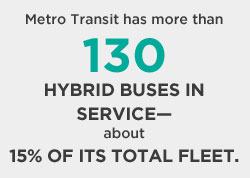
Metro Transit has more than 130 hybrid buses in services--about 15% of its total fleet

Along with a standard hybrid bus and a conventional diesel transit bus, one of the advanced hybrids will be monitored and evaluated in a new study conducted by U of M researchers in collaboration with Metro Transit. The multidisciplinary research team includes Kittelson, ME associate professor Will Northrop, ME research associate Winthrop Watts, and applied economics associate professor Steven Taff.

As part of the study, funded by IREE, the team will collect real-world, on-the-road data from the three buses in all seasons on a variety of route types. The researchers then plan to compare the efficiency and emissions of the buses and make recommendations to Metro Transit about which configuration is the best for a given application. Data collected from the study will also allow Metro Transit to work with bus manufacturers to optimize bus performance.

“We believe the results will be useful in writing bus technical specifications and also in determining if a certain type of bus is best suited to a certain type of bus route,” Wurzinger says.

Ultimately, this information could be used to determine which buses to assign to which routes as well as which type of bus to purchase given fleet replacement or expansion requirements.

The project is scheduled for completion in 2015.

Reprinted from the CTS Catalyst, June 2013.

U of M transportation research highlights video

U of M transportation research highlights during 2012-2013 include a smartphone app for visually impaired pedestrians, pedestrian and bicyclist safety in roundabouts, methods for counting bike and pedestrian traffic on trails, and a filter that takes phosphorous out of storm water.