All posts by Nick

Nick Busse is the communications principal for the Mississippi Watershed Management Organization. He lives in Minneapolis, Minn. Opinions expressed via his personal social media accounts do not represent his employer.

Bridging the gap between research and implementation

The end goal of transportation research, broadly speaking, is to see the results implemented — that is, to transfer the knowledge generated through research to those who can put it to good use. Research Services and the Center for Transportation Studies use a variety of tools to help disseminate research results: our respective websites, email lists, social media, newsletters and this blog, to name a few. But what do we know about how our audiences actually interact with these various channels of communication?

At the Transportation Research Board Annual Meeting earlier this year, researchers from Nebraska presented the findings of a very interesting survey on how engineers and other transportation practitioners prefer to learn about research results. Their presentation, entitled “What Engineers Want: Identifying Transportation Professionals as an Audience for Research,” is available via Slideshare. (Unfortunately, WordPress won’t let me embed it.)

Some key takeaways from the survey:

  • Practitioners overwhelmingly prefer one- or two-page technical briefs to other types of research communication products. (Other popular formats include presentations, video highlights and webinars.)
  • By a wide margin, practitioners use search engines like Google or Bing to seek research results (compared to other options like contacting a colleague or university faculty).
  • Practitioners are mostly interested in information on how to implement findings, as well as cost-benefit analyses of implementation.

The survey results present what I think is a fairly realistic and nuanced picture of the audience for transportation research; they’re also consistent with our (Research Services) own internal research on the issue. The bottom line is that research results need to be condensed into usable bits of information and made easily accessible in a variety of formats. People want information they can use, without having to dig for it. More importantly, they want it in whatever their preferred format is, whether it be print, email, Web, RSS, social media or in-person presentations.

Interestingly, Research Services already produces the kind of two-page technical briefs described in the survey. We call them “technical summaries,” and they are among our most popular products. We generally produce a technical summary for each research project we manage, and post them on our website alongside the full research report. Reading a two-page summary, written in layman’s terms, is certainly easier than poring over research reports that oftentimes number in the hundreds of pages, so it’s not surprising that even those with a strong engineering background prefer the format.

As a side note, last Friday we published a batch of 10 new technical summaries — along with two new transportation research syntheses, which are a type of literature review. Topics range from pedestrian and bicycle safety in roundabout crossings to the effect of intelligent lane control systems on driver behavior. You can check the full list on the Research Services main page.

Now it’s your turn: What forms of communication do you think are most effective at reaching transportation practitioners? Which ones do you prefer? Let us know in the comments.

Permeable pavements could protect the environment, save taxpayer dollars

KSTP has a nice story today on the Minnesota Department of Transportation’s ongoing research into permeable pavements at the MnROAD research facility. (The video isn’t embeddable on WordPress, but you can find a direct link here.)

Permeable pavements (also known as “porous” or “pervious” pavements) are designed to allow water to pass through roadways and infiltrate directly into the underlying aggregate and soil. Their primary effect is to reduce stormwater runoff, which carries harmful materials from the road’s surface out into waterways. Of course, reducing runoff also mitigates the need for the kinds of costly drainage structures that are normally required to manage stormwater. Permeable pavements also reduce noise and mitigate the potential for hydroplaning, among other documented benefits.

These types of pavements are already used in some areas in Minnesota — mainly in parking lots and city streets — and MnDOT has been studying their potential use for full-depth roadway pavements. As the video indicates, so far the results have been encouraging. (You can read more about MnDOT’s ongoing research on the MnROAD website.)

As a side note, the amount of water these pavements can absorb is quite impressive. Last month, we posted a new Local Road Research Board video on stormwater management. In one scene, a public works crew dumps what appears to be several hundred gallons of water onto a permeable pavement and watch as it disappears almost instantaneously. (Watch the clip here.)

Here are the results of some recent permeable pavement studies here in Minnesota:

About those roundabouts

One of my unofficial duties as a MnDOT employee is to respond to a near-constant barrage of opinions from my family and friends regarding the condition of our state’s roadways. (My wife, for example, half-jokingly tries to ascribe personal responsibility to me for the congestion she faces on her morning commute.) Interestingly, one of the issues that gets brought up to me most often in private conversations is roundabouts — the circular intersections that are widely praised by engineers but often vilified by a skeptical public.

From a public interest perspective, the verdict on roundabouts is overwhelmingly positive. With very few exceptions, roundabouts have been shown to dramatically reduce both the frequency and seriousness of traffic accidents when compared to other types of intersections. One oft-cited source, the National Insurance Institute for Highway Safety, reports that U.S. intersections converted to roundabouts have experienced a 35-47 percent decrease in crashes and an 72-80 percent decrease in injury crashes (source here). Moreover, because the don’t have stop signs or traffic lights, roundabouts have been found to reduce traffic delays and pollution.

Perhaps not surprisingly, research on these potential benefits has precipitated a rash of roundabout construction. In Minnesota alone, 115 have already been built, with another 39 either planned or under construction, according to the Pioneer Press. Love them or hate them, roundabouts are becoming a fact of life here.

Of course, not everyone loves them. In spite of their stellar  record, roundabouts remain something of a political lightning rod. This article in the Mankato Free Press and this news segment from KSTP provide typical examples of the kind of skepticism officials face when proposing to put in a roundabout. The problem is persistent enough that many officials see a need to develop a public relations game plan. On June 19, the Transportation Research Board is offering a free webinar entitled “Community Outreach: Successful Outcomes for Roundabout Implementation,” designed to help transportation professionals understand and respond to political opposition to roundabouts. It’s free for employees of TRB sponsor organizations (including MnDOT); a $99 registration fee is required for employees of non-sponsors.

For those who are unfamiliar with roundabouts, there are some good resources designed to help people understand their purpose and benefits. Several years ago, the Local Road Research Board produced the video above (along with an accompanying brochure). MnDOT also has a resource page devoted to explaining the use of roundabouts.

Those with more than a passing interest in the subject might also want to check out these recent MnDOT/LRRB-sponsored studies:

‘Three Ways to Cook a Pothole’

In April, we posted about an innovative pothole-filling technology being developed by the Minnesota Department of Transportation and the University of Minnesota, Duluth. The technique involves zapping pothole patches and the surrounding pavement with a special truck-mounted, 50,000-watt microwave. Researchers have found that heating the base and the patch material at the same time creates a stronger, longer-lasting bond that provides for a more permanent pothole fix.

Last week, the MnDOT/UMD microwave technology found its way into a new MnDOT video (above) that also explores two other experimental pothole-patching methods. One involves using a large “electric oven”-type heating element instead of a microwave. The other utilizes a new exothermic (i.e. heat-generating) asphalt mixture containing taconite from northern Minnesota mines. The video compares the potential benefits of all three of the new technologies, which the department hopes will someday lead to “more pothole-patching power for the taxpayer dollar.”

See also:

Free Complete Streets webcast next week

On Tuesday, June 4, the University of Minnesota is hosting a free Complete Streets seminar. The event will serve as a preview of a forthcoming guide, “Complete Streets Planning and Implementation at Multiple Scales Guidebook and Case Studies,” funded by MnDOT and the Minnesota Local Road Research Board.

Unfortunately, the event itself is sold out, but you can still watch it online for free via webcast. You can find all the relevant information on this web page, including direct links to the webcast sessions:

http://www.eventbrite.com/event/6109392357

According to the announcement, the event will cover “examples of Complete Streets policies, design guidance, engagement strategies, and financing mechanisms that help communities move from policies and plans to on-the-ground projects.”

New video showcases Minnesota city and county stormwater management techniques

Earlier this week, the Minnesota Local Road Research Board released this new video showcasing best practices for local stormwater management. Although it’s primarily a training video for engineers and other public works professionals, non-transportation geeks might also enjoy learning about some of the interesting, innovative techniques being employed in cities and counties across the state.

Those who’d prefer not to watch the whole 14-minute video can skip ahead by clicking on these highlights:

  1. Woodbury’s stormwater ponds (1:52)
  2. Washington County’s bioretention gardens (2:56)
  3. “Green roof” bioretention method (4:02)
  4. Maplewood’s underground detention system (4:39)
  5. Greenway stormwater project in Minneapolis (6:03)
  6. Minnetonka’s hydrodynamic separator treatment system (7:47)
  7. Arden Hills’ infiltration (swales) system (8:26)
  8. Shoreview’s permeable pavements (9:52)
  9. Ramsey-Washington permeable pavement project (11:11)
  10. Tree boxes/trenches in Ramsey-Washington (12:06)

Overall, the video gives you an appreciation for the incredible amount of planning and work that goes into managing stormwater runoff — a task that’s critical to protecting the state’s waterways from pollution (but which many people no doubt take for granted). For those who want to learn more, the best management practices showcased here are examined in greater detail in a recent LRRB report, “Decision Tree for Stormwater BMPs,” which is available for free on the LRRB and MnDOT Research Sevices websites:

Portable weigh-in-motion system demonstration

Weigh-in-motion (WIM) systems consist of sensors placed in road pavements to measure the weight of vehicles passing over them, along with other data such as speed, axle load and spacing, and vehicle type. This data is used to enforce weight limits on trucks and is also useful in a wide range of other applications, such as pavement design and traffic analysis.

However, constructing and maintaining permanent roadside WIM stations is expensive, so these systems are installed primarily on roadways with heavy traffic, such as interstate and trunk highways, and rarely used for rural local roads. Meanwhile, heavy truck volumes on local roads are increasing, significantly shortening their lives. A less costly, portable WIM system is needed for such roads so that collected data can be used to better design these roads to accommodate heavy truck traffic.

One solution for bringing WIM technology to local roads is to implement a portable, reusable system similar to pneumatic tube counters used to conduct traffic counts. With funding and technical assistance from MnDOT and the Local Road Research Board, Professor Taek Kwon of the University of Minnesota—Duluth has developed a prototype system that has already proven to be nearly as accurate as the more expensive, permanent systems.  MnDOT Research Services staff drove up to MnROAD this week to observe a live demonstration of the technology, and made this short video.

The research being conducted here is part of an implementation project based on Kwon’s original study, the results of which can be found in this research report and its accompanying two-page technical summary from MnDOT Research Services.

White House honors MnDOT traffic boss for work on rural intersection safety

The White House named Minnesota Department of Transportation State Traffic Engineer Sue Groth one of its 12 transportation “Champions of Change” for her role in implementing life-saving technology to help prevent collisions at rural intersections. The rural intersection conflict warning systems, which use sensors and lights to give motorists real-time warnings about traffic conditions, were developed by MnDOT’s Office of Traffic, Safety and Technology.

It’s worth noting that MnDOT Research Services and the University of Minnesota are also currently working on a project to develop a low-cost version of these systems using LEDs and solar panels. The ongoing research, being conducted by University of Minnesota— Duluth Professor Taek Kwon, is a continuation of the Advanced Light-Emitting Diode Warning System project completed in 2010.

Here’s the press release from MnDOT:

ST. PAUL, Minn. – On Wednesday, May 8, 2013, the White House honored Sue Groth, Minnesota Department of Transportation’s state traffic engineer, as one of 12 people who are Transportation “Champions of Change.” The Champions event, “Transportation Technology Solutions for the 21st Century,” focused on individuals or organizations that have provided exemplary leadership in developing or implementing transportation technology solutions to enhance performance, reduce congestion, improve safety and facilitate communication across the transportation industry at the local, state or national level.

“These Champions represent the very best in American leadership, innovation and progress,” said Secretary Ray LaHood. “I’m proud to recognize these transportation leaders who work every day to grow our economy and help us reach our destinations more quickly, efficiently and safely.”

The MnDOT Office of Traffic, Safety and Technology has been selected as a Champion of Change for their work to reduce fatal and life-changing crashes on Minnesota roadways, while enhancing mobility for all users. OTST is being honored for designing, testing and helping to deploy dozens of life-saving rural intersection conflict warning systems throughout Minnesota, while leading a national effort to do more of the same throughout rural America. These systems save lives at rural intersections that might otherwise not warrant or afford more traditional traffic control devices or geometric improvements.

See also:

Research partnerships create better pavements

As is painfully evident this time of year, Minnesota’s weather is highly destructive to our asphalt roadways.  One of the biggest challenges for transportation practitioners in cold-climate states like ours is low-temperature cracking in asphalt pavements. The distress caused by  our extreme weather variations and constant freeze-thaw cycles wreaks havoc on our asphalt streets and highways, causing decreased ride quality, increased maintenance costs and shorter pavement lifespans.

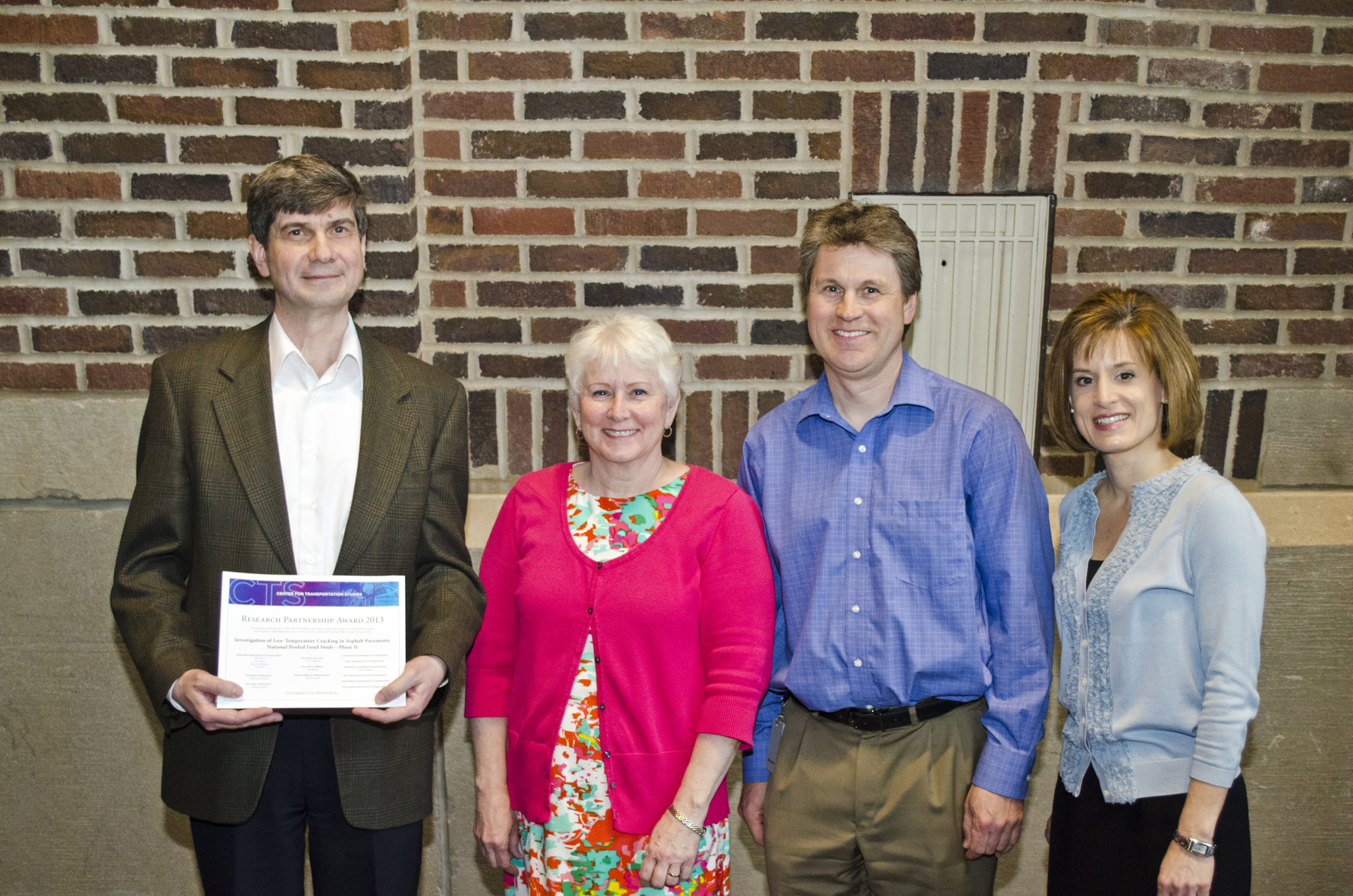
On April 17, the Center for Transportation Studies presented its 2013 Research Partnership Award to the team members of a multi-state, Minnesota-led study designed to combat the problem. The project, Investigation of Low Temperature Cracking in Asphalt Pavements, Phase II,” was a national pooled-fund study involving six state DOTs, four universities, the Minnesota Local Road Research Board and the Federal Highway Administration. It resulted in a new set of tools — test methods, material specifications and predictive models — that will be used to build longer-lasting pavements.

The project is a prime example of the value and benefits of cooperative research. Each organization brought its own unique strengths and expertise to bear on the problem. The University of Minnesota, led by Professor Mihai Marasteanu, brought its strength in lab testing of binders and mixtures, for example; other universities leveraged their respective expertise in data analysis, statistics and modeling capabilities. MnDOT, as the lead state agency, controlled the finances and kept the research on track, guiding the process through technical advisory panels. MnDOT’s materials laboratory and its unique MnROAD pavement research facility also played a key role in the study.

The above video provides an excellent overview of the project and includes commentary from key MnDOT and University of Minnesota team members. MnDOT is already moving to implement the results. It plans to use the new test procedure on several road construction projects this year. Iowa and Connecticut are among the other states reportedly planning implementation projects.

See also:

2013 Research Partnership Award winners

From left: University of Minnesota Professor Mihai Marasteanu, the project’s principal investigator; MnDOT State Aid Director Julie Skallman; MnROAD Operations Engineer Ben Worel; and CTS Associate Director for Development and Finance Dawn Spanhake, who presented the award. (Photo by Cadie Adhikary, Center for Transportation Studies)

The people (and machines) who fix Minnesota’s potholes

In Minnesota, with our often wildly unpredictable weather and constant freeze-thaw cycles, potholes are a fact of life. Anyone who’s climbed into a motor vehicle in the last month or so has doubtlessly encountered countless reminders of this dismal reality. Fortunately, we have a small army of public works professionals devoted to eradicating this perennial nuisance. The Minnesota Local Road Research Board recently produced this video, which nicely explains the various methods used to combat potholes in Minnesota.

Potholes form when water invades cracks in the pavement and infiltrates the soil beneath it. When that water freezes, it stretches the road surface, causing the fractures to expand. After a few cycles of freezing and thawing, the pavement begins to buckle and eventually collapses under the weight of passing traffic, creating disruptions in the road’s surface.

Road crews use a variety of methods to fill potholes. The simplest method is the “throw-and-go” procedure, in which workers simply shovel an asphalt mixture into the pothole and pack it down until the road’s surface is smooth. A related method is “throw-and-roll,” where the patch is compacted using an asphalt roller.

Other methods include:

  • “semi-permanent” patching, in which workers clear the pothole of moisture and debris and then square the edges with a pavement saw before applying the patch;
  • “spray injection,” which involves using specialized equipment to blast water and debris out of the pothole before spray-filling it with asphalt mix and finally applying a dust coat of dry aggregate on top; and
  • “slurry” or “microsurfacing” crack filling, in which a slurry of aggregate, asphalt emulsion and mineral filler is placed over a crack in the pavement and leveled off using a squeegee.

This Asphalt Pavement Maintenance Field Guide (PDF), co-funded by MnDOT and produced by CTS, provides a handy how-to guide to pothole patching and other types of pavement repairs commonly applied by public works professionals in Minnesota.

See also: