

During the past decade, MnDOT has been developing solar projects and actively pursuing cost-effective energy-efficiency measures. Among the potentially effective innovations the agency has considered is adding solar panels to noise barriers and snow fences, transforming these single-function installations to multifunction installations. The electricity generated from this practice could offset installation costs and eventually generate revenue for other purposes.
Continue reading Using Noise Barriers and Snow Fencing to Capture Solar EnergyAll posts by mndotresearch

New Resource for Manhole and Catch Basin Installation
Finding resources that address manhole and catch basin issues occurring in Minnesota can be challenging. In a recent project, researchers surveyed 83 municipalities and interviewed other engineers and product representatives to gather data about manhole and catch basin installation and maintenance practices. The resulting report provides current information for municipal engineers about these essential installations.
Continue reading New Resource for Manhole and Catch Basin Installation
Ultrasonic Devices Deter Bats During Bridge Repair
Researchers tested ultrasonic bat deterrence devices at two MnDOT bridges, tracking bat activity with acoustic echolocation recorders and field inspections. Deterrence devices used in short- and long-term trials dramatically reduced bat activity at bridge site. Analysis showed that bats return promptly when devices are turned off.
Continue reading Ultrasonic Devices Deter Bats During Bridge Repair
New Project: Evaluation of Proprietary Rejuvenators
A wide range of proprietary spray-on asphalt rejuvenators are available on the market. A National Road Research Alliance field study has been initiated to monitor the performance of some vendors’ materials on test sections over the next five to 10 years. Local agencies are interested in learning more about the many products on the market.
Continue reading New Project: Evaluation of Proprietary Rejuvenators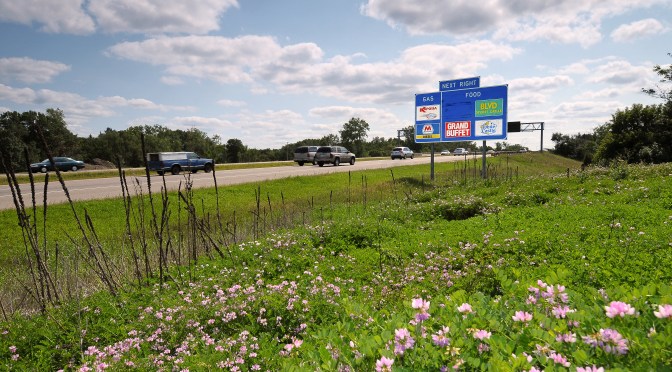
New Project: Comparison of Compost and Proprietary Soil Amendments for Vegetation Establishment
After road construction, the adjacent disturbed soil has a diminished capacity to sustain vegetation, overall soil health is compromised from soil disturbance and there is an increased risk for erosion.
Soil quality in these areas can be replenished by importing topsoil (the preferred choice) or using organic composts. If organic compost is not available, proprietary soil amendments provide a cost-effective alternative. But information regarding the effects, mix ratios and application techniques for these products is limited. Research is needed to better understand optimal organic compost ratios and how to integrate these amendments to improve soil quality.
Continue reading New Project: Comparison of Compost and Proprietary Soil Amendments for Vegetation Establishment
New Project: Tool to Estimate the Safety Impact of Vehicle Levels of Automation on Minnesota Roads
While commercially available self-driving vehicles may still be decades away, an increasing number of vehicles on the market offer advance driver assistance systems (ADAS). For example, ADAS features include adaptive cruise control, steering automation, and hands-free steering.
Continue reading New Project: Tool to Estimate the Safety Impact of Vehicle Levels of Automation on Minnesota Roads
New Project: MnDOT Haul and Detour Routes – Impacts on Local Roads
When local roads are temporarily used as haul roads or as detour routes, MnDOT compensates local agencies. However, local agencies believe the compensation model is outdated and inadequate, especially for local roads not built for large volumes of heavy vehicles. The methodology also has not been updated to reflect that local agencies have invested more local property and sales tax revenue into their systems beyond the gas tax.
Continue reading New Project: MnDOT Haul and Detour Routes – Impacts on Local Roads
Research Pays Off Webinar Series: Performance Benefits of Fiber-Reinforced Thin Concrete Pavement and Overlays
The National Road Research Alliance (NRRA) is hosting “Performance Benefits of Fiber-Reinforced Thin Concrete Pavement and Overlays” on September 21 at 10 a.m. CST, presented by Manik Barman, University of Minnesota Duluth.
Continue reading Research Pays Off Webinar Series: Performance Benefits of Fiber-Reinforced Thin Concrete Pavement and Overlays
New Project: Pavement Marking/Colored Pavement Friction Differential and Product Durability
Pavement markings contain glass media to provide retroreflectivity. These markings are slipperier than surrounding pavement. The sudden difference in friction between pavement and pavement markings can create a safety hazard for pedestrians (including those with disabilities), bicyclists and motorcyclists, especially during wet conditions.
Continue reading New Project: Pavement Marking/Colored Pavement Friction Differential and Product Durability
New Project: Benefits of Preventive Concrete Pavement Maintenance
Early preventive maintenance of concrete pavement—maintenance performed in the first five to seven years of pavement life—is a low-cost way to increase pavement service life. But no quantitative evaluations of service life extension have been conducted that compare early intervention to late or no intervention.
Without these comparisons, meaningful determinations of pavement life extension operations cannot be made. Federal Highway Administration (FHWA) research has found that agency projects focused on the end-of-service life may redirect funds from rehabilitation projects that could improve overall system quality.
Continue reading New Project: Benefits of Preventive Concrete Pavement Maintenance
