

Minnesota agencies are evaluating how to meet the U.S. electric vehicle (EV) target of at least 50% by 2030. Numerous technical, social and coordination considerations are inherent in a transition to electric fleets.
Continue reading New Project: Transitioning to EV Fleets: Best Practices and a Decision ToolAll posts by Malee Yang

New Project: Investigating Real Storms and the Impact of Potential Climate Change Adaptations
MnDOT designs stormwater management infrastructure based on historical rainfall data and traditional design assumptions, including rainfall intensity and distribution, rainfall event duration and existing moisture conditions. Stormwater management infrastructure designed using traditional design parameters determines the risk of flooding, property damage and human safety in communities.
Continue reading New Project: Investigating Real Storms and the Impact of Potential Climate Change Adaptations
New Project: Roadside Feature Placement and Pedestrian Safety on Low and Intermediate Speed Roads
Guidelines for designing and placing roadside features have traditionally focused on automobile safety on higher-speed roads. Research has also shown feature placement can have safety benefits for pedestrians and bicyclists on lower-speed roads.
Continue reading New Project: Roadside Feature Placement and Pedestrian Safety on Low and Intermediate Speed Roads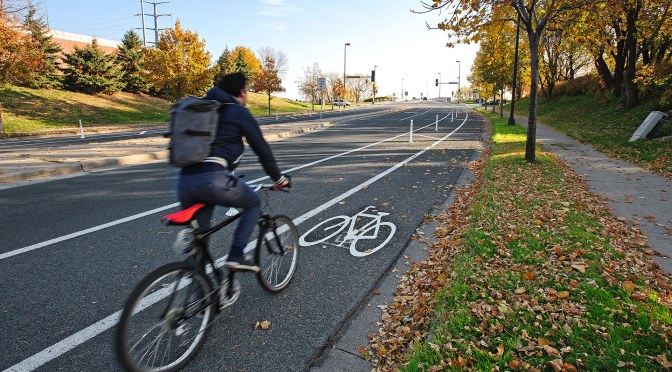
Using Mobile Device Data to Estimate Bicyclist and Pedestrian Traffic
MnDOT relies on estimates of annual average daily traffic volumes to plan and maintain safe, effective transportation network infrastructure for all travelers. Estimating traffic volumes for nonmotorized road users such as bicyclists and pedestrians has been challenging because monitors are limited compared to vehicle traffic counters. Data from mobile devices, routinely collected through a variety of platforms, offers a potential source of traveler routes. Using monitored nonmotorized traveler data to validate mobile datasets, researchers produced a data visualization tool to estimate bicyclist and pedestrian counts within the Twin Cities area.
Continue reading Using Mobile Device Data to Estimate Bicyclist and Pedestrian Traffic
Safety of Commercial Vehicles Navigating at Roundabouts
The safety benefits of roundabouts over signalized intersections have been well-established for vehicular traffic, with previous studies showing decreases in fatal and serious injury crashes. But many stakeholders continue to perceive that heavy commercial vehicles are at risk and may overturn when navigating a roundabout. A MnDOT investigation comparing commercial vehicle crash data between roundabouts and intersections with traffic signals found fewer total crashes and serious crashes in roundabouts compared to other intersections, particularly after MnDOT modified roundabout design guidance to address commercial vehicle concerns.
Continue reading Safety of Commercial Vehicles Navigating at Roundabouts
Testing High Friction Aggregates using SCRIM Technology at MnROAD
High Friction Surface Treatments (HFST) are pavement treatments that involve applying a high-quality aggregate and binder to pavement surfaces to help maintain friction. The treatment has significantly reduced crashes and injuries in wet and dry road conditions in high crash areas. However, HFST can be a costly treatment. Researchers, funded by MnDOT and the Local Road Research Board, are evaluating if taconite, a readily available Minnesota byproduct, can be an effective alternative treatment in low volume areas.
Continue reading Testing High Friction Aggregates using SCRIM Technology at MnROAD
Measuring the Effects of Road Features on Driving Speeds
The Complete Streets approach to roadway design uses site characteristics to create a safer, more accessible environment for all road users. New research demonstrates that roadway design features have a measurable impact on driving speeds. The development of speed reduction factors (SRFs) that estimate the impact of road features on speed reduction provides a data-driven approach to highway design.
Continue reading Measuring the Effects of Road Features on Driving Speeds
New Project: Cost Benefit Analysis for Sustainable Energy Building Upgrades at Safety Rest Areas and Travel Information Centers
MnDOT manages over 50 large safety rest areas (SRAs) with several amenities and travel information centers (TICs) with expanded customer service. Many of the SRA and TIC buildings were built before the significant advancements in energy efficiency and building technology made in the past few decades.
Continue reading New Project: Cost Benefit Analysis for Sustainable Energy Building Upgrades at Safety Rest Areas and Travel Information Centers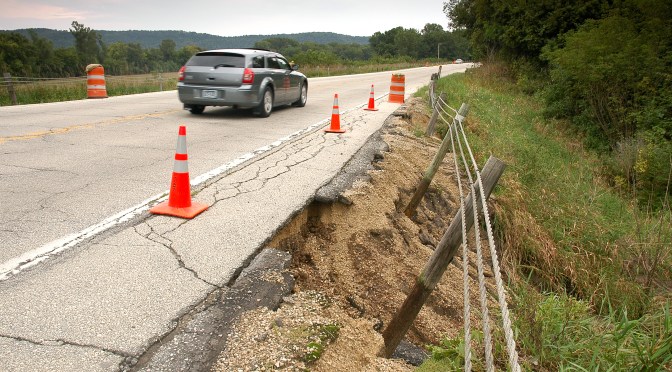
New Project: Vulnerability Assessments of Critical Slope Areas Using Advanced Monitoring Techniques
MnDOT continues working on systematically and proactively assessing stability of slopes along its highway system. Efforts are aimed at minimizing the potential for slope failures that could result in threats to public safety and costly repairs.
Continue reading New Project: Vulnerability Assessments of Critical Slope Areas Using Advanced Monitoring Techniques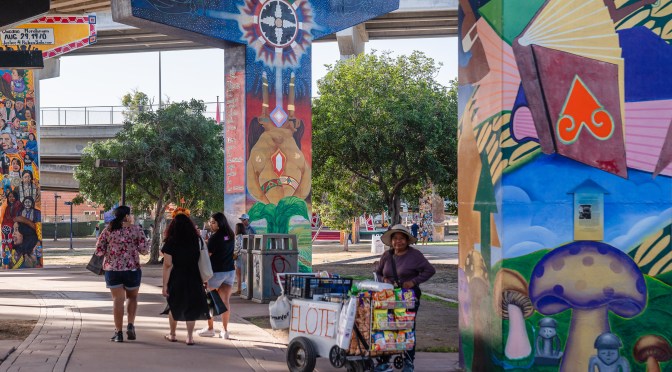
Social Outcomes Improve by Incorporating Arts and Culture into Transportation Planning
Historically, transportation projects have had a disproportionately negative effect on BIPOC (Black, Indigenous and people of color) and low-income communities. Today, state departments of transportation (DOTs) may be able to mitigate these negative effects by reaching out to these communities and incorporating their ideas and feedback into transportation planning. Local artists and culture bearers could serve as ambassadors for these communities by participating in the transportation planning process based on their creative placemaking ideas and connection to the community.
Continue reading Social Outcomes Improve by Incorporating Arts and Culture into Transportation Planning Crossroads