

Reprinted from CTS News October 6, 2026
From freight, commercial, and public transit to personal commuters, delivery drivers, and emergency services, millions of vehicles travel Minnesota roadways each year. As the number of drivers on the roads grows, ensuring safe and reliable transportation infrastructure is crucial. A recent analysis performed by the Transportation Policy and Economic Competitiveness (TPEC) Program examined the performance and condition of Minnesota’s roadways at the county level from 2018–2024.
Using data regularly collected and maintained by the state, the TPEC team — led by Camila Fonseca-Sarmiento, director of fiscal research at the Institute for Urban and Regional Infrastructure Finance at the UMN’s Humphrey School of Public Affairs and a CTS scholar — assessed condition, safety, and performance trends of Minnesota transportation infrastructure and how these measures have changed over time. Bridge and pavement conditions were categorized as being in good condition, fair condition, or poor condition.
Pavement conditions and trends
The data examined focused on two roadway networks in Minnesota — the National Highway System (NHS) and the County State-Aid Highway (CSAH) system. The NHS, which includes interstates and local and national highways, makes up just 10 percent of statewide lane miles but carries a majority of vehicle traffic. The CSAH system carries significantly less traffic but is more than double the length of the NHS. Pavement types across these roadway networks were evaluated by surface distress or visible defects, ride quality or pavement smoothness, the overall condition of pavement, and the estimated time until the end of the pavement’s service life. Among the analysis’s key insights:
- More than 80 percent of NHS roads and more than 60 percent of CSAH system roads are in good condition.
- The CSAH system has more than double the number of roads in poor condition than the NHS.
- Interstates consistently have the highest pavement quality.
- Counties with an interstate highway tend to have the most vehicle traffic and pavement in good condition.
- Counties in northwest Minnesota have the most CSAH roads in good condition while the metro area has the fewest.
Bridge conditions and trends
The team’s research found that the bridge network across Minnesota, comprising 13,500 bridges, remains generally well maintained. Some key trends identified:
- Bridge conditions have been slowly declining since 2019, with the number of bridges in fair condition increasing.
- As the population grows, the share of bridges in good condition declines.
- Counties in northwest Minnesota have a higher rate of bridges in poor condition.
These insights indicate that more bridges will require greater levels of maintenance and preservation efforts in the years to come.
Crash trends
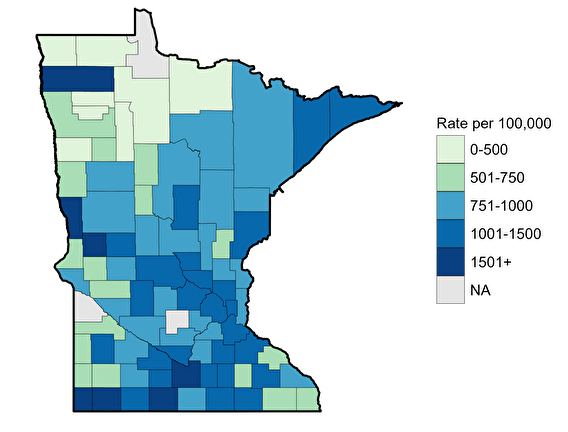
The COVID-19 pandemic altered the driving habits of many — as more people stayed home, fewer vehicles traveled the roads. While the total number of crashes across Minnesota has declined since 2020, the severity of crashes has risen slightly. Among the key crash trends from the report:
- Minnesota counties average 929 crashes per 100,000 people.
- Counties in southwest Minnesota have higher rates of property damage, injury, and fatal crashes.
- Counties in northwest Minnesota have lower rates of property damage, injury, and fatal crashes.
- Between 2019 and 2023, crashes statewide causing property damage decreased by 22 percent and fatal and injury crashes decreased by 13 percent.
- Severe weather or wildlife encounters may be contributing to increased crashes in some counties.
- As the population grows, crash rates increase.
“The findings emphasize the importance of continued monitoring and investment in Minnesota’s transportation infrastructure,” Fonseca-Sarmiento says. “Understanding how roadway and bridge conditions vary throughout the state is essential for prioritizing resources when investing in the transportation network and improving safety. As transportation demands continue to evolve, data-driven decision-making will remain crucial to ensure a reliable and resilient transportation network for Minnesotans.”
— Krysta Rzeszutek, CTS digital editor
Related MnDOT Research from 2026
- Pavement Data Collection and Management Tool Selection for Local Agencies in Minnesota-TRS-053
- Review of Field Produced Innovative Asphalt Concrete Mixtures
- Best Practice for Seal Coating & Pavement Markings with Rumble/Mumble Strips
- An Analysis of Crash Data and Safety Trends in ATV’s and UTV’s in Minnesota
- Bridge Approach Roadway Embankment Improvements
- Robust Data Driven Condition Monitoring of Pavements Based on Temperature Data
- Guidance for MnDOT Haul and Detour Routes – Impacts on Local Roads
- Using Electric Vehicle Onboard Data for Pavement Quality Assessment and Management
- Long-Term Field Performance Evaluation of Chip-Seals

