
When temperatures fall below 15 degrees Fahrenheit (F), salt loses its effectiveness at melting snow on roads. To accommodate lower temperatures, transportation agencies often combine an alternative deicer with salt brine to treat roads and return them to an appropriate level of service. This project investigated the most common alternative deicer used in Minnesota to provide guidance to state and county winter maintenance managers about its application at different concentrations and temperatures.
MnDOT and counties across the state have been using alternative deicers to help clear roads when temperatures are too cold for salt to work alone. Alternative deicers in brine form have been effective at temperatures below 15 degrees F, but complete data is not currently available that characterizes their performance.
This project investigated the freeze point, ice melt capacity and field performance of the most common alternative deicer used by MnDOT and county transportation agencies. The results could offer guidance to winter maintenance managers, especially those in the coldest regions of Minnesota, to effectively treat roads and fight refreeze when temperatures drop or deicer concentrations become too diluted to be effective.
What Did We Do?
The evaluation began by quantifying the freeze point curve for 10 mixtures of the selected deicer and salt brine from 32 to -34 degrees F. The mixtures ranged from 100% salt brine to 100% alternative deicer. They were inserted into temperature-controlled baths for at least one hour and later categorized as unfrozen, half-frozen, mostly frozen or wholly frozen.
Next, investigators quantified the ice melting capacity for six mixtures down to -21 degrees F. Visual observations evaluated a range of concentrations at a given temperature and time to determine the rate of ice melting or crystal growth for each alternative deicer mixture application.
Field testing in 2025 evaluated the deicing performance of varying ratios of the alternative deicer under actual conditions of pavement, traffic, precipitation, sun and wind. The tests evaluated the alternative deicer with an on-pavement treatment comparison across times and rates of application and co-treatment with rock salt.
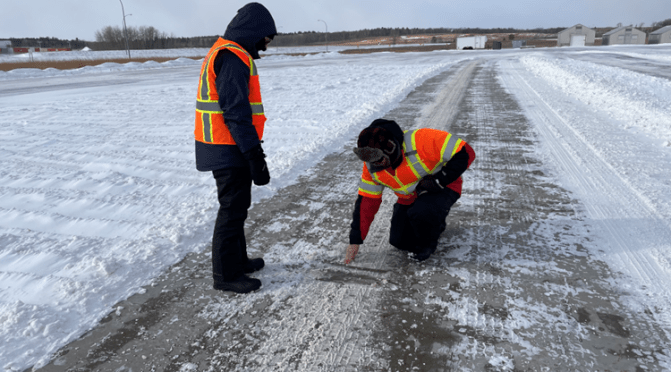
Investigators conducted the on-pavement testing at a site that had received 6 inches of dry snow three to four days before testing. Conditions on the day of the testing were 8 degrees F, mostly sunny to lightly overcast skies and winds at 15 to 30 mph with gusts to 45 mph. Traffic was dispersed across the road after alternative deicer treatment.
A second phase of field testing in 2026 further evaluated on-pavement treatment comparisons over an additional winter season.
What Did We Learn?
In the laboratory, tests to develop a freeze point curve for the alternative deicer found a freeze point in mixtures up to 60% of alternative deicer, with no freeze points for the alternative deicer at concentrations above 60%. No eutectic temperature was found as the freeze point curve of the alternative deicer continued to temperatures colder than -40 degrees F, the limit of the laboratory’s freezer.
In the field, rock salt had limited or nonexistent deicing effectiveness across the differing amounts applied, but traffic volume and pavement orientation had a greater impact. The expected ineffectiveness of salt was due to a low temperature of 9 degrees F, at which salt has very limited ice melt capacity. Further, the alternative deicer treatment also showed limited effects on deicing the roads across the range of treatment ratios at this temperature.
However, the alternative deicer did soften the road surface snowpack so that the snowplow could effectively remove it. This softening strategy with the alternative deicer was effective for temperatures between approximately 15 to -20 degrees F—temperatures at which salt brine alone would have no beneficial impact.
The second phase of testing demonstrated similar results and identified a ratio of 80:20 (salt brine to alternative deicer) at 15 gallons per lane mile as an effective application method. Investigators also noted that deicing performance is highly dependent on ice thickness, and increased rates of alternative deicer application could have a more significant impact.
“These results provide valuable guidance to winter maintenance managers and highlight the benefits that softening road surface snowpack can have on clearing roads,” said Joseph Huneke, Transportation Program Supervisor, MnDOT Office of Fleet Equipment and Contracts.
What’s Next?
The results of this project offer valuable guidance to winter maintenance managers as they attempt to provide safe travel conditions and a high level of service during and after winter storms. Rather than working to completely clear roads with salt and alternative deicers, a strategy to soften the snowpack with subsequent plowing may be the best option at temperatures below 15 degrees F.

