
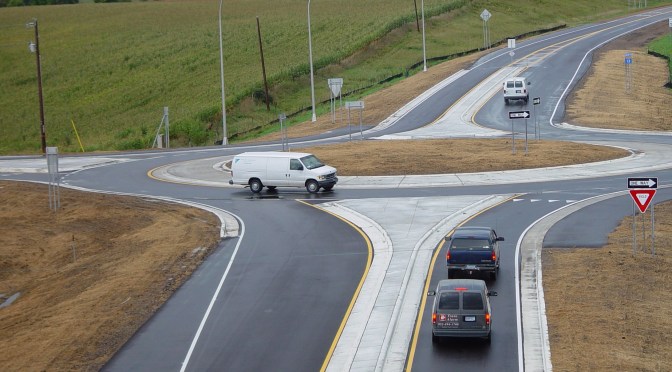
Roundabouts and J-turns improve safety and road user experiences. While public familiarity and acceptance of these alternative intersections designs increase over time, questions remain regarding economic impacts on nearby businesses. An analysis of roundabouts and J-turns continued to show benefits for road users and no notable negative economic impacts on nearby businesses.
What Was the Need?
Evaluations of roundabouts and J-turns have repeatedly shown safety, operational and road user benefits across Minnesota. Approximately 550 roundabouts and more than 100 J-turns have been installed across the state. Despite proven reductions in fatal and serious injury crashes, improved traffic flow and positive pedestrian experiences, transportation agencies continue to field questions and occasional complaints about roundabouts and J-turns from nearby residents and businesses.
Some businesses raise concerns about potential revenue impacts resulting from changes in access as traffic patterns change. MnDOT and the Local Road Research Board (LRRB) wanted to understand whether these intersections cause economic harm to nearby businesses and, if so, how potential impacts could be mitigated.
What Did We Do?
An evaluation of roundabouts and J-turns focused on stakeholder perceptions and nearby business performance. Following a literature review of national and Minnesota studies on the operational, safety and economic impacts of roundabouts and J-turns, investigators analyzed public feedback in Minnesota.
After finding no legal complaints or litigation related to roundabouts or J-turns in Minnesota, investigators collected more than 100 roundabout comments and 12 J-turn comments submitted to MnDOT’s public feedback portal between 2018 and 2025. Surveys were distributed to Minnesota residents, community stakeholders and businesses near 30 roundabout or J-turn locations.
Investigators estimated the economic value of avoided crashes based on prior safety analyses of roundabouts and J-turns, and MnDOT provided historic average annual daily traffic data for 16 roundabouts and 16 J-turns for traffic flow analyses. Finally, the team analyzed commercial business databases to compare estimated revenue trends for businesses within a half mile of roundabouts and J-turns with similar businesses in nearby areas without alternative intersections.
What Did We Learn?
The study’s multiple tasks revealed several positive findings regarding roundabouts and J-turns.
“While the safety benefits of alternative intersections like roundabouts and J-turns have been shown in several previous research efforts, we now have evidence that nearby businesses are not economically harmed by these intersection types,” said Derek Leuer, State Traffic Safety Engineer, MnDOT Office of Traffic Engineering.
Online Public Feedback. Two-thirds of commenters recognized benefits associated with roundabouts. About one-third raised concerns, including slippery winter conditions, inadequate signage and the need for greater public awareness of how to navigate roundabouts. Comments on J-turns primarily recommended public education about safety and traffic movement as well as improved signage and signal timing, but did not indicate opposition to the implementation of J-turns.
Stakeholder Surveys. Most of the 950 residents who responded were confident in navigating roundabouts and supported their installation, with most reporting that they would not change their visiting habits to businesses they frequent. Slightly more than half of respondents were confident in navigating J-turns, while about one-third remained unfamiliar with how J-turns operate.
Community stakeholders similarly reported positive perceptions of roundabouts and more mixed views of J-turns due to lower familiarity and awareness. Most of the 110 stakeholders who responded lacked access to data on business sales, property values or business closures but reported that businesses near the alternative intersections appeared to be operating normally.
Most of the 107 business owners surveyed reported no or minimal negative impacts on sales, and many indicated neutral or positive impacts on customer access and safety. Some identified a need for improved signage and public education.
Safety and Traffic Analyses. Traffic flow analyses showed either increases or no changes in traffic volumes. Investigators estimated substantial economic benefits from avoided crashes of $131 million at 130 roundabouts and $263 million at 95 J-turn locations, which are typically located on higher-speed roadways than roundabouts.
Economic Analysis of Business Impacts. Investigators found no significant changes in business revenue after the installation of roundabouts and J-turns. In some cases, small temporary impacts appeared, possibly because drivers were still becoming familiar with the intersections.
Investigators summarized the project’s results in a fact sheet, brochure and informational videos that will be posted on MnDOT’s Roundabouts website to support public education efforts.
What’s Next?
MnDOT will continue to install roundabouts and J-turns where appropriate while working with stakeholders and nearby business owners as needed. MnDOT and LRRB can use the communications tools as templates when working with district and local government traffic and public engagement staff to propose roundabouts or J-turns in their communities.

