

Speed Safety Cameras (SSCs) detect the speed of vehicles through the use of radar technology or detectors that are embedded in the surface of the roadway, and associate those readings with a photograph or video of the vehicle. They can be deployed as fixed units (a stationary camera targeting a specific location), point-to-point units (multiple cameras that capture average speed over a set distance) or mobile (a portable camera positioned in a trailer or vehicle). The results are then “read” by trained analysts in a data center, who may or may not be members of law enforcement. Speeding tickets are then issued on the basis of this technology. The question facing the Minnesota Legislature in 2024 was, is this needed? And what are the best practices for implementing it?
Continue reading Administrative Rules and Structures of Speed Safety Camera SystemsTag Archives: safety
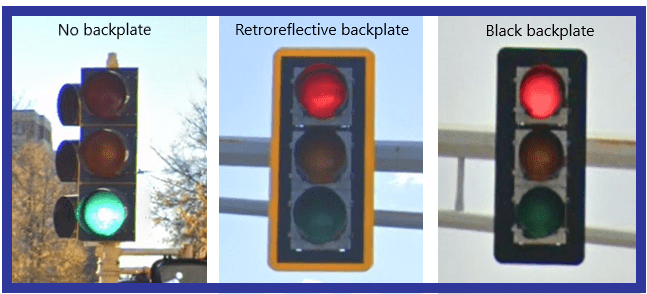
Improving Traffic Signal Visibility
Inconspicuous traffic signals are often cited as contributing to collisions at intersections. If that is true, making traffic signals more conspicuous should lead to fewer crashes. A study published at the TRB conference in 2005 suggested that yellow retroreflective backplates were most effective, reducing accidents by 15% at intersections, and the FHWA later adopted this as a Proven Safety Countermeasure.
Continue reading Improving Traffic Signal Visibility
New Project: Roadside Feature Placement and Pedestrian Safety on Low and Intermediate Speed Roads
Guidelines for designing and placing roadside features have traditionally focused on automobile safety on higher-speed roads. Research has also shown feature placement can have safety benefits for pedestrians and bicyclists on lower-speed roads.
Continue reading New Project: Roadside Feature Placement and Pedestrian Safety on Low and Intermediate Speed Roads
NCITE Webinar: LRRB Mini-Roundabout Guidance
Tuesday, August 6, 10-11 a.m., free to attend
Increasingly, local agencies are opting for mini-roundabouts for some locations instead of traditional roundabouts, which typically require a larger footprint than a standard four-way intersection. Mini-roundabouts are characterized by a small diameter and fully traversable islands (central island and splitter islands).
Join the Apex Engineering Group for a presentation on the Local Road Research Board project, Mini-Roundabout FAQs. Project team members Michael Marti and Zach Heimer with SRF Consulting Group and Jon Pratt with the City of Detroit Lakes will discuss this new guidance.
The guidebook defines mini and compact roundabouts and provides selection criteria on when to use them as well as details regarding the center treatment. The FAQ format provides easy navigation to technical information.
If you have difficulty accessing the meeting, use the meeting ID and passcode:
- Meeting ID: 251 050 866 163
- Passcode: tGP6ix

TZD Traffic Safety Hotdish: A Roadmap for Traffic Safety Culture Research and the Road Ahead
Wednesday, July 17, 2024
10:00 – 11:15 a.m. CDT
As states and localities adopt a vision of zero traffic fatalities, greater attention must be given to communication, collaboration, leveraging resources, and applying a systemic approach to traffic safety which requires a change in culture among road users and traffic safety agencies. This change in culture is tied to education, engineering, enforcement, and emergency services.
This free virtual event will highlight the Traffic Safety Culture Research Roadmap, recently released by the National Academies of Sciences, Engineering, and Medicine. The roadmap (Research Report 1091) presents a path forward to promote traffic safety culture among state departments of transportation and other transportation safety agencies.
Dr. Wes Kumfer, who led the creation of the roadmap, will review its development and contents. Jay Otto will share example projects and show how they fit into research on traffic safety culture. Join us to learn how you can identify traffic safety culture research needs and get insights to take back to your own organizational cultures!
The webinar is free to attend, but registration is required. Once you have registered, you will receive an email confirmation with a Zoom link. The link should not be shared with others; it is unique to you.
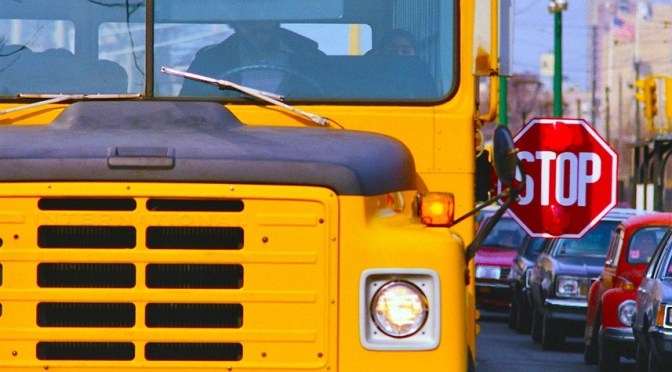
New Project: Development of a System to Report School Bus Stop Arm Violations
When a motorist ignores an extended school bus stop arm, it creates a direct and serious risk to children boarding and exiting a school bus. Capturing information about such incidents is a critical step in better understanding why they occur and how they can be prevented.
Continue reading New Project: Development of a System to Report School Bus Stop Arm Violations
New Project: Evaluation of Static and Dynamic No Right Turn on Red Signs at Traffic Signals
Making signalized intersections safer for pedestrians can be achieved by reducing points of conflict between pedestrians and vehicles. One source of conflict occurs when a vehicle makes a right turn on red (RTOR) onto a street in which pedestrians are crossing. During this turn, the driver must cross the path of pedestrians while at the same time searching for gaps in conflicting vehicle flow.
Continue reading New Project: Evaluation of Static and Dynamic No Right Turn on Red Signs at Traffic Signals
New Project: Assessing Methods to Mitigate Cognitive and Physical Declines That Influence Driving Performance of Older Drivers
Supporting older drivers to safely age in place as they experience age-related declines is important as many Minnesota drivers are reaching retirement age. Minnesotans, 65 years and older, are expected to represent 20% of the state population by 2025, with an overall increase of 122% from 2010-2040. While older drivers are generally safe drivers, those aged 75-85 face the highest risks from injury.
Continue reading New Project: Assessing Methods to Mitigate Cognitive and Physical Declines That Influence Driving Performance of Older Drivers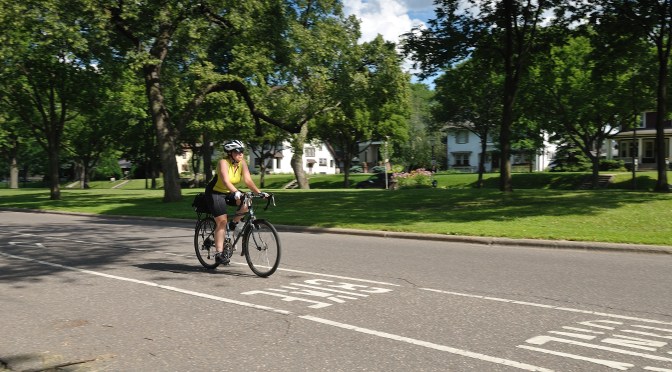
Uncovering Connections Between Gender and Transportation Safety
This post was originally posted on Catalyst, November 2022.
It’s no secret that the transportation system is an uneven playing field. Understanding disparities related to race, income, and other factors is critical, and much more work is needed. Gender in particular is an under-researched yet important aspect of the design of vehicles, infrastructure, and amenities.
Continue reading Uncovering Connections Between Gender and Transportation Safety
New Project: Designing and Implementing Maintainable Pedestrian Safety Countermeasures
In Minnesota, one challenge with installing safety countermeasures for people walking and ensuring year-round access to pedestrian infrastructure is winter maintenance.
Continue reading New Project: Designing and Implementing Maintainable Pedestrian Safety Countermeasures Crossroads