

Aggregate materials used in the base and subbase layers of pavements provide structural support and drainability to Minnesota roads. But the supply of locally available high-quality aggregate material is becoming increasingly scarce. This project explored sustainable and cost-effective solutions for constructing durable flexible pavement roads with lower quality aggregate material.
Continue reading Evaluating Road Designs That Use Lower Quality AggregateTag Archives: pavement

Understanding the Performance of Road Base Stabilization Additives
Full-depth reclamation (FDR)—an effective and efficient pavement reconstruction method—can be made even more sustainable by strengthening the road base. Laboratory and field testing of proprietary stabilizers used to amend FDR material illustrated improvements in pavement stiffness and economic benefits over time. New pavement design standards for base stabilizers can guide road engineers in choosing the optimal products for sustainable roads.
Continue reading Understanding the Performance of Road Base Stabilization Additives
Solutions to Mitigate Dowel/Tie-Bar Propagated Cracking – Phase 1
Cracking and spalling of concrete pavements reduce the service life of the roadway and result in added costs to an agency and disruptions to the traveling public when the damage is repaired.
Continue reading Solutions to Mitigate Dowel/Tie-Bar Propagated Cracking – Phase 1
Development of Mix Designs and Matrix of Materials for MnROAD Low Carbon Concrete Test Site
To address climate change mitigation goals, highway agencies are seeking alternative concrete paving mixtures that have a reduced embodied carbon content (ECC).
The research team first focused on developing a matrix of reduced ECC concrete mixtures to be tested at MnROAD. The 16 concrete mixtures selected for inclusion in the test matrix met minimum engineering requirements to ensure constructability and performance and were approved by MnDOT.
Between July 27 and August 9, 2023, 16 test cells were constructed at the MnROAD I-94 facility to evaluate reduced ECC concrete paving mixtures. The purpose of constructing these cells was to assess the in-service performance, environmental impact, and constructability of various alternative supplementary cementitious materials (ASCMs) that may reduce the embodied carbon content of concrete, while providing an opportunity to assess test results and in-service performance in coming years.
A preliminary environmental assessment showed that most mixtures were expected to have either a similar or lower ECC compared to the control mixture representative of typical MnDOT paving-grade concrete. Quality assurance testing conducted on field-cast specimens revealed generally acceptable results; most of the materials had similar performance compared to the control mixture, but the cells will continue to be monitored.

Finding High-Performing Aggregate Bases for Long-Lasting Pavement
Two county roads provided a testing ground for three combinations of aggregate bases and asphalt binders. Results from more than two decades of research and monitoring of pavement test sections validated previous conclusions. A larger gradation aggregate base showed superior performance over the pavement life cycle when compared with the standard aggregate base. Additionally, sections constructed without transverse joints to allow natural thermal cracking outperformed sections with sawn and sealed joints.
Continue reading Finding High-Performing Aggregate Bases for Long-Lasting Pavement
New Project: Improving and Developing Pavement Design Inputs and Performance Functions for Cold Recycled Pavement Layers
Local agencies in Minnesota use cold recycling technologies for flexible pavement rehabilitation because of their economic and environmental benefits. The three main methods are cold in-place recycling (CIR), cold central plant recycling (CCPR), and stabilized full-depth reclamation (SFDR).
Continue reading New Project: Improving and Developing Pavement Design Inputs and Performance Functions for Cold Recycled Pavement Layers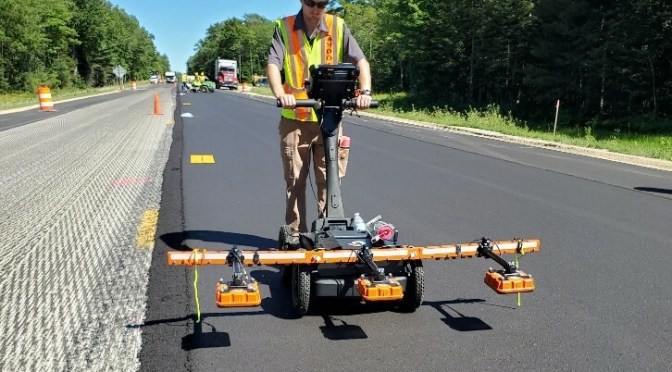
Measuring Pavement Density for Sustainable Centerline Joints
Longitudinal joints, created when lanes are paved sequentially, often need significant maintenance as the joints crack or deteriorate. While materials, construction methods and other factors may cause joint deterioration, insufficient pavement density is primarily responsible for weak joints, and measuring density has not traditionally been a widespread practice. New recommendations for joint construction and quick, nondestructive methods of measuring density during construction will support local agencies in laying longer-lasting pavement.
Continue reading Measuring Pavement Density for Sustainable Centerline Joints
Continuous Moisture Measurement During Pavement Foundation Construction
Accurate and timely moisture measurement of earthwork during compaction of foundation layers is crucial to proper construction and long-term durability of the pavement structures. Since the traditional methods for measuring moisture are point specific, expensive and/or time consuming. None of the existing methods have been able to deliver real-time, continuous moisture measurements that would aid engineers in delivering more durable pavement structures.
Continue reading Continuous Moisture Measurement During Pavement Foundation Construction
Effect of Low and Moderate Recycled Concrete Aggregate Replacement Levels on Concrete Properties
As the demand for aggregate in construction increases, recycling concrete waste as aggregate has been recognized as an environmentally sustainable solution with potential cost savings. It would allow recycling of construction and demolition waste and reduce some of the need to quarry and haul virgin aggregate. However, the use of recycled concrete aggregate (RCA) has been limited by concerns over its quality and performance, and by lack of uniform specifications as to what kind and how much of the aggregate to use in pavement construction. Studies and on-the-ground experience have shown that high levels of RCA reduce the durability of pavements. The effects of lower replacement levels have not been well documented, however.
Continue reading Effect of Low and Moderate Recycled Concrete Aggregate Replacement Levels on Concrete Properties
Comparing Additives Used in Stabilized Full-Depth Reclamation
Beltrami and Hubbard counties planned pavement rehabilitation on a shared road, presenting a unique opportunity to directly compare two stabilizers: engineered emulsion and Base One, a proprietary mix. While there were some variations in performance and cost, both met design values for pavement strength.
Continue reading Comparing Additives Used in Stabilized Full-Depth Reclamation Crossroads