
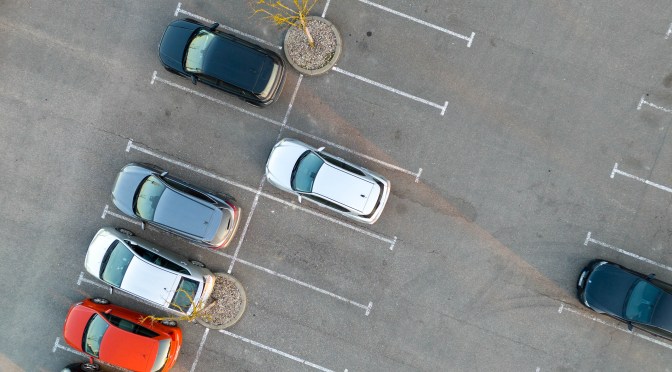
Minimum parking requirements were established in the mid-20th century to mitigate increased motor vehicle congestion but have the potential to contribute to urban sprawl, hinder development, and curb incentives for drivers to choose alternative travel modes. Eliminating or reducing these requirements can help remove excess parking supply, increase alternative modes such as transit ridership, reduce vehicle miles traveled (VMT), and enhance economic productivity. Decreasing VMTs directly mitigates emissions by reducing car travel distances and many VMT reduction strategies hold additional benefits such as increasing accessibility and reducing traffic congestion.
VMT reduction also plays a significant role in Minnesota’s efforts to reduce greenhouse gas emissions from the transportation sector. New legislation passed in 2023 requires reducing VMT up to 20% per capita by 2050. The impacts of parking space requirements or long-term benefits and challenges associated with modifying or removing these requirements have not been studied in Minnesota. This project will investigate, document, and advance the understanding of minimum parking requirements in Minnesota and the region and their impact on VMT reduction.
Researchers aim to establish recommended values based on differing types of land use and community context, e.g., urban, suburban, and rural within Minnesota. Specifically, this project will examine the long-term benefits and challenges presented by reducing and/or removing currently established parking space requirements with new or redevelopment projects, and opportunities for parking space reallocation with existing uses.
“This research aims to fill a critical knowledge gap, will modernize minimum parking requirements reduce vehicle miles traveled, and provide communities with more flexible land‑use options,” said Mark Vizecky, state aid operations engineer, State Aid for Local Transportation at MnDOT.
The Objectives:
- Perform literature reviews of historical and current practices, policy and requirements regarding parking space requirements in Minnesota and the Upper Midwest and of current best practices regarding parking space requirements and the impact parking has on land use and travel behavior.
- Interview local agencies and the League of Minnesota Cities to gain insight into current parking space practices, policies, and requirements across Minnesota.
- Conduct an online survey of business stakeholders to assess the potential economic impacts of parking policy changes regarding customer behavior, business density, operating costs, opportunity cost and sunk cost, and accessibility.
- Conduct a travel behavior and mode choice survey using a diverse group of daily commuters from Minnesota’s urban, suburban, and rural communities to understand the influence of parking policies on traveler behavior.
- Analyze survey responses using discrete choice modeling to develop utility equations for different parking requirements, which will help predict mode shifts and associated VMT reductions.
- Utilize travel demand model data from eight metropolitan planning organizations in Minnesota to assess how changes in parking requirements could impact VMT reduction.
- Analyze the sensitivity and data requirements for a parking space requirement that will be effective for local use and develop a toolkit for local municipalities to assess parking needs and the economic impacts of parking policies in local communities.
Project Details
- Start Date: 06/02/2025
- Estimated Completion Date: 04/30/2027
- Funding: Local Road Research Board (LRRB)
- Principal Investigator: Kakan Dey
- Co-Principal Investigators: Subasish Das, Ali Zockaie
- Technical Liaison: Mark Vizecky
Details of the research study work plan and timeline are subject to change.
To receive email updates about this project, visit MnDOT’s Office of Research & Innovation to subscribe.

