
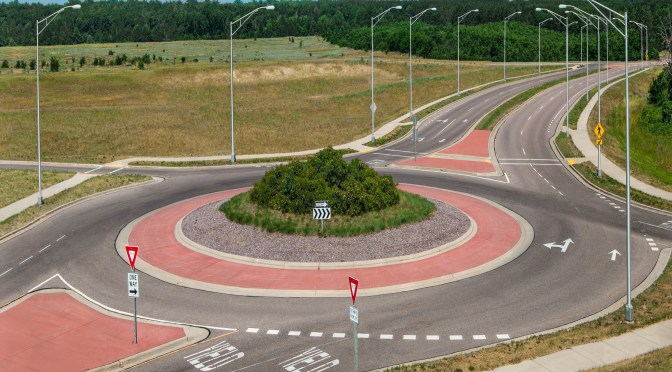
Roundabouts have been repeatedly shown to reduce fatal and serious crashes, in part by slowing vehicles as they move through intersections. Less was known, however, about how far those speed-reducing effects extend beyond the intersection itself or how they compare with other intersection types. To better understand these upstream and downstream impacts, MnDOT and local transportation agencies worked with investigators to measure vehicle speeds at roundabouts, signalized intersections and all-way stop-controlled intersections. The results showed that roundabouts provide traffic calming benefits beyond the intersection, supporting their continued use as a safe and effective design alternative.
What Was the Need?
Roundabout intersections have proven safety benefits. Previous research projects sponsored by Minnesota transportation agencies showed lower, more consistent travel speeds and significantly fewer serious injury and fatal crashes compared to traditional intersections.
Many factors, such as geometric differences in intersection design and supplementary traffic control devices, may affect driver speeds. Prior research, however, had not directly compared how speeds vary as drivers approach and exit different intersection types.
To optimize the safety benefits of roundabouts and support design decisions, MnDOT and the Local Road Research Board wanted to understand how intersection type may affect driver speeds entering and exiting intersections, including signalized and all-way stop-controlled intersections, and whether specific roundabout characteristics correlated with reduced driver speeds.
“This project illustrated clear traffic calming benefits of roundabout intersections. Drivers exiting a roundabout had slower speeds 250 to 1,000 feet away than drivers exiting other intersection types,” said Mark Wagner, Assistant State Traffic Engineer at MnDOT’s Office of Traffic Engineering.
What Did We Do?
A literature review of driver behavior and other factors that affect speed
selection at various intersection designs revealed limited research comparing speeds among roundabouts and other intersection types, including deceleration entering and acceleration exiting intersections.
Investigators collaborated with the project’s Technical Advisory Panel to select 21 intersection locations, including 11 single- or double-lane roundabouts, two all-way stop-controlled intersections and eight signalized intersections. Speed limits ranged from 45 to 65 mph, and where possible, the intersections and roundabouts had similar characteristics such as traffic volumes, median types and number of approach lanes.
To measure approach and exit speeds at each intersection type, investigators used a combination of handheld lidar speed guns and high-definition video cameras to track vehicles for several hundred to 1,000 feet on either side of the intersections and record speeds, times and vehicle data.
Over two rounds of weekday, off-peak data collection, investigators recorded data from 50 vehicles at each site, totaling more than 1,000 vehicle speed trajectories on entry and exit at the intersections. To compare speed profiles of the three intersection types, investigators analyzed the data to understand relationships among driving speeds, acceleration and deceleration rates, and intersection characteristics.
What Did We Learn?
Field studies showed reductions in driving speeds along corridor segments near roundabouts. Compared to signalized and all-way stop-controlled intersections, drivers began slowing down farther from roundabout entrances. Similarly, while drivers exited roundabouts at higher speeds than at other intersection types, vehicle speeds remained lower up to 1,000 feet downstream of roundabouts compared to the other intersection types.
Rates of speed change also varied by intersection type. Driver deceleration was more gradual approaching roundabouts, and acceleration rates were lower upon exiting roundabouts than other intersection types. At signalized intersections, deceleration rates depended on whether drivers approached during the green or red phase.
The geometric features of the 11 roundabouts observed, such as the entry radius and dimensions of central and splitter islands, were relatively uniform across locations. Due to this uniformity and the small sample size, the study did not find any notable impacts of geometric features on driving behavior.
What’s Next?
The findings illustrate the traffic calming benefits of roundabouts and reinforce the growing body of evidence favoring roundabouts as a safe and effective intersection alternative in many contexts. While additional research could explore the impacts of different geometric features on driving speeds, MnDOT and local governments will continue incorporating roundabouts into context-sensitive road designs.

