Tag Archives: Minnesota
How those little blue lights make intersections safer
A story from WCCO-TV last week answered a question that has likely been puzzling many commuters passing through Ramsey County: what are those blue lights popping up on traffic signals?
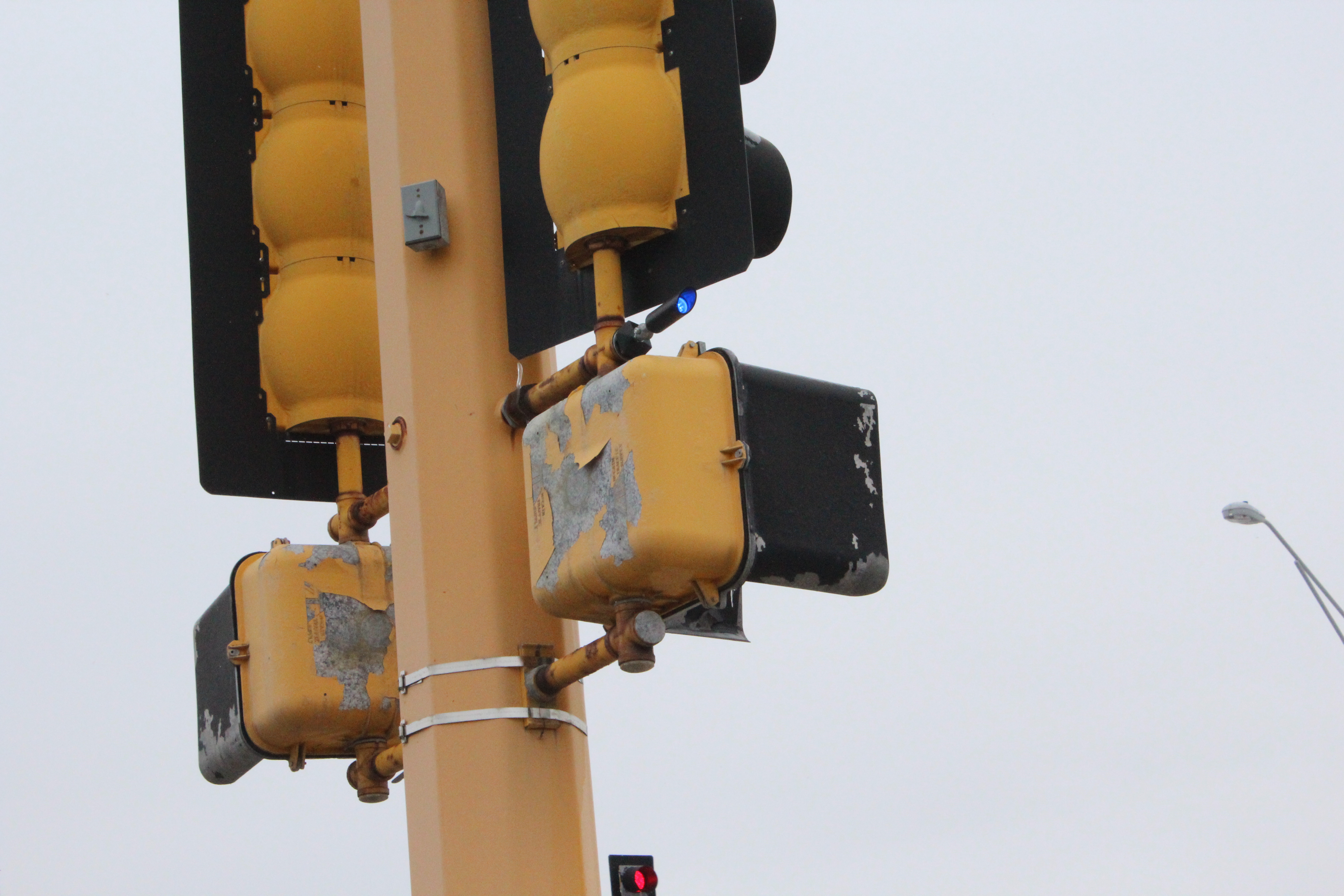
The report explains that the blue lights illuminate when a traffic signal changes to red, allowing a patrol officer to witness and enforce a signal violation more easily and safely. What the report doesn’t explain is the safety benefits to be gained from increased red light enforcement.
In Ramsey County, the proposal for a recent large deployment of blue lights came from traffic engineers, not police.
“Our county safety highway program conducted by MnDOT indicated a lot of right-angle crashes related to people running red lights,” said Ramsey County Planner Joseph Lux. “These are typically the accidents with the severest injuries.”
As part of the statewide Towards Zero Deaths (TZD) initiative in July 2013, MnDOT worked with counties to develop safety plans that emphasize low-cost, high-value safety improvements.
A federal grant is helping fund the installation of 128 blue lights at 49 intersections in Ramsey County (see locations) over the next two weeks. Deputies will begin enforcement later this month, but the hope is that the blue lights will be so effective, active enforcement won’t be necessary long-term.
A blue light, positioned on each of the four corner intersection poles, turn on whenever the opposite signal light turns red.
“The comments we’ve received from local police is they don’t want to write tickets; they just want people to quit running red lights,” Lux said.

The blue light indicators allow a police officer to view an infraction from many viewpoints, instead of having to pursue the offending vehicle through the intersection. Also only one squad is required to patrol an intersection; not two.
The blue light indicators have been shown to increase traffic safety. In Florida, crashes due to people running red lights fell by 33 percent, according to a low-cost safety improvement pooled fund study conducted on behalf of MnDOT and 37 other states.
Unlike Florida’s blue lights, Ramsey County’s are being placed on the signal pole, instead of the masthead. They’re more prominent than a couple indicators the county tried previously at accident-prone intersections in Little Canada and Maplewood.
“They’re bright and noticeable to the public, but not distracting, like the ones Florida puts on the masthead,” Lux explained.
According to WCCO-TV, the blue lights are funded by a $120,000 federal grant, with $13,000 in matching local funds.
Temporary signs will be put up by Ramsey County to notify the public of the new indicators.
A few other Minnesota communities — including Blaine, Crystal, Olmsted County and Dakota County — have also installed blue light indicators in recent years.
Lux explained that Ramsey County is installing blue lights on intersections that are easily enforced by law enforcement, as well as those that aren’t, in hopes that the public will obey them all because of the heightened presence.
Watch MnDOT Snowfighters train at Camp Ripley
Mobile imagery, LiDAR help MnDOT maintain its assets
How do you quickly and cost-effectively get an accurate inventory of transportation assets spread out along more than 1,100 miles of roadway?
That was the problem facing the Minnesota Department of Transportation’s Metro District, which needed an inventory of its plate beam guardrail and concrete barriers.
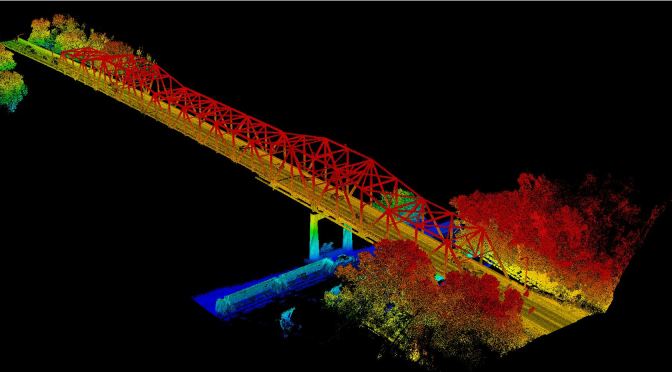
To accomplish this, engineers in the district launched an innovative research implementation project using a pair of mobile mapping technologies — Light Detection and Ranging (LiDAR) and mobile imaging — that can collect vast amounts of geospatial data on highway infrastructure in a safe and efficient manner.
Mobile imaging uses a camera mounted on a vehicle driving at highway speeds to take high-resolution photos at regular intervals. It’s accurate to within 1 foot, which makes it suitable for use in preliminary (30 percent) design plans without additional field surveys. In this project, researchers collected mobile images of roadway barriers and extracted data from them along Metro District roadways, including all ramps, overpasses, interchanges, weigh stations, rest areas and historical sites.

Researchers also collected LiDAR data at three Metro District sites. LiDAR uses a laser range finder and reflected laser light to measure distances. It provides survey-grade data accurate to within 0.1 foot, but it is significantly more expensive to collect than mobile imaging.
“Mobile imagery and mobile LiDAR are relatively new technologies, but this research shows that they are options that we can use. Collecting this information manually would have taken a lot more time and money,” said MnDOT Asset Management Engineer Trisha Stefanski.
MnDOT’s barrier inventory will provide invaluable information for design, planning and maintenance. The data will be published on MnDOT’s Georilla map server, where it will be beneficial to a variety of projects and recurring tasks. For example, if a vehicle hits a barrier, maintenance staff will be able to check the database to see the type of barrier and end treatment to ensure they bring the right equipment to make repairs. Although the project focused on barriers, the imagery contains data on other assets as well. MnDOT has already used the imagery to extract noise wall and sign data.
- Minnesota Department of Transportation Metro Barrier Extraction and LiDAR Project – Final Report #2014-22 (PDF, 1 MB, 13 pages)
- Using Mobile Mapping to Inventory Barriers – Technical Summary #2014-22TS (PDF, 1 MB, 2 pages)
This blog post was adapted from an article in our upcoming issue of Accelerator, MnDOT’s research and innovation newsletter.

‘High Bridge’ study yields insights on bridge deck maintenance
One of St. Paul’s most iconic landmarks is helping the Minnesota Department of Transportation find the most cost-effective methods of maintaining concrete bridge decks.
For the last three years, the Smith Avenue High Bridge, which connects downtown St. Paul with the city’s west side, has served as a test bed for a variety of products used to seal cracks on bridge decks. Through MnDOT-funded research, various sealant products have been applied on different areas of the bridge deck, with their performance tracked over time.
“This project will help MnDOT make cost-effective maintenance decisions to preserve its current bridge infrastructure,” said Sarah Sondag, a senior engineer with MnDOT Bridge Operations Support.
The bridge was chosen in part because of its large deck area, which allowed for the application of 12 sealant products and three control sections.
Sealing deck cracks is a routine preventive maintenance task for bridge crews. Left untreated, cracks can allow moisture and chlorides to penetrate the bridge deck, which can lead to the corrosion of reinforcing steel, deck deterioration and the need for early deck replacement.

MnDOT maintains a list of approved bridge deck crack sealing products, but until now had little data on how well each one performs in the field. The recently published report also examined several products that are not currently on the Approved Products List.
Among the study’s findings: some of the products on MnDOT’s Approved Products List did not perform as well as other products that are not currently on the list. MnDOT is using the results of the study to update its qualification process for products to get on the approved list. Insights gained from studying application techniques will also be used to update MnDOT’s bridge maintenance manual.
*Note: This blog post was adapted from an article and technical summary that will be featured in the upcoming issue of the Accelerator newsletter.
More:
- Concrete Bridge Deck Crack Sealant Evaluation and Implementation – Final Report (PDF, 40 MB, 164 pages)
- Developing a Preventive Maintenance Strategy for Bridge Deck Cracking – Technical Summary (PDF, 1 MB, 2 pages)
RailVolution showcases Minnesota transit successes
Before a national audience of 1,400 urban planners and transit enthusiasts, Hennepin County Commissioner Peter McLaughlin and others told the story of how the Twin Cities metropolitan area was transformed into a community that embraces “livability” and mass transit, including light rail.
“The growth was horizontal and there were lots of people who were saying it wouldn’t work in Minnesota,” said McLaughlin, during the opening plenary of the RailVolution conference in Minneapolis.
But the metro region bucked years of infighting and helped pass a transportation bill in 2008 that allows counties to tax for the expansion of transit in the metro area. Anoka, Ramsey, Hennepin, Dakota and Washington Counties decided to pool their resources from the quarter-cent transit sales tax, which is why the Southwest Light Rail Line is able to move forward.
“They had to believe their day would come,” McLaughlin said of the counties.

This was the first time the annual conference has been held in the Twin Cities, allowing Minnesota leaders to share their success stories.
Minnesota Department of Transportation Commissioner Charlie Zelle, who biked the Greenway trail to get to the conference, spoke of MnDOT’s commitment to multi-modal transportation and maximizing the health of Minnesota’s people and economy.
“MnDOT is more than a highway department,” he said. “We have a statewide bike plan and we will probably be the second state in the union to have a statewide pedestrian plan.”
Michael Langley of Greater MSP said a mix of transportation types is critical to attracting talented workers to the Twin Cities, especially millennials.
“Nearly every area of the world is facing a future workplace shortage,” he said. “It’s fueling a competition for talent like we’ve never seen.”
Federal Highway Administration Secretary Anthony Foxx on Tuesday addressed conference attendees about the need for a bipartisan compromise on funding. He proposed moving away from the Highway Trust Fund to a more inclusive transportation account (named the Surface Transportation Trust Fund) that also addresses rail needs, with $19 billion in proposed dedicated funding. He also discussed the recent announcement of $3.6 billion in resiliency funds for transit systems.
During his comments, he wore a red bicycle pin that the MnDOT commissioner frequently wears at multi-modal events.
During the five-day conference, attendees toured the recently completed Green Line and attended dozens of workshops on topics ranging from street walkability to bus-rapid transit to the use of mobile phones to enhance bus service. On Sunday, the Northstar commuter train traveled for the first time to St. Paul’s Union Depot and conference attendees took it back to Minneapolis.
Partnership planned for nation’s top pavement testing facilities
The nation’s two largest pavement testing centers are planning to partner in order to better leverage research performed at their cold and hot-weather facilities.
MnROAD, located in Albertville, Minnesota, and its southern U.S. equivalent, the National Center for Asphalt Technology in Auburn, Alabama, are full-scale test tracks that evaluate different types of pavement material under real-life conditions using semi-trailer truck and live interstate traffic.
Each facility has a history of evaluating the performance of pavement preservation treatments, including chip sealing, micro-surfacing, crack sealing and thin overlays. To address needs in both northern and southern climates, similar test sections would be developed at each facility to address national issues.
“By working together we can maximize the potential for each track,” said MnROAD Operations Engineer Ben Worel. “A closer relationship between NCAT and MnROAD is a logical progression in developing and evaluating new sustainable technologies, pavement systems and construction methods that lead to safer, quieter, lower-cost and longer-lasting roads.”

The partnership idea was introduced to federal officials earlier this month at a national pavement performance conference in Minneapolis. Final details must still be worked out.
One of the workshops at the event discussed the proposed partnership between MnROAD and NCAT. Further talks are expected at the end of October.
“NCAT is thrilled about the opportunity for a partnership with MnROAD to address pavement research needs at a national level,” said NCAT Director Randy West. “Bringing NCAT and MnROAD results together will expand the climate base, loading distribution and other important pavement factors.”
Pavement conference
Pavement engineers from around the nation gathered Sept. 2 to 5 for the Midwestern Pavement Preservation Partnership forum and the SHRP2 R26 Workshop for the Preservation of High-Traffic-Volume Roadways, which featured tours of MnROAD, Minnesota’s cold weather pavement testing facility.
Conference participants also reviewed the latest preservation techniques being developed for high volume roads. MnROAD’s chip sealing study, which demonstrated that highways with an average daily traffic (ADT) of 58,000 can be successfully chip sealed, was especially attention-grabbing for agencies who don’t chip seal on roads with more than 2,000 ADT.
A national panel of speakers included Michael Trentacoste, director of the federal Turner-Fairbank Highway Research Center (pictured in top photo), who discussed Federal Highway Administration’s support of pavement preservation research and implementation.
With about 160 people in attendance over four days, MnDOT Materials Engineer Jerry Geib said the conference was successful in sharing the benefits of pavement preservation techniques with other state DOTs and federal highway officials who want adopt new practices to help alleviate budget constraints.
Drinking water solutions may help construction site runoff
The same chemicals used to treat drinking water might now be able to treat stormwater runoff to reduce the amount of pollutants entering Minnesota lakes and rivers from road construction sites.
A research project headed by Mankato State University and funded by the Minnesota Department of Transportation has identified three chemical flocculants that are effective at removing a broad range of Minnesota soils from water.
“Water is leaving construction sites carrying too much sediment,” said Minnesota State University-Mankato Environmental Engineering Professor Steve Druschel. “Chemical treatment has been used to treat drinking water for 70 to 80 years, and our thought was to try it in construction as well.”

Recent MnDOT research has investigated monitoring the amount of sediment in stormwater runoff and using temporary ponds to let sediment settle out of stormwater before it runs off the construction site. MnDOT also wanted to examine the possibility of treating construction runoff with flocculants, which are chemicals that cause suspended sediment to form clumps that quickly settle out of the solution.
Researchers tested 21 chemicals to see how well they could remove 57 types of soil from water. While no chemical was effective for the entire range of Minnesota’s soils, three chemicals were broadly effective on a range of samples.
The research will contribute to improved treatment of stormwater runoff from construction sites and reduce the amount of sediment pollution entering the state’s rivers and lakes.
Although flocculants have been used to treat drinking water for seven decades, there has been only limited testing of their use in treating construction runoff. Research was needed to evaluate the effectiveness of this approach.

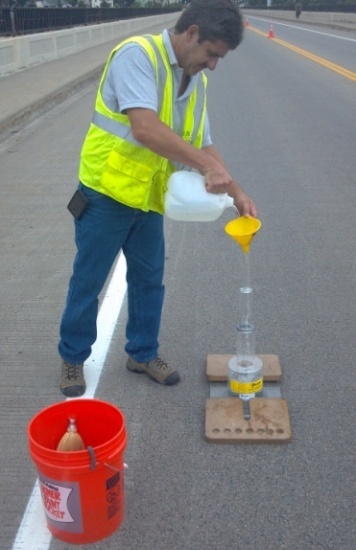
chemical and mounting it above the water (as shown here), although thorough mixing must be ensured. MnDOT hopes to develop a system that will automatically dispense a precise dose based on the amount of sediment in the water.
Since it is not feasible for workers to constantly monitor sediment concentration in stormwater runoff, MnDOT hopes to leverage the knowledge gained from this project to develop an automated system that measures the amount of sediment in runoff and automatically adds the appropriate dose of flocculant to treat the water.
“We’re trying to develop a portable water treatment plant that can be applied to construction projects to deliver clean runoff water after a storm,” said MnDOT Environmental Specialist Dwayne Stenlund.
Any chemicals recommended for field usage will need to be approved by the Minnesota Pollution Control Agency, and methods for disposing of used chemicals will need to be identified as the environmental impacts of residual chemicals are unknown.
*Editor’s note: This article was adapted from the September-October 2014 issue of our Accelerator newsletter. Read it online or sign up for your free subscription.
Related Resources
- Flocculation Treatment BMPs for Construction Water Discharges – Technical Summary, 1 MB (PDF); Final Report, 29 MB (PDF)
Parking availability system takes aim at truck driver fatigue
MnDOT, in partnership with the Federal Highway Administration, is test-deploying a high-tech system to help combat drowsy driving and keep truck drivers in compliance with federal hours-of-service regulations.
Developed by researchers at the University of Minnesota, the prototype system lets drivers know when parking spaces are available at rest stops ahead. It has been deployed at several locations along the heavily traveled I-94 corridor between Minneapolis and St. Cloud.
From today’s MnDOT news release:
ST. PAUL, Minn. – New technology along the I-94 corridor west and northwest of the Twin Cities is helping truckers find safe places to park. Three Minnesota Department of Transportation rest areas are now equipped with automated truck stop management systems that tell truck drivers when parking spaces are available.
The technology will improve safety, lead to better trip and operations management by drivers and carriers and help MnDOT and private truck stop owners manage their facilities more effectively, according to John Tompkins, MnDOT project manager.
“So far, the results have been positive. We’ve had 95 percent accuracy in determining the availability of spaces,” he said.
Federal hours of service rules require truck drivers to stop and rest after 11 hours of driving. Tompkins said if drivers continue to drive beyond 11 hours, they could become fatigued and be forced to park in unsafe locations such as freeway ramps. They could also face legal penalties.
The problem of truck driver fatigue recently took the national spotlight when an allegedly drowsy driver slammed his semitrailer into a limousine carrying actor-comedian Tracy Morgan and six others. One passenger died in the crash.
The parking availability project is led by MnDOT Freight Project Manager John Tompkins and University of Minnesota professor Nikolaos Papanikolopoulos. MnDOT Research Services & Library produced the video above, which demonstrates the system in action. You can learn more about the project on the Center for Transportation Studies website.
What it’s like to drive a 40-ton truck in circles for science (video)
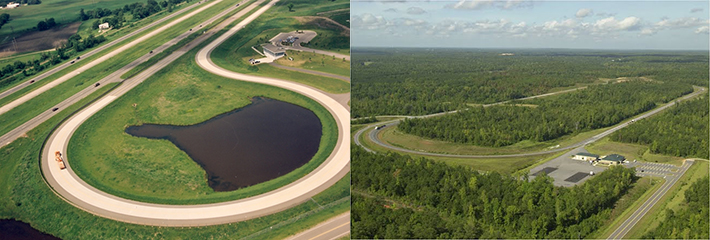
The only way to test pavements is to destroy them — slowly and painstakingly, one moving vehicle at a time. At MnROAD, the state’s world-renowned pavement research facility, the bulk of this monotonous-but-necessary work is performed by live traffic passing through Albertville on I-94. But on the facility’s 2.5-mile low volume road test track, which simulates rural road conditions, more controlled methods are preferred.
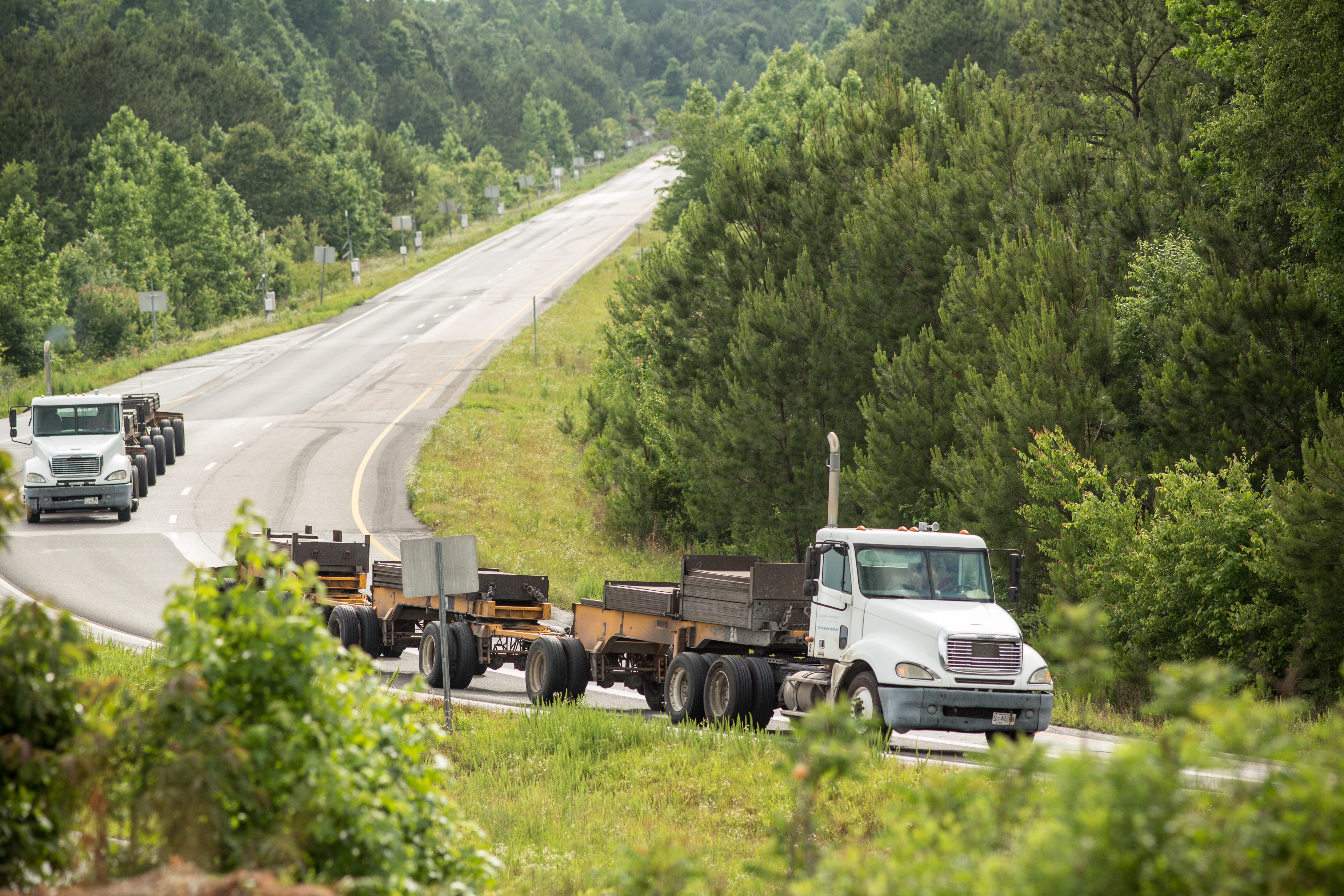
Doug Lindenfelser is one of several MnROAD employees who take turns driving an 80,000-pound semi tractor trailer in laps around the closed-loop low-volume track. The truck is loaded to the maximum allowable weight limit on Minnesota roadways. As it passes over the facility’s 23 distinct low-volume test cells, an array of sensors capture data on the pavement’s performance, which researchers then use to design stronger, longer-lasting roads. The truck only drives on the inside lane; that way, the outside lane can be used as an “environmental lane” to compare damage caused by loading vs. damage caused by environmental factors.
He has other duties as well, but on a given day, Doug might drive the truck 60 or 70 times around the low-volume road test track. It might not sound very exciting, but as Doug explains, some days his job can be quite interesting. We interviewed him on camera during a recent visit to MnROAD. The resulting video is available above and on our YouTube channel.
For those who might be wondering, all this diligent destruction of pavement has paid off. It is estimated that MnROAD’s first phase of research (from 1994-2006) has resulted in cost savings of $33 million each year in Minnesota and $749 million nationally. Cost savings from its second phase (2007-2015) are being calculated, and the facility is scheduled to enter its third phase in 2016.
Learn More:
- MnROAD Brochure (PDF)
- MnROAD Two-Page Summary (PDF)