This webinar may not be related to MnDOT research, but we thought you might find it interesting if you drink coffee.
Join CTS and Patrick Hessini, CTS Executive Committee member and head of supply chain at Cameron’s Coffee, for an in-depth look at the challenges and logistics of today’s supply chain. Grab a cup of coffee and bring your lunch as we learn about where and how we get our coffee from trees to mugs.
Registration
This webinar is free, but registration is required. Once you have registered, you will receive an email confirmation with a Zoom link. The link should not be shared with others; it is unique to you.
Freight transportation is evolving rapidly, and its future success will require managing increased residential demand, planning for equity, and incorporating micro-delivery options such as cargo e-bikes. At the 2024 CTS Transportation Research Conference, three experts shared their knowledge of these trending topics in a session focused on the future of urban freight.
In response to the increasing demand for residential package delivery spurred by the shift towards online shopping, U of M Department of Industrial and Systems Engineering PhD student Can Yin shared her research on mobile parcel locker scheduling. Yin explained that in the growing ecommerce market, last-mile delivery is the most expensive and time consuming. While door delivery is commonly used, it can be unsecure and inconvenient for customers.
“Parcel lockers are an alternative, but they come with the disadvantages of limited locations, expensive fixed cost, and the inability to adapt to varying demand,” Yin said.
A newer, more flexible alternative is the use of mobile, vehicle-based parcel lockers, which offer greater flexibility, higher accessibility, and lower fixed costs—particularly if autonomous vehicles eliminate the need for driver salaries. However, mobile parcel lockers also create challenges for e-commerce businesses such as estimating demand and customer choices.
To address these challenges, Yin’s research team developed a mobile parcel locker demand-estimation model. Additionally, the researchers found that compared with stationary lockers, mobile lockers offer a better value and demand fulfillment.
Another challenge surrounding the rapid growth of e-commerce and urban freight is racial equity in urban freight planning. In his presentation, University of Washington Urban Freight Lab researcher Travis Fried explained how his research is seeking to better understand these inequities and create a framework for mitigating them.
The past and present systems that perpetuate the segregation of people and neighborhoods have been well documented. However, Fried said there is little research exploring how these patterns play out in freight planning and their impacts on air quality, health, and road safety for people of color. Fried’s research looked at high-volume traffic exposure and found that low-income populations of color were disproportionately exposed to e-commerce traffic.
“By our most conservative estimate, BIPOC [Black, Indigenous, and people of color] populations were exposed to 35 percent more traffic related to last-mile home delivery on average, despite ordering less than half as many packages as white populations,” Fried said. That’s because delivery facilities and highways are disproportionately located near historically marginalized neighborhoods, he explained.
In light of this finding, Fried emphasized the importance of including equity considerations when prioritizing urban freight strategies. “Solutions focused on the upper end of the distribution chain have outsized benefits for marginalized communities, so we need to consider that in our cost-benefit evaluations and engagement strategies,” he added.
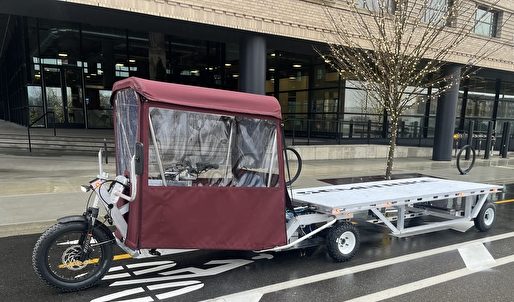
Using cargo e-bikes for last-mile freight delivery was the topic of the session’s final presentation from Marc Liu of Civilized Cycles. Liu explained how his company’s innovative semi-trike—which has as much cargo capacity as a small delivery van—can be used to move a significant amount of cargo over short distances, particularly within campus environments such as universities, hospitals, residential developments, and military bases.
Semi e-trike from Civilized Cycles
“Regardless of what these campuses are moving, they have the same core challenge of moving as much cargo as possible while keeping operating costs as low as possible,” Liu said. “On top of that, emissions and safety are key concerns because most of this happens in pedestrian-heavy areas.”
Liu explained that the first customers for the cargo e-bikes are micro-mobility fleet operators at the forefront of sustainable transportation including Lime, Net Zero Logistics, and Amazon. Moving forward, the company is targeting campus environments for expansion. Liu said that “economics drives adoption” and believes the key to adoption is offering an affordable, American-made product that reduces vehicle fleet costs, increases safety, improves efficiency, and reduces greenhouse gas emissions.
Article originally published in Catalyst, February 6, 2023.
Supply chains aren’t normally at the top of the news, but pandemic-related disruptions and empty shelves have put them there. What does the future hold for freight and supply chain resilience? Speakers at the 25th Annual Freight and Logistics Symposium reviewed recent challenges and discussed how to make supply chains more cooperative, connected, and resilient.
Detours around bridges in a critical freight transportation route create costs to the trucking industry, taxpayers and state economy. New load rating factors for the slab-span bridges across Shingle Creek will give MnDOT more flexibility in managing truck traffic and keeping freight moving efficiently.
Diversity, equity, and inclusion (DEI) are becoming increasingly important factors in the modern workforce. Integrating DEI is not only a strong moral move that can set an organization apart from its peers but also a way to promote innovation, attract talent, and retain valuable employees in a tight labor market.
While electric cars and buses are becoming more common, medium and heavy duty electric trucks are still in their infancy, and the nationwide infrastructure needs to support them still has to be determined.
In a new study, MnDOT will identify the electric charging infrastructure needed along Minnesota highway corridors to support clean freight transportation.
This article was originally published in Catalyst, February 2021.
Among the attendees at the Center for Transportation Studies Freight and Logistics Symposium in December, 44 percent expected to add staff to their organization in 2021, according to a live poll conducted by keynote speaker Joe Mahon. Another 39 percent of respondents expected staffing to remain steady.
How does the ability to move freight affect the economic health of a state, region, and even a city? How are the supply chains of businesses impacted by freight flow? And what challenges and opportunities does Minnesota face when it comes to leveraging and strengthening its freight modes?
The 2016 Freight and Logistics Symposium offered a thoughtful examination of those questions and explored other topics related to improved mobility in Minnesota, including congestion, regulation, labor shortages, and the value of all freight modes to the state’s economy.
The event, held December 2, 2016, in Minneapolis, included:
A presentation on the power of freight flow data in attracting industry to a location and ways to use data in making a compelling case for businesses to invest
A panel Q&A featuring four industry experts from diverse organizations that depend on reliable freight movement
A discussion of how the 2016 election results may affect freight transportation
The symposium was sponsored by CTS in cooperation with MnDOT, the Minnesota Freight Advisory Committee, the Council of Supply Chain Management Professionals, the Metropolitan Council, and the Transportation Club of Minneapolis and St. Paul.
Today, moving freight accounts for more than a third of the world’s transport energy—and that share is growing. The rise in global trade, online retailing, and business-to-business delivery is not only changing how goods are moved but also the type of goods moved and how far or frequently they are transported.
Currently, this massive movement of goods throughout the economy relies on an intricate—and largely decentralized—multimodal network of truck, rail, ship, and airplane delivery. However, change is on the horizon. In a study sponsored by MnDOT and the Minnesota Local Road Research Board, U of M experts outline the important impacts these changes will have on the road network and transportation infrastructure.
“There is hope that new methods of organization and proposed standardization will increase efficiency of freight movement and give rise to a new era of goods transport,” says Adam Boies, an assistant professor in the Department of Civil, Environmental, and Geo- Engineering (CEGE). “In the years to come, we expect that advances in logistics systems will be enabled by new technologies, approaches, and the desire for increased efficiency.”
Changes in the way logistics operations are organized will help drive advances. New information technology permits the sharing of data between and across businesses, which in turn drives efficiency and leads to fuller vehicles. “This may reduce the distance traveled by heavy goods vehicles per unit of GDP, which may in turn reduce costs and entice more demand for delivered goods,” says CEGE professor David Levinson, the study’s principal investigator. “Ultimately, this could mean fewer trips by individual consumers and more deliveries. We anticipate the result will be a net reduction in distance traveled.”
The study also examined some of the potential drivers for changes in the freight industry as a result of logistics reorganization. These include supply chain pooling, in which individual logistics operations are shared between collaborators, and the Physical Internet Initiative, which seeks to create standards for packaging to enable the homogenization of freight technology. “While both of these advancements have the potential to increase logistics efficiency by reducing the transportation of empty loads, they will also increase truck weights—which may increase pavement damage,” Boies says.
Other transportation and logistics changes will result from shifts in the ways businesses and consumers receive goods and services, including business-to-business systems and technologies that enable a sharing economy, same-day delivery services, 3-D printing, and “last mile” delivery services. In addition, a growing portion of purchases can be delivered directly over the Internet. “Delivery is easily automated for data-based goods like books, music, video, and software,” Levinson says. “Purchases that could once only be completed by moving things can now be done by moving data.”
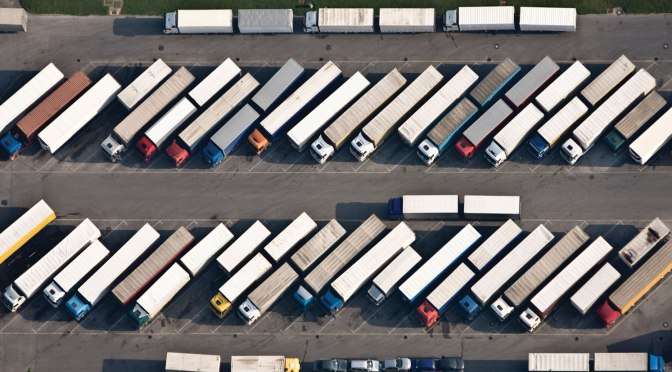
With freight traffic increasing on U.S. roadways, commercial truck drivers often struggle to find safe and legal places to park. If parking spaces are not available at a nearby rest area or truck stop, drivers may be forced to pull over in unsafe locations or continue driving and become dangerously fatigued. Drivers may also risk violating federal hours-of-service rules, which require them to rest after 11 hours of driving.
In response to this issue, a team from MnDOT, the University of Minnesota, and the American Transportation Research Institute is developing a system that can identify available truck parking spaces and communicate the information to drivers—helping them determine when and where to stop. System benefits include improved safety, reduced driver fatigue, and better trip management.
The system uses a network of digital cameras suspended above a parking area to monitor space availability. Image processing software developed by researchers at the U of M’s computer science and engineering department analyzes the video frames and determines the number of available spaces.
As part of a demonstration project funded by MnDOT and the Federal Highway Administration, the project team is installing the system at three MnDOT rest areas and one private truck stop on I-94 west and northwest of the Twin Cities.
The U of M research team first installed the system in late 2012 at the the Elm Creek Rest Area, two miles north of Interstate 494 on I-94. As of early 2014, the system has been installed at an additional rest area, and a third site is in progress.
Next steps for the project include implementing several mechanisms that will communicate parking information to truck drivers. First, the team plans to install variable message signs along I-94 this spring. Also in the works are an in-cab messaging system and a website.
Overall results of the demonstration project will help the team determine whether this technology holds promise for use in other corridors throughout the nation.
Read the full article in the February issue of Catalyst.





 Crossroads