
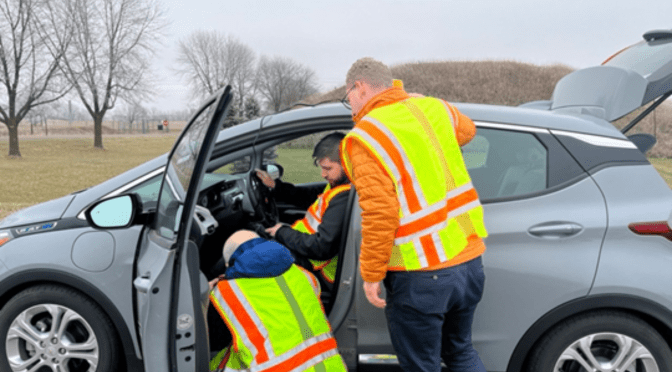
Many modern vehicles continuously track location and performance data such as speed and acceleration. Collecting large amounts of this data to use in machine learning models has many potential applications, including aggregating and evaluating road pavement conditions. This project investigated the feasibility of using large amounts of onboard data from electric vehicles to monitor and assess pavement conditions comprehensively and cost-effectively across a large network.
Continue reading Using Onboard Vehicle Data to Assess Pavement QualityTag Archives: electric vehicles

The winding road to an electric fleet
Reprinted from CTS News, November 24, 2025
Even for cities, counties, and organizations with zero-carbon emissions goals, most fleet managers are skeptical about going fully electric. Calculating the return on investment for a single vehicle is straightforward—but for a fleet, it’s complex.
Continue reading The winding road to an electric fleet
New Project: Transitioning to EV Fleets: Best Practices and a Decision Tool
Minnesota agencies are evaluating how to meet the U.S. electric vehicle (EV) target of at least 50% by 2030. Numerous technical, social and coordination considerations are inherent in a transition to electric fleets.
Continue reading New Project: Transitioning to EV Fleets: Best Practices and a Decision Tool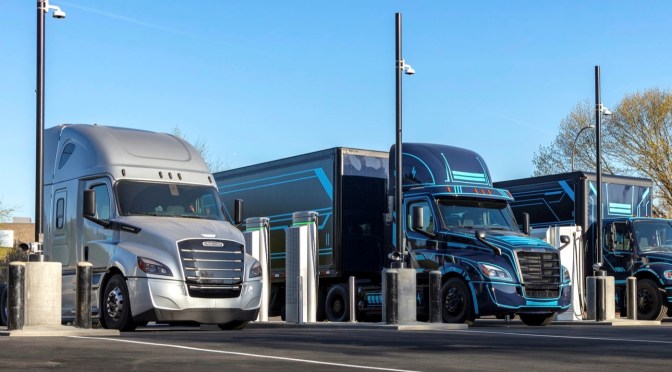
Researchers identify Minnesota’s best charging locations for e-trucks, aiming to boost adoption
By Megan Tsai, reprinted from CTS News, February 8, 2024
Aiming to eliminate barriers to electric truck adoption in Minnesota, U researchers have identified the state’s most suitable e-truck charging locations.
Currently, the adoption of electric medium- and heavy-duty trucks is lagging compared with the rising popularity of personal and transit electric vehicles. There are several reasons behind the delay, but one key factor is the lack of an adequate charging station network for e-trucks. The Minnesota Department of Transportation (MnDOT) called on U of M researchers for insight and guidance.
“Our goal was to understand the needs and opportunities for e-truck charging stations and to optimize the location of charging stations in Minnesota, ” says Alireza Khani, associate professor with the Department of Civil, Environmental and Geo-Engineering and the project’s principal investigator.
The project was conducted in two stages. In the first stage, researchers identified the most important criteria to consider when planning e-truck charging stations; this was done with a survey of experts and stakeholders, including staff from MnDOT, the Freight Mobility Research Institute, and the American Trucking Associations.
Based on this survey, researchers ranked the relative importance of the criteria and assigned each a weighted value. The top three criteria were ease of access for e-truck drivers, proximity to power substations, and proximity to existing truck stops. Other criteria included environmental conditions (land cover, water resources, and flood risk), land prices, and the potential to generate onsite solar energy.
During the second stage, researchers developed geographic information system layers for each criterion and pared down candidate locations using optimization modeling. The model was designed to consider truck demand in Minnesota, the routing and charging activities of e-trucks, and the market penetration rate of e-trucks, with a goal of minimizing total travel costs to promote greater adoption of e-trucks.

“This optimization model is a novel decision-making tool that will help MnDOT maximize its return on investment in the charging station network,” Khani says. “The model can be expanded to incorporate other contributing factors and inform policy decisions.”
To gain additional insight into Minnesota e-truck adoption, researchers tested the model with several assumptions based on the reduced per-mile operating costs of e-trucks over diesel trucks. They found that the adoption of e-trucks would grow sharply as the charging station network is developed; the growth rate would be highest when the first 30 to 40 stations are added. The modeling also found that solar generation was not a viable option to fully power truck charging stations.
MnDOT is focused on meeting the state’s greenhouse gas reduction goals, and increasing the adoption of e-trucks would help MnDOT proactively address this significant subsector of transportation greenhouse gas emissions.
“This project helped us understand considerations for e-truck charging stations, such as electric power substation location and capacity,” says Andrew Andrusko, freight planning director with MnDOT’s Office of Freight and Commercial Vehicle Operations. “It also identified optimal locations for truck charging stations to support intrastate freight movement.”
Future of Mobility: Decarbonized transportation
April 26, 2023
The Future of Mobility series collects the perspectives of top U researchers and other national experts. In 17 articles, the authors scan the horizon and reflect on critical transportation topics. Each article recommends action steps for public officials and policymakers.
Continue reading Future of Mobility: Decarbonized transportation
EV System Impacts
Model helps analyze EV system impacts, evaluate policies for subsidies and charging
Electric vehicles (EVs) are expected to capture a substantial portion of the future vehicle market. In the short term, however, technology and infrastructure limitations—such as driving range and charging availability—will prevent transition on a large scale. Because EVs will share the road network with gasoline vehicles (GVs), says Alireza Khani, “it’s crucial to understand how EVs and GVs will coexist.”
Continue reading EV System Impacts
Researcher Charts Path for Greater use of Electric Freight Vehicles in Minnesota
This article was originally published in Catalyst, May 2022.
In Minnesota, trucking produces about 13 percent of the total pollutants in the state. Moreover, a 2019 EPA report identified the transportation sector as the source of the highest share of greenhouse gas emissions in the United States, a problem compounded by the fact that this pollution is more concentrated in urban areas.
Continue reading Researcher Charts Path for Greater use of Electric Freight Vehicles in Minnesota
New Project: Identifying and Optimizing Electric Vehicle Corridor Charging Infrastructure for Medium- and Heavy-Duty Trucks
Transportation is the number one emitter of greenhouse gas emissions in Minnesota and medium to heavy duty trucks contribute to about 40% of transportation carbon pollution.
While electric cars and buses are becoming more common, medium and heavy duty electric trucks are still in their infancy, and the nationwide infrastructure needs to support them still has to be determined.
In a new study, MnDOT will identify the electric charging infrastructure needed along Minnesota highway corridors to support clean freight transportation.
Continue reading New Project: Identifying and Optimizing Electric Vehicle Corridor Charging Infrastructure for Medium- and Heavy-Duty Trucks
Evaluating the Use of Hybrid Vehicles in Municipal Fleets
The availability of hybrid electric utility vehicles expands the field of choices for a fleet manager looking to replace or expand fleets. In order to justify new vehicle purchases, fleet managers of local agencies need to determine how choices impact budgets and operations.
Continue reading Evaluating the Use of Hybrid Vehicles in Municipal Fleets
Alternative fuels will help shape Minnesota’s transportation future
The mix of fuels used to power the vehicles on our nation’s roadways is diversifying rapidly. While gasoline and diesel are still dominant, an increasing percentage of vehicle power is coming from alternatives such as biofuel, natural gas, and electricity. What could this shift mean for Minnesota’s transportation future? MnDOT and the Minnesota Local Road Research Board turned to U of M experts for analysis.
“The rise of alternative fuels is something we need to keep a close eye on, because it presents a number of issues that may significantly alter our state’s transportation system,” says Adam Boies, an assistant professor in the U of M’s Department of Civil, Environmental, and Geo- Engineering (CEGE).
Minnesota leads the nation in biofuel use, in part due to a series of legislative acts designed to encourage ethanol production and consumption. Boies predicts, however, that biofuel consumption in the state is near saturation and that future shifts will likely be between biofuels. “These shifts may alter the routes of heavy-goods vehicles in the state as refineries shift from corn and soy to fuels derived from agriculture wastes and forest byproducts,” he says.
If the price of natural gas remains significantly lower than diesel fuel, natural gas vehicles will likely make up an increasing share of the heavy-duty vehicle fleet in Minnesota. A larger natural gas refueling infrastructure will need to be developed, most likely by private organizations that manage fleets of vehicles. “As this happens,” Boies says, “efforts must ensure that natural gas vehicles and refueling infrastructure do not emit significant quantities of methane, which has a high global warming potential.”
Minnesota electric vehicle sales have lagged behind the nation—winter temperatures are one factor—but Boies expects the numbers to rise. He estimates 16 percent of new cars sold in Minnesota in 2035, and 56 percent in 2050, will be electrified. The growing numbers will require a more robust charging infrastructure, likely supplied or subsidized by government agencies, he says.
In the long term, on-road charging systems are being investigated. In these systems, under study in several countries, charging coils embedded within the roadway transfer power wirelessly to vehicles. “The systems could make electric vehicles drastically more efficient by reducing vehicle battery size,” he says.
Better vehicle efficiency is likely to continue the trend of falling fuel tax revenues. “Minnesota will need a method for producing revenues from electric vehicles to maintain long-term funding for the transportation road network,” he says. “Currently the higher price of electric vehicles results in increased revenues during vehicle registration, which tends to offset the difference in fuel tax revenues. However, as the price differential between electric vehicles and traditional vehicles shrinks, there will be decreased funding for Minnesota roadways unless additional revenue sources are found.”
Finally, emphasis on fuel efficiency in the light-duty and heavy-duty vehicle fleets will drive the weight of these vehicle segments in opposite directions. “Light-duty vehicles will get lighter and heavy-duty vehicle fleet operators will lobby for increased weight limits on Minnesota roadways to reduce the energy intensity of goods deliveries,” Boies says. “This growing disparity in weight between the two vehicle classes may require increased safety measures to reduce the severity of crashes between vehicle classes.”
“The question of how alternative fuels and electric vehicles will impact the transportation system, ownership models, and operating costs, as well as vehicle and driver safety, are extremely important topics to study,” says Ken Buckeye, MnDOT program manager. “The potential for these trends to impact our revenue streams is also very significant. When you couple those trends with the federal mandate for a CAFÉ standard of 56 mpg by 2025, we are likely to see some profound impacts that reach across modes, jurisdictions, and funding mechanisms.”
Boies’s research is part of a multi-pronged study funded by MnDOT and the LRRB that analyzed the technological shifts altering surface transportation and the implications for Minnesota. Other contributors included CEGE professor and principal investigator David Levinson and associate professors Jason Cao and Yingling Fan of the Humphrey School of Public Affairs. Their high-level white papers are compiled in a final report: The Transportation Futures Project: Planning for Technology Change.
 Crossroads