New Project: Enhancing Managed Lane Equity Analysis

Managed lanes, like Minnesota’s E-ZPass express lanes, are designed to improve mobility and travel time reliability for transit users, carpoolers and other motorists during peak travel hours. The lanes provide many societal benefits such as increased transit ridership, higher vehicle occupancies, more reliable travel options, and reduced traffic congestion and pollution.

However, because the lanes use pricing to deliver these benefits, they must be designed, constructed and operated equitably. The key is striking a balance that’s fair for everyone.

Continue reading New Project: Enhancing Managed Lane Equity Analysis

New Project: Improving Transportation Equity for All by Centering the Needs of Marginalized and Underserved Communities

Government policies often prioritize the needs of the dominant group or culture, resulting in systems and services that benefit some people more than others. To better address the transportation needs of underserved communities, transportation agencies must first understand people’s lived transportation experiences. Listening is a critical first step toward mitigating the effects of marginalization and discrimination in transportation.

Continue reading New Project: Improving Transportation Equity for All by Centering the Needs of Marginalized and Underserved Communities

New Project: Assessing the Effects of Highway Improvements on Adjacent Businesses

Highway improvement projects in metropolitan areas can offer a variety of benefits, including greater safety for travelers and increased activity for businesses near the roadway. However, improved roads may also negatively impact long-standing businesses as new retailers and chain stores displace them.

A greater understanding of the effects of highway improvements on businesses in the Twin Cities’ commercial corridors will help MnDOT deliver projects more successfully.

Continue reading New Project: Assessing the Effects of Highway Improvements on Adjacent Businesses

‘Expanding the Transportation Workforce’ project creates tools for local agencies

Local transportation agencies in Minnesota are facing a growing workforce shortage. In a recent project, Minnesota LTAP led the creation of tools to help expand the transportation workforce and fill open positions—today and tomorrow.

Continue reading ‘Expanding the Transportation Workforce’ project creates tools for local agencies

New Project: Evaluation of Proprietary Rejuvenators

A wide range of proprietary spray-on asphalt rejuvenators are available on the market. A National Road Research Alliance field study has been initiated to monitor the performance of some vendors’ materials on test sections over the next five to 10 years. Local agencies are interested in learning more about the many products on the market.

Continue reading New Project: Evaluation of Proprietary Rejuvenators

U Students Offer Ideas For Transit Changes in Carver County

This article was originally published in Catalyst, August 2021.

The transit needs of Carver County, Minnesota, are undergoing a shift driven by changes in population size and demographics. Student researchers from the U of M teamed up with county planners to identify and address these changing needs.

Continue reading U Students Offer Ideas For Transit Changes in Carver County

Transition to Distance-Based Fees: Where do we go from here?

This article was originally published in Catalyst, August 2021.

As vehicles switch from gas-fueled to electric and revenues from the gas tax begin to decline, experts in the transportation industry are looking for alternative ways to fund roadways. Distance-based user fees (DBUFs) have been gaining political traction as a possibility.

Continue reading Transition to Distance-Based Fees: Where do we go from here?

State-Of-The-Art Vehicle to Drive CAV Research

This article was originally published in Catalyst, August 2021.

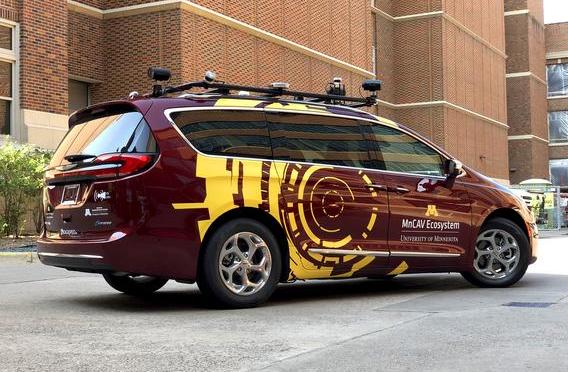
With the arrival of its fully outfitted autonomous vehicle in July, the University’s MnCAV Ecosystem is ready to facilitate research and testing of sensing technologies, vehicle control, platooning, traffic patterns, and other topics related to connected and autonomous vehicles (CAVs).

Continue reading State-Of-The-Art Vehicle to Drive CAV Research

New Project: Comparison of Compost and Proprietary Soil Amendments for Vegetation Establishment

After road construction, the adjacent disturbed soil has a diminished capacity to sustain vegetation, overall soil health is compromised from soil disturbance and there is an increased risk for erosion.

Soil quality in these areas can be replenished by importing topsoil (the preferred choice) or using organic composts. If organic compost is not available, proprietary soil amendments provide a cost-effective alternative. But information regarding the effects, mix ratios and application techniques for these products is limited. Research is needed to better understand optimal organic compost ratios and how to integrate these amendments to improve soil quality.

Continue reading New Project: Comparison of Compost and Proprietary Soil Amendments for Vegetation Establishment

Minnesota's transportation research blog