

Minnesota’s winters have been warming significantly faster than summers over the last several decades. In fact, the state’s winters are among the fastest warming in the U.S. This warming trend is likely increasing the time in which winter temperatures are near freezing, which could increase the number of freeze-thaw events. An increase in freeze-thaw events could have detrimental effects on Minnesota’s pavement systems.
Continue reading Have Minnesota’s Warmer Winters Increased the Number of Freeze-Thaw Cycles?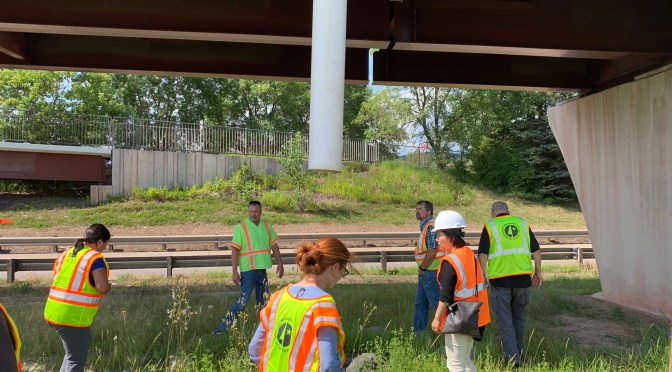
Environmental Evaluations of Potassium Acetate Used as a Road Salt Alternative
New research explored the environmental impacts of an alternative to road salt—potassium acetate, which is effective on ice at lower temperatures. Minnesota’s winter roads have been effectively treated for decades with chloride-based mixtures for anti-icing and deicing. Salt, however, corrodes steel in vehicles and infrastructure. Additionally, chloride runoff harms the aquatic environment. For example, up to 70% of road salt applied on Minneapolis-St. Paul metropolitan area roads ends up in groundwater aquifers and nearby lakes, many of which exceed regulatory limits for chloride concentrations.
Continue reading Environmental Evaluations of Potassium Acetate Used as a Road Salt Alternative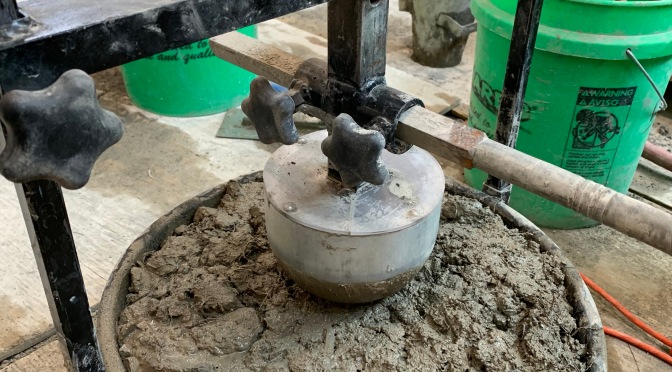
Fiber-Reinforced Concrete’s Potential as a Performance Engineered Mixture
Reinforcing concrete pavement with structural fibers improves its durability and helps protect against potential faulting and cracking. MnDOT has used fiber-reinforced concrete (FRC) on some concrete bridge decks and pavements. Winter weather, freeze-thaw cycles and road salt, however, still hasten concrete deterioration. In a recent study, researchers evaluated FRC in the context of performance engineered mix design methods, giving MnDOT confidence in the parameters that FRC needs to meet to help withstand Minnesota’s harsh weather.
Continue reading Fiber-Reinforced Concrete’s Potential as a Performance Engineered Mixture
Treating Stormwater with Local By-Products Reduces Road Construction Costs, Minimizes Waste
This article was originally published in Catalyst, August 2022.
Ongoing research is looking into the possibility of using local industrial waste for roadside stormwater construction projects. This would help reduce material and transportation costs and put otherwise wasted materials to use.
Continue reading Treating Stormwater with Local By-Products Reduces Road Construction Costs, Minimizes Waste
Automated Vehicles Could Increase Accessibility for Twin Cities East Metro
This article was originally published in Catalyst, August 2022.
Connected and automated vehicle (CAV) technology is moving forward, with three pilot shuttle projects on tap in Minnesota this year alone. Rapid developments are leaving little time for planners and policymakers to prepare for the mainstreaming of technology and the evolution of the current transportation system—all while ensuring that transportation equity has a seat in the vehicle.
Continue reading Automated Vehicles Could Increase Accessibility for Twin Cities East Metro
Could remote drivers be the future of ride-hailing?
This article was originally published in Catalyst, August 2022.
A new technology combining nearly autonomous vehicles with remote “tele-operators” has the potential to overcome both the technological and societal hurdles posed by driverless vehicles. Ride-hailing providers will be an important application for remote-driving technology, and U of M researchers found it offers clear advantages for companies and their customers.
Continue reading Could remote drivers be the future of ride-hailing?
Managing Building Assets With Scanning and Reality Modeling
MnDOT owns and maintains approximately 900 buildings across Minnesota, and the Building Services Section is responsible for planning repairs, renovations or expansions. Architects, engineers and other specialists involved in these activities require data regarding building and site conditions. Collecting this data is often a multidisciplinary and laborious effort that can be time-consuming and expensive. Alternative technologies, however, can gather and process large amounts of accurate information more comprehensively, safely and cost-effectively.
Continue reading Managing Building Assets With Scanning and Reality Modeling
Improving Asphalt Performance and Durability With Superpave 5
Minnesota’s harsh climate requires dense, durable asphalt to avoid frequent maintenance and replacement. Asphalt mixes as designed in the laboratory, however, don’t always perform consistently in the field. A new Superpave mix shows promise for providing cost-effective, high-performing pavements for state roadways.
Continue reading Improving Asphalt Performance and Durability With Superpave 5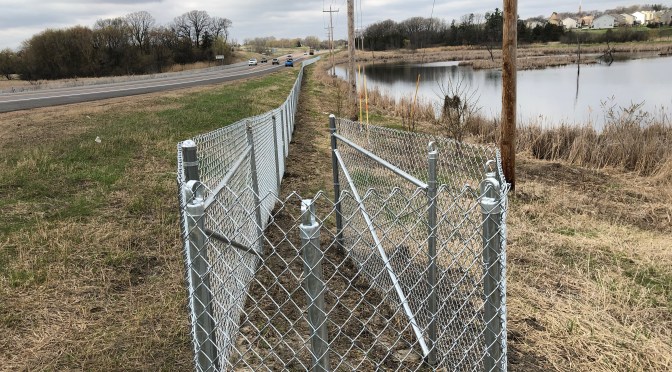
Improving Road Safety and Wildlife Conservation With Barrier Fencing
Small animals crossing roads put the animals at risk and present a significant safety hazard to road users. Motorists who suddenly stop or slow to avoid small animals crossing the road can cause significant safety concerns. Motorcyclists and bicyclists risk serious injury if they swerve or hit an animal, as do pedestrians in the road trying to assist the animals. A new, cost-effective fence design was tested and shown to be effective in preventing small animal crossings, benefiting both public safety and conservation.
Continue reading Improving Road Safety and Wildlife Conservation With Barrier Fencing
Roadside Safe Spaces for Butterflies and Bees
Pollinators such as rusty-patched bumble bees and monarch butterflies, critical to our eco-system, are at risk due to the loss of native habitat. A University of Minnesota research team, with support of MnDOT and the Local Road Research Board, studied whether restored roadsides could provide safe habitats for declining pollinator populations.
Continue reading Roadside Safe Spaces for Butterflies and Bees Crossroads