

Speed Safety Cameras (SSCs) detect the speed of vehicles through the use of radar technology or detectors that are embedded in the surface of the roadway, and associate those readings with a photograph or video of the vehicle. They can be deployed as fixed units (a stationary camera targeting a specific location), point-to-point units (multiple cameras that capture average speed over a set distance) or mobile (a portable camera positioned in a trailer or vehicle). The results are then “read” by trained analysts in a data center, who may or may not be members of law enforcement. Speeding tickets are then issued on the basis of this technology. The question facing the Minnesota Legislature in 2024 was, is this needed? And what are the best practices for implementing it?
Continue reading Administrative Rules and Structures of Speed Safety Camera SystemsCategory Archives: Traffic and Safety

New Project: Speed Impacts from Roundabouts and Other Traffic Control Devices
Roundabouts are effective at reducing driver speeds and lowering serious crash rates compared to other intersection types. Speeds vary in roundabouts, however, depending on geometric factors such as the number of lanes, entry and exit widths, and diameter. The use of supplementary control devices such as sign types, sign placement and pavement markings may also impact entry and exit speeds.
Continue reading New Project: Speed Impacts from Roundabouts and Other Traffic Control Devices
New Project: Effect of Centerlines on Prevailing Traffic Speeds of Low-Speed, Two-Lane, Two-Way Roads in Urban Contexts
Vehicle speed has a substantial influence on both the likelihood and severity of crashes involving nonmotorized road users. Reducing speeds on urban streets, in particular, enhances safety for the greatest number of vulnerable road users.
Continue reading New Project: Effect of Centerlines on Prevailing Traffic Speeds of Low-Speed, Two-Lane, Two-Way Roads in Urban Contexts
Guidelines for Implementing Mini-Roundabouts
Increasingly, roundabouts are the solution of choice for many intersections because they improve safety and traffic flow and reduce pollution due to less vehicle delays. Traditional roundabout design typically requires a larger footprint than a conventional four-way intersection.
Continue reading Guidelines for Implementing Mini-Roundabouts
New Project: Rural Intersection Enhancement and Driver Behavior Study
The risk of severe crashes increases when minor roads intersect with higher-speed roads in rural areas. MnDOT and county traffic engineers strive to find creative solutions that will prompt drivers to make safe decisions when navigating through intersections.
Continue reading New Project: Rural Intersection Enhancement and Driver Behavior Study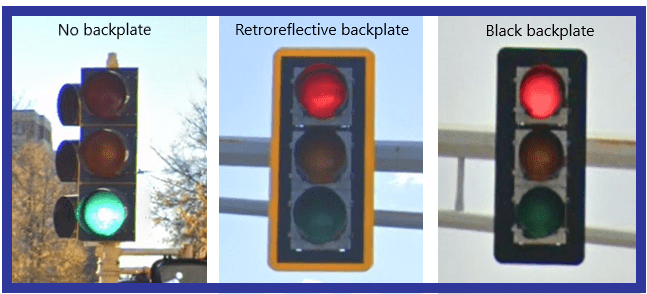
Improving Traffic Signal Visibility
Inconspicuous traffic signals are often cited as contributing to collisions at intersections. If that is true, making traffic signals more conspicuous should lead to fewer crashes. A study published at the TRB conference in 2005 suggested that yellow retroreflective backplates were most effective, reducing accidents by 15% at intersections, and the FHWA later adopted this as a Proven Safety Countermeasure.
Continue reading Improving Traffic Signal Visibility
Tribal Pedestrian Safety
A new video developed by the Center for Transportation Studies highlights a multiyear study of pedestrian safety at reservations that was undertaken by U of M researchers and partners from seven Anishinaabe tribes. The work was sponsored by the Minnesota Department of Transportation (MnDOT).
Continue reading Tribal Pedestrian Safety
New Project: Roadside Feature Placement and Pedestrian Safety on Low and Intermediate Speed Roads
Guidelines for designing and placing roadside features have traditionally focused on automobile safety on higher-speed roads. Research has also shown feature placement can have safety benefits for pedestrians and bicyclists on lower-speed roads.
Continue reading New Project: Roadside Feature Placement and Pedestrian Safety on Low and Intermediate Speed Roads
Lower speed limits signal a commitment to safety in St. Louis Park.
Reprinted from Catalyst, September 5, 2024
What’s the right speed limit for local roads? Legislation passed in 2019 makes it possible for Minnesota cities to set speed limits below 25 mph without special approval. As a result, it’s a question many local transportation officials have been considering.
Continue reading Lower speed limits signal a commitment to safety in St. Louis Park.
Safety of Commercial Vehicles Navigating at Roundabouts
The safety benefits of roundabouts over signalized intersections have been well-established for vehicular traffic, with previous studies showing decreases in fatal and serious injury crashes. But many stakeholders continue to perceive that heavy commercial vehicles are at risk and may overturn when navigating a roundabout. A MnDOT investigation comparing commercial vehicle crash data between roundabouts and intersections with traffic signals found fewer total crashes and serious crashes in roundabouts compared to other intersections, particularly after MnDOT modified roundabout design guidance to address commercial vehicle concerns.
Continue reading Safety of Commercial Vehicles Navigating at Roundabouts Crossroads