Public transit agencies are reimagining mobility through innovation, integration, and technology to create seamless travel experiences and improve access for all users. TRB will host a webinar on Tuesday, December 16, 2025 from 1:00 PM to 2:30 PM Eastern that will highlight strategies and technologies transforming the future of connected mobility. This session will explore how public agencies and technology partners are addressing fragmented systems through open platforms, integrated trip planning, and seamless fare payment, drawing on lessons from the Federal Transit Administration’s Integrated Mobility Innovation (IMI) and Accelerating Innovative Mobility (AIM) programs. Attendees will also gain insights into how Mobility-as-a-Service (MaaS) and Autonomous Mobility-on-Demand (AMoD) can expand access, improve service efficiency, and rebuild ridership. Presenters will share real-world examples, research, and lessons learned to help agencies advance scalable, user-centered transportation systems.
Automated vehicle (AV) features such as adaptive cruise control could significantly increase driver safety and mobility. But in some circumstances, these features can alter vehicle movement and spacing, and interfere with traffic flow. This project analyzed the integration of varying levels of AVs with human-driven vehicles (HVs) and the impact on ramp meter operations to measure the effects and identify potential solutions and modifications.
Automated vehicles (AVs) using advanced driver assistance systems depend on pavement markings to accurately track roadway lanes. While MnDOT continues to ensure human drivers easily and effectively detect and interpret various pavement markings, the agency also wanted to understand marking designs and characteristics that support AV functions. Field observations in different locations, during the day and at night, using different data collection methods allowed researchers to evaluate the impact of various pavement marking properties on AV lane-keeping functions. Results support MnDOT in producing pavement marking guidance that is responsive to changing needs.
Driverless vehicles present an enticing opportunity for increased traffic safety and reduced labor costs. However, technical issues and concerns remain regarding the interaction between driverless vehicles and human drivers. This project included observing and analyzing the interactions of a driverless shuttle and other road users in a pedestrian-heavy area to develop strategies for decreasing potential threats. Increasing the speed of the driverless shuttle and displaying clearer electronic messaging on the back of the shuttle could improve safety challenges.
Freight transportation is evolving rapidly, and its future success will require managing increased residential demand, planning for equity, and incorporating micro-delivery options such as cargo e-bikes. At the 2024 CTS Transportation Research Conference, three experts shared their knowledge of these trending topics in a session focused on the future of urban freight.
In response to the increasing demand for residential package delivery spurred by the shift towards online shopping, U of M Department of Industrial and Systems Engineering PhD student Can Yin shared her research on mobile parcel locker scheduling. Yin explained that in the growing ecommerce market, last-mile delivery is the most expensive and time consuming. While door delivery is commonly used, it can be unsecure and inconvenient for customers.
“Parcel lockers are an alternative, but they come with the disadvantages of limited locations, expensive fixed cost, and the inability to adapt to varying demand,” Yin said.
A newer, more flexible alternative is the use of mobile, vehicle-based parcel lockers, which offer greater flexibility, higher accessibility, and lower fixed costs—particularly if autonomous vehicles eliminate the need for driver salaries. However, mobile parcel lockers also create challenges for e-commerce businesses such as estimating demand and customer choices.
To address these challenges, Yin’s research team developed a mobile parcel locker demand-estimation model. Additionally, the researchers found that compared with stationary lockers, mobile lockers offer a better value and demand fulfillment.
Another challenge surrounding the rapid growth of e-commerce and urban freight is racial equity in urban freight planning. In his presentation, University of Washington Urban Freight Lab researcher Travis Fried explained how his research is seeking to better understand these inequities and create a framework for mitigating them.
The past and present systems that perpetuate the segregation of people and neighborhoods have been well documented. However, Fried said there is little research exploring how these patterns play out in freight planning and their impacts on air quality, health, and road safety for people of color. Fried’s research looked at high-volume traffic exposure and found that low-income populations of color were disproportionately exposed to e-commerce traffic.
“By our most conservative estimate, BIPOC [Black, Indigenous, and people of color] populations were exposed to 35 percent more traffic related to last-mile home delivery on average, despite ordering less than half as many packages as white populations,” Fried said. That’s because delivery facilities and highways are disproportionately located near historically marginalized neighborhoods, he explained.
In light of this finding, Fried emphasized the importance of including equity considerations when prioritizing urban freight strategies. “Solutions focused on the upper end of the distribution chain have outsized benefits for marginalized communities, so we need to consider that in our cost-benefit evaluations and engagement strategies,” he added.
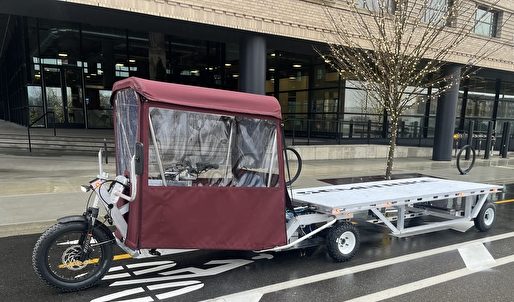
Using cargo e-bikes for last-mile freight delivery was the topic of the session’s final presentation from Marc Liu of Civilized Cycles. Liu explained how his company’s innovative semi-trike—which has as much cargo capacity as a small delivery van—can be used to move a significant amount of cargo over short distances, particularly within campus environments such as universities, hospitals, residential developments, and military bases.
Semi e-trike from Civilized Cycles
“Regardless of what these campuses are moving, they have the same core challenge of moving as much cargo as possible while keeping operating costs as low as possible,” Liu said. “On top of that, emissions and safety are key concerns because most of this happens in pedestrian-heavy areas.”
Liu explained that the first customers for the cargo e-bikes are micro-mobility fleet operators at the forefront of sustainable transportation including Lime, Net Zero Logistics, and Amazon. Moving forward, the company is targeting campus environments for expansion. Liu said that “economics drives adoption” and believes the key to adoption is offering an affordable, American-made product that reduces vehicle fleet costs, increases safety, improves efficiency, and reduces greenhouse gas emissions.
Since the 2004 DARPA Grand Challenge, connected and autonomous vehicles (CAVs) have been highly anticipated and widely discussed. Today, Teslas with “autopilot” and General Motors vehicles with Super Cruise driver-assistance technology are already on roads, and pilot “robotaxi” services operate in several major US cities.
However, most CAVs are currently classified, at best, as Level 4 by the Society of Automotive Engineers. This means they are designed and operated with specific, predefined conditions—known as their operational design domain (ODD)—and must stop safely when those conditions are no longer met. Despite advancements in artificial intelligence and machine learning, there is still a long way to go before fully autonomous, or Level 5, vehicles become a reality.
Partial remote driving, or teleoperated driving (ToD), has emerged as a potential interim solution. With ToD, a remote operator can take control if a CAV encounters conditions beyond its ODD. Enabled by 5G cellular networks, ToD has shown promise in controlled settings, but the question remains whether current 5G networks can reliably support remote driving on a large scale.
In a recent project, University of Minnesota researchers investigated the feasibility of and critical networking requirements for remote CAV operation. The project was led by Zhi-Li Zhang, a professor in the Department of Computer Science and Engineering, and Rajesh Rajamani, a professor in the Department of Mechanical Engineering. Their work was supported by CTS seed funding, which aims to help CTS scholars develop expertise in emerging areas and foster strategic relationships that position them for future funding opportunities.
According to Zhang, 5G was designed to enable low-latency applications—those that process high volumes of data with minimal delay. In reality, today’s commercial 5G networks mainly support conventional mobile broadband access, especially to improve download speeds. But when it comes to teleoperation, higher uplink speeds and low latency in both directions are essential, Zhang says.
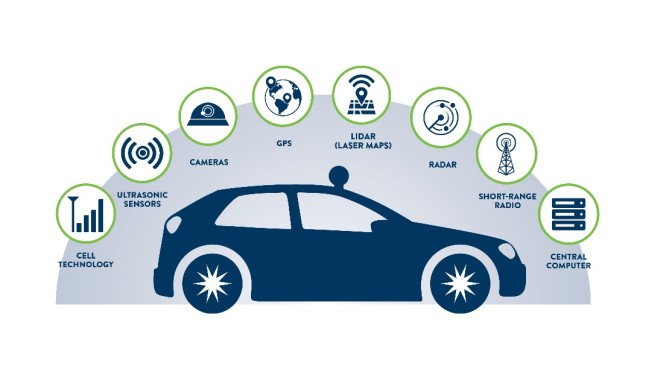
To test 5G’s potential, the research team used the MnCAV Ecosystem’s research vehicle—which is outfitted with cameras and lidar sensors—to conduct repeated driving experiments on commercial 5G networks in downtown Minneapolis. The study focused on end-to-end uplink performance of sensor data from the vehicle to a remote teleoperation station, analyzing how well these networks could support responsive, safe control.
Results showed that while transmitting a single video stream from a CAV is feasible, adding additional streams, especially from lidar—essential for depth perception—can strain the network. The researchers also found that, even in the case of a single video stream, latency increased when the vehicle was traveling at higher speeds and at handover points between 5G base stations, posing risks for safe and reliable remote driving.
These findings highlight fundamental challenges for remote driving on commercial 5G. However, thanks in part to this CTS-funded project, Zhang, Rajamani, and other researchers from the University of Minnesota and the University of Michigan were awarded an NSF grant to study further solutions.
One approach the researchers are exploring in this project is a new “predictive display” mechanism that leverages generative artificial intelligence to overcome the latency challenge of 5G networks. The mechanism uses recent but slightly delayed (e.g., by 0.5 seconds) data to predict the CAV’s current surroundings. Early tests suggest that this method could improve remote driving performance by masking the 5G network delay, helping teleoperators drive more effectively. However, the researchers say further work is needed to refine the technology and make remote CAV operation reliable and robust at scale.
Automatic vehicle location (AVL) systems using GPS are creating opportunities for local agencies to improve their operations even in real time. A five-page guide and a video from the LRRB highlight the features and benefits of such systems for snowplowing.
The benefits of public transportation, including reducing individual vehicle use and traffic congestion, aren’t always optimized beyond densely populated urban settings. While transit may extend to more suburban or rural areas, land development patterns can make it challenging for people to reach their destinations by transit alone. Pairing transit with an autonomous mobility service is a potential solution. Researchers assessed transportation needs in a suburban shopping area and developed a system designed to deliver passengers from the end of a transit line to their ultimate destination. Simulations of the autonomous mobility service revealed its potential to increase transit efficiency and reduce individual vehicle use.
Reprinted from Catalyst, November 9, 2023 —Pam Snopl
What’s next in the future of mobility? Infrastructure is always critical—the challenge of how to fund, protect, and maintain it continues unabated, whether from wear and tear or malicious cyberattacks.




 Crossroads