

Detours around bridges in a critical freight transportation route create costs to the trucking industry, taxpayers and state economy. New load rating factors for the slab-span bridges across Shingle Creek will give MnDOT more flexibility in managing truck traffic and keeping freight moving efficiently.
Continue reading Updating Load Ratings for Shingle Creek Slab-Span BridgesAll posts by mndotresearch

Estimating Corrosion of Embedded Steel Rebars in Bridge Structures
Corrosion of steel reinforcement in bridge structures creates uncertainty in the structural capacity. A new prediction tool will help estimate rebar section loss to accurately plan for appropriate bridge maintenance repairs.
Continue reading Estimating Corrosion of Embedded Steel Rebars in Bridge Structures
Economic Effects of Complete Streets Projects on Minnesota’s Main Streets
Complete Streets is a national initiative to encourage the design of safe, convenient transportation systems with access to users of all types, ages and abilities. MnDOT’s Complete Streets policy aims to provide a safe and functional transportation system for all users. Perceived and actual economic impacts of these road projects on small cities vary, but MnDOT has new strategies to work with local partners and evaluate economic benefits for smaller communities.
Continue reading Economic Effects of Complete Streets Projects on Minnesota’s Main Streets
20 Tips to Up Your Social Media Game
One of the best ways to connect with communities about projects and events that affect them is to reach them where they already are – on social media. But whether you’re a social media newbie or a communications professional, there are always new trends, technology, and platforms to learn, and it can be overwhelming.
Continue reading 20 Tips to Up Your Social Media Game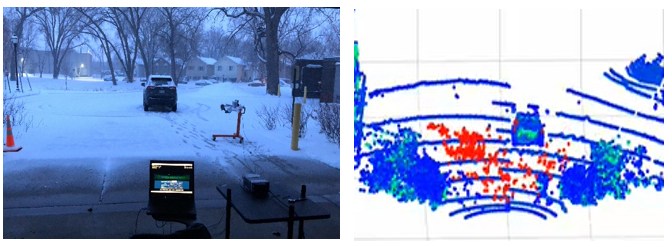
Evaluating Weather’s Effects on the Accuracy of Automated Vehicles
Fully automated vehicles may not be market-ready yet, but one day, they expect to provide a variety of benefits like reduced emissions and greater safety and transportation equity. These vehicles and the complex combination of underlying technologies that power them are continually being tested and improved to ensure the vehicles will meet the highest standards of safety and performance.
Continue reading Evaluating Weather’s Effects on the Accuracy of Automated Vehicles
Nondestructive Detection of Pile Length for High-Mast Light Towers
A new testing method will allow MnDOT to determine the underground foundation pile depths of high-mast light towers (HMLTs) without digging or dismantling. HMLTs need to meet design standards to ensure load-bearing stability. By using the new method to evaluate pile depth, MnDOT could avoid costly retrofits or replacements, and prioritize light towers in need of redesign.
Continue reading Nondestructive Detection of Pile Length for High-Mast Light Towers
Have Minnesota’s Warmer Winters Increased the Number of Freeze-Thaw Cycles?
Minnesota’s winters have been warming significantly faster than summers over the last several decades. In fact, the state’s winters are among the fastest warming in the U.S. This warming trend is likely increasing the time in which winter temperatures are near freezing, which could increase the number of freeze-thaw events. An increase in freeze-thaw events could have detrimental effects on Minnesota’s pavement systems.
Continue reading Have Minnesota’s Warmer Winters Increased the Number of Freeze-Thaw Cycles?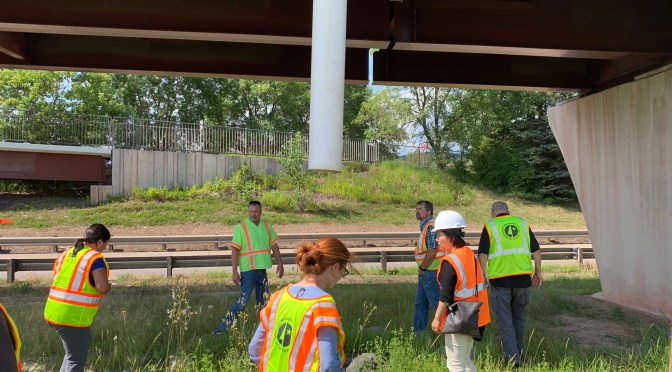
Environmental Evaluations of Potassium Acetate Used as a Road Salt Alternative
New research explored the environmental impacts of an alternative to road salt—potassium acetate, which is effective on ice at lower temperatures. Minnesota’s winter roads have been effectively treated for decades with chloride-based mixtures for anti-icing and deicing. Salt, however, corrodes steel in vehicles and infrastructure. Additionally, chloride runoff harms the aquatic environment. For example, up to 70% of road salt applied on Minneapolis-St. Paul metropolitan area roads ends up in groundwater aquifers and nearby lakes, many of which exceed regulatory limits for chloride concentrations.
Continue reading Environmental Evaluations of Potassium Acetate Used as a Road Salt Alternative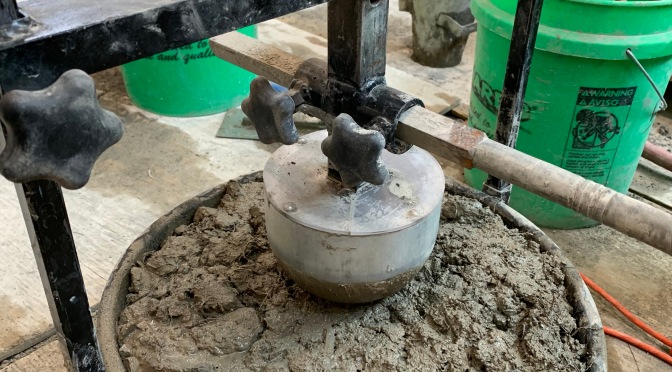
Fiber-Reinforced Concrete’s Potential as a Performance Engineered Mixture
Reinforcing concrete pavement with structural fibers improves its durability and helps protect against potential faulting and cracking. MnDOT has used fiber-reinforced concrete (FRC) on some concrete bridge decks and pavements. Winter weather, freeze-thaw cycles and road salt, however, still hasten concrete deterioration. In a recent study, researchers evaluated FRC in the context of performance engineered mix design methods, giving MnDOT confidence in the parameters that FRC needs to meet to help withstand Minnesota’s harsh weather.
Continue reading Fiber-Reinforced Concrete’s Potential as a Performance Engineered Mixture
Managing Building Assets With Scanning and Reality Modeling
MnDOT owns and maintains approximately 900 buildings across Minnesota, and the Building Services Section is responsible for planning repairs, renovations or expansions. Architects, engineers and other specialists involved in these activities require data regarding building and site conditions. Collecting this data is often a multidisciplinary and laborious effort that can be time-consuming and expensive. Alternative technologies, however, can gather and process large amounts of accurate information more comprehensively, safely and cost-effectively.
Continue reading Managing Building Assets With Scanning and Reality Modeling Crossroads