
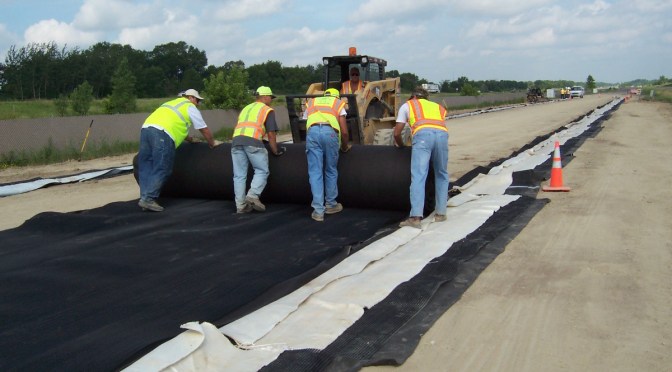
Geotextiles are synthetic polymer materials used to improve the performance of roadways. As discussed in this 2011 technical summary, geotextiles facilitate filtration and water drainage, improve the integrity and functioning of base materials, and provide a stable construction platform over soft or wet soils. These improvements can benefit both the cost-efficiency and longevity of pavements.
Geosynthetic materials have been used throughout Minnesota, and can be found in both reconstructed and new roadway projects. The use of geotextiles as a separator layer under concrete overlays, however, has had limited documentation in Minnesota and other cold weather climates. MnROAD‘s recent dedication of several test cells to this purpose will determine the performance of this application of geotextiles, with the goal of improving its applications on other Minnesota roadways.
The new test sections, designated as Cells 140 and 240, consist of a very thin, 3-inch concrete overlay over an existing 7-inch concrete pavement constructed 20 years ago. Some unique features of the design include the use of a fiber-reinforced concrete mix, two different thicknesses of the nonwoven geotextile, and the use of a special type of glue, rather than nails, to fasten it to the existing concrete before paving.
The fabric and fiber used in the concrete mix were supplied through a public-private partnership with Propex Geotextile Systems. The results of this study, along with other unbonded overlays constructed at MnROAD and around the country, will be incorporated into a new national pooled fund project — TPF 5-(269) — led by MnDOT. This project will develop an improved mechanistic design procedure for unbonded overlays.
A second application being demonstrated at MnROAD is the use of a geosynthetic drainage system under several dowel bar baskets in new concrete pavement test section. Minnesota has historically used a dense-graded base layer under concrete pavements to provide a stable foundation and construction platform. However, this material drains very slowly, and traps moisture within the joints, leading eventually to significant distress (See Effect of Drainage on the Performance of Concrete Pavement Joints in Minnesota.) This application will compare the use of the geotextile drainage material placed under both sealed and unsealed joints, as well as a control joint without the drainage material.

 Crossroads