Tag Archives: infiltration

New Project: Engineering Post-Construction Soil Composition to Support Resilient Stormwater Management

Post-construction soils can produce much higher stormwater runoff rates than pre-construction or typical vegetated soils. Poor soil conditions can hinder the establishment of vegetation and carry large volumes of runoff, sediment, and nutrient loads to local waters. Organic soil amendments (composts) may support post-construction vegetative growth by boosting soil structure, nutrient availability, and water holding capacity.

This research aims to define targeted pre-construction soil health baselines, determine optimized design and field implementation inputs that return soils to baseline health indices using organic amendments, and identify how these inputs can benefit transportation requirements and resilient stormwater treatment.

The results may facilitate the quantification of benefits provided through soil health restoration and the development of implementable guidance for roadside soil health restoration techniques.

“This research project will help us understand how implementing soil health practices can improve the performance of roadside vegetation establishment resulting in MnDOT being able to close out construction contracts and stormwater permits sooner,” said Warren Tuel, Natural Resources Program Coordinator with MnDOT’s Office of Environmental Stewardship. “There are also significant potential stormwater benefits of soil health practices including increased infiltration, improved treatment of pollutants present in highway stormwater runoff. The improved management of stormwater will result in improved water quality of runoff from MnDOT highway systems resulting in greater protection of the many water resources here in Minnesota.”

The objectives are:

  1. Evaluate resilience to water availability through organic amendment (e.g., compost) addition through greenhouse stormwater experiments
  2. Optimize amendment loadings based on resilience
  3. Develop a “recipe” for improving the health of poor soils based on soil health measurements, by amending the soil with compost or other organics

Project Details

  • Start Date: 05/16/2025
  • Estimated Completion Date: 06/30/2027
  • Funding: MnDOT
  • Principal Investigator: Bora Cetin
  • Co-Principal Investigators: Angela Farina
  • Technical Liaison: Warren Tuel

Details of the research study work plan and timeline are subject to change.

To receive email updates about this project, visit MnDOT’s Office of Research & Innovation to subscribe.
How roadside drainage ditches reduce pollution

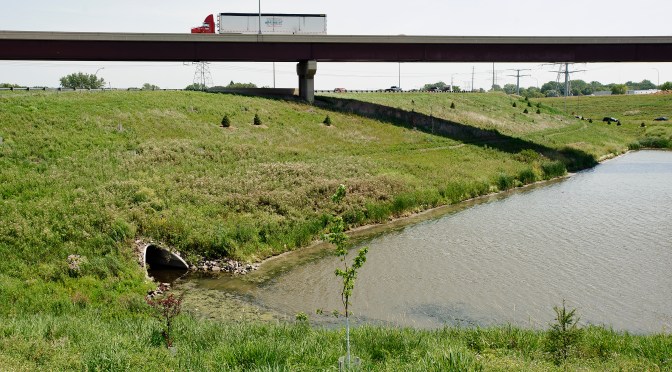
Stormwater can pick up chemicals and sediments that pollute rivers and streams. Roadside drainage ditches, also known as swales, lessen this effect by absorbing water. But until recently, MnDOT didn’t know how to quantify this effect and incorporate it into pollution control mitigation measures.

In a recently completed study, researchers evaluated five Minnesota swales, measuring how well water flows through soil at up to 20 locations within each swale.

“There’s a big push in Minnesota, and probably everywhere, to do more infiltration,” Barbara Loida, MS4 Coordinator Engineer, MnDOT Metro District, said. “We know that our ditches are doing some of that, but we wanted to look at how much infiltration these ditches are providing.”

A key finding: grassed swales are significantly better at absorbing water than expected, which may reduce the need for other, more expensive stormwater management practices, such as ponds or infiltration basins.

This could save MnDOT and counties significant right-of-way and construction costs currently expended on more expensive stormwater management techniques. While swales were recognized in the Minnesota Pollution Control Agency’s new Minimal Impact Design Standards, there was a need to quantify the amount of water a swale can absorb so it could receive the appropriate MIDS credits.

Researchers also tested the ability of carbon, iron chips, steel wool and other materials to remove pollutants as ditch check filters—material put into swales to enhance removal of pollutants.

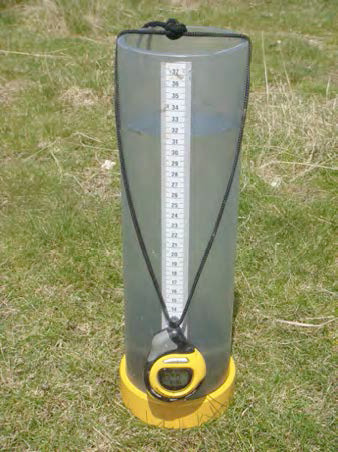
Gradations on a Modified Philip Dunne infiltrometer allow the measurement of stormwater infiltration.

What’s Next?

A follow-up project, which the MPCA is participating in, will seek to clarify the impact of swale roughness on infiltration rates. The goal is a calculator for real-world infiltration rates that MnDOT and local agencies would be able to implement.

MPCA, MnDOT and the city of Roseville are also partnering on a project to install and test the effectiveness of ditch check filters in real-world locations.

Maintenance recommendations should help MnDOT and local agencies ensure that swales operate at maximum efficiency. These recommendations should continue to be revised as knowledge evolves.

Related Resources

*Editor’s note: This article was adapted from our upcoming edition of the Accelerator. Read the newsletter online, or sign up to receive by mail.