

Automated vehicle (AV) features such as adaptive cruise control could significantly increase driver safety and mobility. But in some circumstances, these features can alter vehicle movement and spacing, and interfere with traffic flow. This project analyzed the integration of varying levels of AVs with human-driven vehicles (HVs) and the impact on ramp meter operations to measure the effects and identify potential solutions and modifications.
Continue reading Impacts of Automated Vehicle Feature IntegrationTag Archives: automated vehicles

Pavement Markings to Support Automated Vehicles
Automated vehicles (AVs) using advanced driver assistance systems depend on pavement markings to accurately track roadway lanes. While MnDOT continues to ensure human drivers easily and effectively detect and interpret various pavement markings, the agency also wanted to understand marking designs and characteristics that support AV functions. Field observations in different locations, during the day and at night, using different data collection methods allowed researchers to evaluate the impact of various pavement marking properties on AV lane-keeping functions. Results support MnDOT in producing pavement marking guidance that is responsive to changing needs.
Continue reading Pavement Markings to Support Automated Vehicles
Safety Considerations Associated with Driverless Shuttles
Driverless vehicles present an enticing opportunity for increased traffic safety and reduced labor costs. However, technical issues and concerns remain regarding the interaction between driverless vehicles and human drivers. This project included observing and analyzing the interactions of a driverless shuttle and other road users in a pedestrian-heavy area to develop strategies for decreasing potential threats. Increasing the speed of the driverless shuttle and displaying clearer electronic messaging on the back of the shuttle could improve safety challenges.
Continue reading Safety Considerations Associated with Driverless Shuttles
Helping automated vehicles ‘see’ through fog and snow
April 18, 2023
While fully automated vehicles (AVs) have not yet reached the roads, the work to get them market-ready is steadily moving forward. One of the essential technologies these vehicles rely on for safety and performance is lidar, which has traditionally experienced a loss of accuracy in bad weather.
Continue reading Helping automated vehicles ‘see’ through fog and snow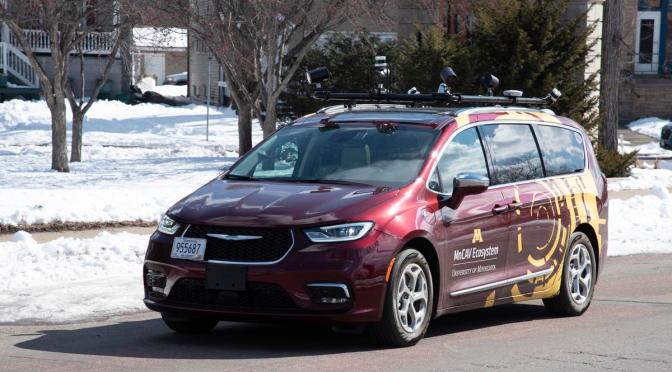
Paving the way for smarter and safer AVs
This article was originally posted on Catalyst, January 2023.
There’s been a lot of progress toward self-driving cars in recent years, but we still have a long way to go before the system runs like a well-oiled machine. Even with all the advances in artificial intelligence and machine learning, automated vehicles (AVs) are still not well-equipped to handle crashes, bad weather, poor visibility, and other unexpected situations on the road.
Continue reading Paving the way for smarter and safer AVs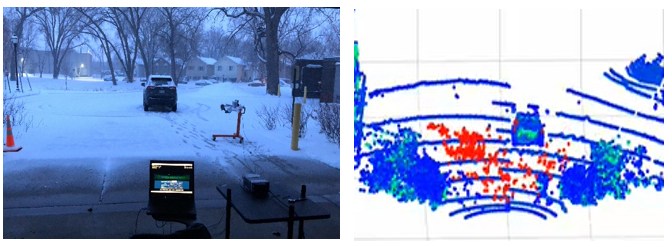
Evaluating Weather’s Effects on the Accuracy of Automated Vehicles
Fully automated vehicles may not be market-ready yet, but one day, they expect to provide a variety of benefits like reduced emissions and greater safety and transportation equity. These vehicles and the complex combination of underlying technologies that power them are continually being tested and improved to ensure the vehicles will meet the highest standards of safety and performance.
Continue reading Evaluating Weather’s Effects on the Accuracy of Automated Vehicles
New Project: Assessment of Pedestrian Safety and Driver Behavior Near Automated Vehicles
With the number of automated vehicles increasing on our roadways it is important to understand their potential impacts and how other road users will interact with them. In the future, there will be a more pronounced shared levels-of-automation transportation network, with fully manual, partially automated, and fully automated vehicles sharing the same Minnesota roads. While planners and engineers have a reasonable idea of how humans drive around other humans, what is not as well-known is human driving behavior around automated vehicles.
Continue reading New Project: Assessment of Pedestrian Safety and Driver Behavior Near Automated Vehicles
Adding Autonomous Vehicles to Ride-Hailing Fleets Could Benefit Platforms and Drivers
This article was originally published in Catalyst, February 2022.
In recent work, researchers in the U’s Department of Industrial and Systems Engineering (ISyE) examined one potentially important application of autonomous vehicle (AV) technology: ride hailing.
Continue reading Adding Autonomous Vehicles to Ride-Hailing Fleets Could Benefit Platforms and Drivers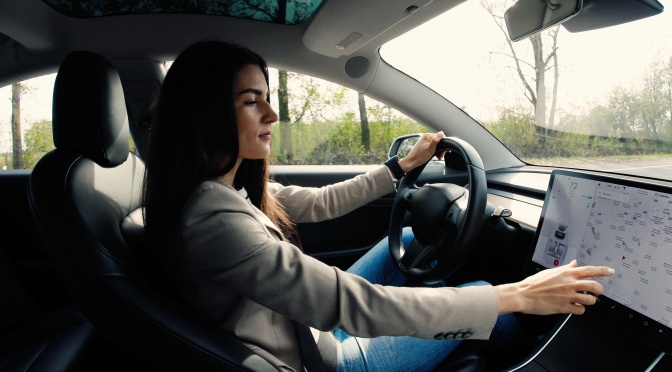
New Project: Tool to Estimate the Safety Impact of Vehicle Levels of Automation on Minnesota Roads
While commercially available self-driving vehicles may still be decades away, an increasing number of vehicles on the market offer advance driver assistance systems (ADAS). For example, ADAS features include adaptive cruise control, steering automation, and hands-free steering.
Continue reading New Project: Tool to Estimate the Safety Impact of Vehicle Levels of Automation on Minnesota Roads
New Project: Autonomous Vehicles – What Should Local Agencies Expect?
Connected Automated Vehicles (CAV) are part of tomorrow’s transportation future happening today. The evolution of vehicle technology is shifting how drivers interact with the infrastructure around them. Local agencies are beginning to respond and anticipate these changes, while CAV manufacturers request to test their vehicles on local roadways further pushing the urgency on local agencies.
Continue reading New Project: Autonomous Vehicles – What Should Local Agencies Expect? Crossroads