

The goods that continuously move through Minnesota by road, rail, air, water, and pipelines drive the state’s economy, making efficient freight transit—and excellent freight infrastructure—a high priority for the Minnesota Department of Transportation (MnDOT).
Continue reading Researchers Identify Freight Data Sources, Create Guidance to Aid Infrastructure PlanningCategory Archives: Research
General research posts.
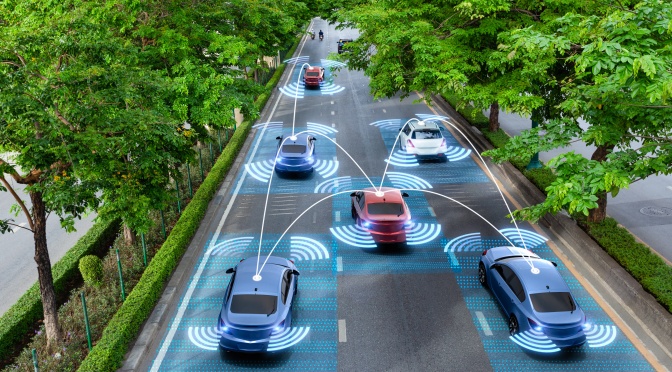
Preparing for the Future of CAVs: Cybersecurity, Winter Weather Research
Connected and automated vehicles (CAVs) hold promise for improving transportation operations—but could also provide pathways for “malicious actors” to compromise vehicle security, said Rafael Stern, a U of M assistant professor, in a recent CTS webinar.
Continue reading Preparing for the Future of CAVs: Cybersecurity, Winter Weather Research
Strategies improve pollinator roadside habitat, reduce costs
First published in Catalyst, May 22, 2023.
Transportation agencies revegetate roadsides after construction projects to provide road stability, stormwater filtration, and visual appeal. Revegetation is also a good opportunity to create pollinator-friendly habitat. However, planting and maintaining ditches can be expensive, funds for such projects are usually limited, and there isn’t much data on which methods actually work.
Continue reading Strategies improve pollinator roadside habitat, reduce costs
Multimodal trip planner to make travel easier in Greater Minnesota, rural areas
Reprinted from Catalyst, May 9, 2023
When a person wants to take a trip across the country, they can choose from a variety of travel planning apps to help make that happen. But what if the trip they want to take is from Mankato to New Ulm, or within their own community, using non-personal transportation?
The Minnesota Department of Transportation has launched a pilot project to bring trip planning and payment technology for daily trips to areas less dense than urban settings.
Residents and visitors in southern and western Minnesota now have the ability to plan for and, in some cases, pay for public transit and intercity bus trips using the Transit app. Travel and route information for these agencies went live within Transit on March 1.

Transit, a free app available for download in Google Play or the Apple App Store, is used in more than 300 cities around the world. It allows users to see route and travel options for public transit and connecting services. Select agencies also have in-app ticketing, allowing riders to pay for fares electronically and then show their device to transit drivers to ride.
“This pilot with the Transit app focuses on rural areas because this technology has not yet been made available outside of Minnesota’s big cities,” says Elliott McFadden, MnDOT’s Greater Minnesota Shared Mobility Program coordinator. “The project will be the first to bring the latest technology to make it easier to plan and take trips in many communities in Greater Minnesota.”
The pilot will run through April 2024 and is funded by two innovation grants from the Federal Transit Administration at a cost of $1.9 million.
U of M researchers led by Alireza Khani will evaluate the project to help determine whether this technology should be scaled to the rest of the state. Focusing on southern Minnesota, the research team will work closely with MnDOT’s project management team and the platform development team to study these questions:
- How do residents of the region benefit from having access to a variety of mobility options through an integrated platform?
- To what extent does the platform help increase transit ridership and reduce personal vehicle use?
- How can the features of the platform—such as route planning or pricing—be optimized for greater system efficiency and benefits for all residents?
“Our goal is to provide the data and analysis policymakers need to make the most effective transit investments,” says Khani, an associate professor in the Department of Civil, Environmental, and Geo- Engineering.
(Adapted from a MnDOT press release, March 1, 2023.)
More Information

Monitoring Bumble Bee Populations in the Twin Cities Metro – Lessons Learned
In a project funded by MNDOT, entomologists developed an innovative method for surveying bumble bee populations alongside roadways. The researchers have recently published an article in Biological Conversations, Vol 283 focusing on the lessons learned about sampling when surveying these quick-moving bees.
Continue reading Monitoring Bumble Bee Populations in the Twin Cities Metro – Lessons Learned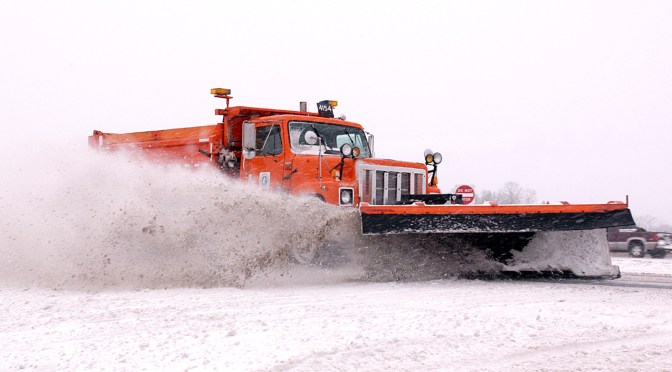
New Clear Roads Research: Evaluating high-performance plow blades
A variety of factors can affect a snowplow blade’s long-term performance, making it difficult for an agency to determine which blades are the most cost-effective overall. By developing a field test protocol and cost-benefit analysis methodology, the new research will make it easier for Clear Roads agencies to evaluate and compare blades in the future using the same standard procedures used in this project.
Continue reading New Clear Roads Research: Evaluating high-performance plow blades
Future of Mobility: Decarbonized transportation
April 26, 2023
The Future of Mobility series collects the perspectives of top U researchers and other national experts. In 17 articles, the authors scan the horizon and reflect on critical transportation topics. Each article recommends action steps for public officials and policymakers.
Continue reading Future of Mobility: Decarbonized transportation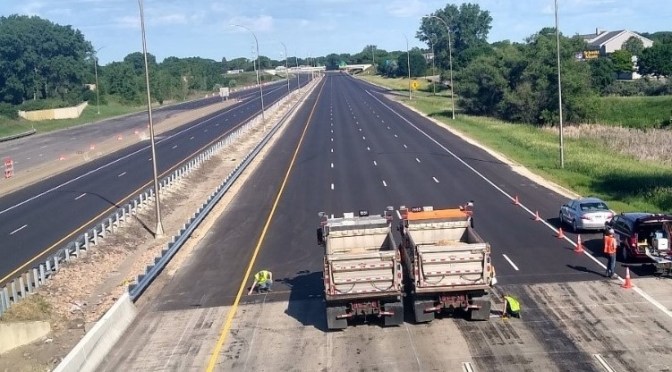
New methods to determine safe bridge loading will help keep Minnesota’s truck freight moving
April 10, 2023
When transportation officials determine which route a heavy truck should take, their aim is maximizing efficiency while ensuring safety. Detours around bridges on critical freight routes increase fuel and labor costs for the trucking industry—and eventually hit consumer pocketbooks, too.
Continue reading New methods to determine safe bridge loading will help keep Minnesota’s truck freight moving
Surge pricing for rides influences customer evaluation of driver performance
April 13, 2023
Surge pricing in rideshare apps leads to more complaints from customers, which ultimately eats away at drivers’ incomes, according to new U of M research.
Continue reading Surge pricing for rides influences customer evaluation of driver performance
Helping automated vehicles ‘see’ through fog and snow
April 18, 2023
While fully automated vehicles (AVs) have not yet reached the roads, the work to get them market-ready is steadily moving forward. One of the essential technologies these vehicles rely on for safety and performance is lidar, which has traditionally experienced a loss of accuracy in bad weather.
Continue reading Helping automated vehicles ‘see’ through fog and snow Crossroads