All posts by Shannon Fiecke

Marketing and Communications Manager, MnDOT Research Services

Mobile imagery, LiDAR help MnDOT maintain its assets

How do you quickly and cost-effectively get an accurate inventory of transportation assets spread out along more than 1,100 miles of roadway?

That was the problem facing the Minnesota Department of Transportation’s Metro District, which needed an inventory of its plate beam guardrail and concrete barriers.

To accomplish this, engineers in the district launched an innovative research implementation project using a pair of mobile mapping technologies — Light Detection and Ranging (LiDAR) and mobile imaging — that can collect vast amounts of geospatial data on highway infrastructure in a safe and efficient manner.

Mobile imaging uses a camera mounted on a vehicle driving at highway speeds to take high-resolution photos at regular intervals. It’s accurate to within 1 foot, which makes it suitable for use in preliminary (30 percent) design plans without additional field surveys. In this project, researchers collected mobile images of roadway barriers and extracted data from them along Metro District roadways, including all ramps, overpasses, interchanges, weigh stations, rest areas and historical sites.

A MnDOT worker replaces a section of broken guardrail.
A MnDOT worker replaces a section of broken guardrail on I-94 near the Lowry Tunnel in Minneapolis. (Photo by Dave Gonzalez, MnDOT)

Researchers also collected LiDAR data at three Metro District sites. LiDAR uses a laser range finder and reflected laser light to measure distances. It provides survey-grade data accurate to within 0.1 foot, but it is significantly more expensive to collect than mobile imaging.

“Mobile imagery and mobile LiDAR are relatively new technologies, but this research shows that they are options that we can use. Collecting this information manually would have taken a lot more time and money,” said MnDOT Asset Management Engineer Trisha Stefanski.

MnDOT’s barrier inventory will provide invaluable information for design, planning and maintenance. The data will be published on MnDOT’s Georilla map server, where it will be beneficial to a variety of projects and recurring tasks. For example, if a vehicle hits a barrier, maintenance staff will be able to check the database to see the type of barrier and end treatment to ensure they bring the right equipment to make repairs. Although the project focused on barriers, the imagery contains data on other assets as well. MnDOT has already used the imagery to extract noise wall and sign data.

This blog post was adapted from an article in our upcoming issue of Accelerator, MnDOT’s research and innovation newsletter.

3D-vertical
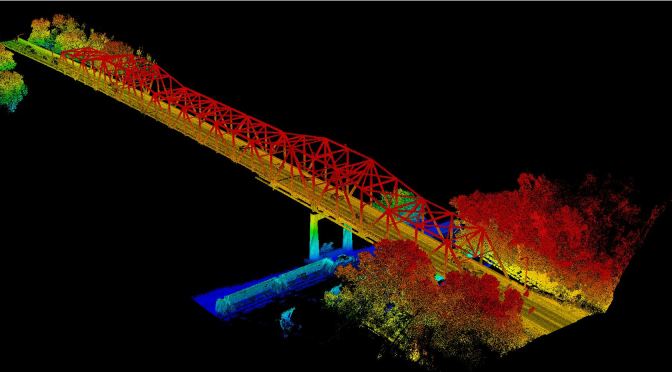
Thousands of data points can be extracted from this image of a Highway 61 roadway segment created with LiDAR Technology.

How roadside drainage ditches reduce pollution

Stormwater can pick up chemicals and sediments that pollute rivers and streams. Roadside drainage ditches, also known as swales, lessen this effect by absorbing water. But until recently, MnDOT didn’t know how to quantify this effect and incorporate it into pollution control mitigation measures.

In a recently completed study, researchers evaluated five Minnesota swales, measuring how well water flows through soil at up to 20 locations within each swale.

“There’s a big push in Minnesota, and probably everywhere, to do more infiltration,” Barbara Loida, MS4 Coordinator Engineer, MnDOT Metro District, said. “We know that our ditches are doing some of that, but we wanted to look at how much infiltration these ditches are providing.”

A key finding: grassed swales are significantly better at absorbing water than expected, which may reduce the need for other, more expensive stormwater management practices, such as ponds or infiltration basins.

This could save MnDOT and counties significant right-of-way and construction costs currently expended on more expensive stormwater management techniques. While swales were recognized in the Minnesota Pollution Control Agency’s new Minimal Impact Design Standards, there was a need to quantify the amount of water a swale can absorb so it could receive the appropriate MIDS credits.

Researchers also tested the ability of carbon, iron chips, steel wool and other materials to remove pollutants as ditch check filters—material put into swales to enhance removal of pollutants.

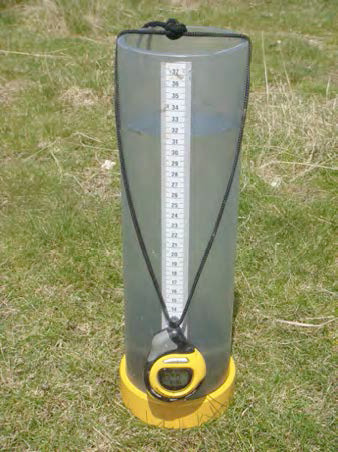
Gradations on a Modified Philip Dunne infiltrometer allow the measurement of stormwater infiltration.
What’s Next?

A follow-up project, which the MPCA is participating in, will seek to clarify the impact of swale roughness on infiltration rates. The goal is a calculator for real-world infiltration rates that MnDOT and local agencies would be able to implement.

MPCA, MnDOT and the city of Roseville are also partnering on a project to install and test the effectiveness of ditch check filters in real-world locations.

Maintenance recommendations should help MnDOT and local agencies ensure that swales operate at maximum efficiency. These recommendations should continue to be revised as knowledge evolves.

Related Resources

*Editor’s note: This article was adapted from our upcoming edition of the Accelerator. Read the newsletter online, or sign up to receive by mail. 

RailVolution showcases Minnesota transit successes

Before a national audience of 1,400 urban planners and transit enthusiasts, Hennepin County Commissioner Peter McLaughlin and others told the story of how the Twin Cities metropolitan area was transformed into a community that embraces “livability” and mass transit, including light rail.

“The growth was horizontal and there were lots of people who were saying it wouldn’t work in Minnesota,” said McLaughlin, during the opening plenary of the RailVolution conference in Minneapolis.

But the metro region bucked years of infighting and helped pass a transportation bill in 2008 that allows counties to tax for the expansion of transit in the metro area. Anoka, Ramsey, Hennepin, Dakota and Washington Counties decided to pool their resources from the quarter-cent transit sales tax, which is why the Southwest Light Rail Line is able to move forward.

“They had to believe their day would come,” McLaughlin said of the counties.

MnDOT Commissioner Charles Zelle, who ran a regional bus company before being appointed to MnDOT, said it was faster for him to bike to the conference than to take his car.

This was the first time the annual conference has been held in the Twin Cities, allowing Minnesota leaders to share their success stories.

Minnesota Department of Transportation Commissioner Charlie Zelle, who biked the Greenway trail to get to the conference, spoke of MnDOT’s commitment to multi-modal transportation and maximizing the health of Minnesota’s people and economy.

“MnDOT is more than a highway department,” he said. “We have a statewide bike plan and we will probably be the second state in the union to have a statewide pedestrian plan.”

Michael Langley of Greater MSP said a mix of transportation types is critical to attracting  talented workers to the Twin Cities, especially millennials.

“Nearly every area of the world is facing a future workplace shortage,” he said. “It’s fueling a competition for talent like we’ve never seen.”

Federal Highway Administration Secretary Anthony Foxx on Tuesday addressed conference attendees about the need for a bipartisan compromise on funding. He proposed moving away from the Highway Trust Fund to a more inclusive transportation account (named the Surface Transportation Trust Fund) that also addresses rail needs, with $19 billion in proposed dedicated funding. He also discussed the recent announcement of $3.6 billion in resiliency funds for transit systems.

During his comments, he wore a red bicycle pin that the MnDOT commissioner frequently wears at multi-modal events.

During the five-day conference, attendees toured the recently completed Green Line and attended dozens of workshops on topics ranging from street walkability to bus-rapid transit to the use of mobile phones to enhance bus service. On Sunday, the Northstar commuter train traveled for the first time to St. Paul’s Union Depot and conference attendees took it back to Minneapolis.

Partnership planned for nation’s top pavement testing facilities

The nation’s two largest pavement testing centers are planning to partner in order to better leverage research performed at their cold and hot-weather facilities.

MnROAD, located in Albertville, Minnesota, and its southern U.S. equivalent, the National Center for Asphalt Technology in Auburn, Alabama, are full-scale test tracks that evaluate different types of pavement material under real-life conditions using semi-trailer truck and live interstate traffic.

Each facility has a history of evaluating the performance of pavement preservation treatments, including chip sealing, micro-surfacing, crack sealing and thin overlays. To address needs in both northern and southern climates, similar test sections would be developed at each facility to address national issues.

“By working together we can maximize the potential for each track,” said MnROAD Operations Engineer Ben Worel. “A closer relationship between NCAT and MnROAD is a logical progression in developing and evaluating new sustainable technologies, pavement systems and construction methods that lead to safer, quieter, lower-cost and longer-lasting roads.”

A test track at the National Center for Asphalt Technology in Alabama, MnROAD's hot-weather equivalent.
A test track at the National Center for Asphalt Technology in Alabama, MnROAD’s hot-weather equivalent.

The partnership idea was introduced to federal officials earlier this month at a national pavement performance conference in Minneapolis. Final details must still be worked out.

One of the workshops at the event discussed the proposed partnership between MnROAD and NCAT. Further talks are expected at the end of October.

“NCAT is thrilled about the opportunity for a partnership with MnROAD to address pavement research needs at a national level,” said NCAT Director Randy West. “Bringing NCAT and MnROAD results together will expand the climate base, loading distribution and other important pavement factors.”

Pavement conference

Pavement engineers from around the nation gathered Sept. 2 to 5 for the Midwestern Pavement Preservation Partnership forum and the SHRP2 R26 Workshop for the Preservation of High-Traffic-Volume Roadways, which featured tours of MnROAD, Minnesota’s cold weather pavement testing facility.

Conference participants also reviewed the latest preservation techniques being developed for high volume roads. MnROAD’s chip sealing study, which demonstrated that highways with an average daily traffic (ADT) of 58,000 can be successfully chip sealed, was especially attention-grabbing for agencies who don’t chip seal on roads with more than 2,000 ADT.

A national panel of speakers included Michael Trentacoste, director of the federal Turner-Fairbank Highway Research Center (pictured in top photo), who discussed Federal Highway Administration’s support of pavement preservation research and implementation.

With about 160 people in attendance over four days, MnDOT Materials Engineer Jerry Geib said the conference was successful in sharing the benefits of pavement preservation techniques with other state DOTs and federal highway officials who want adopt new practices to help alleviate budget constraints.

Drinking water solutions may help construction site runoff

The same chemicals used to treat drinking water might now be able to treat stormwater runoff to reduce the amount of pollutants entering Minnesota lakes and rivers from road construction sites.

A research project headed by Mankato State University and funded by the Minnesota Department of Transportation has identified three chemical flocculants that are effective at removing a broad range of Minnesota soils from water.

“Water is leaving construction sites carrying too much sediment,” said Minnesota State University-Mankato Environmental Engineering Professor Steve Druschel. “Chemical treatment has been used to treat drinking water for 70 to 80 years, and our thought was to try it in construction as well.”

Adding flocculant to a sample of water from the Minnesota River causes sediment to clump and sink.

Recent MnDOT research has investigated monitoring the amount of sediment in stormwater runoff and using temporary ponds to let sediment settle out of stormwater before it runs off the construction site. MnDOT also wanted to examine the possibility of treating  construction runoff with flocculants, which are chemicals that cause suspended sediment to form clumps that quickly settle out of the solution.

Researchers tested 21 chemicals to see how well they could remove 57 types of soil from water. While no chemical was effective for the entire range of Minnesota’s soils, three chemicals were broadly effective on a range of samples.

The research will contribute to improved treatment of stormwater runoff from construction sites and reduce the amount of sediment pollution entering the state’s rivers and lakes.

Although flocculants have been used to treat drinking water for seven decades, there has been only limited testing of their use in treating construction runoff. Research was needed to evaluate the effectiveness of this approach.

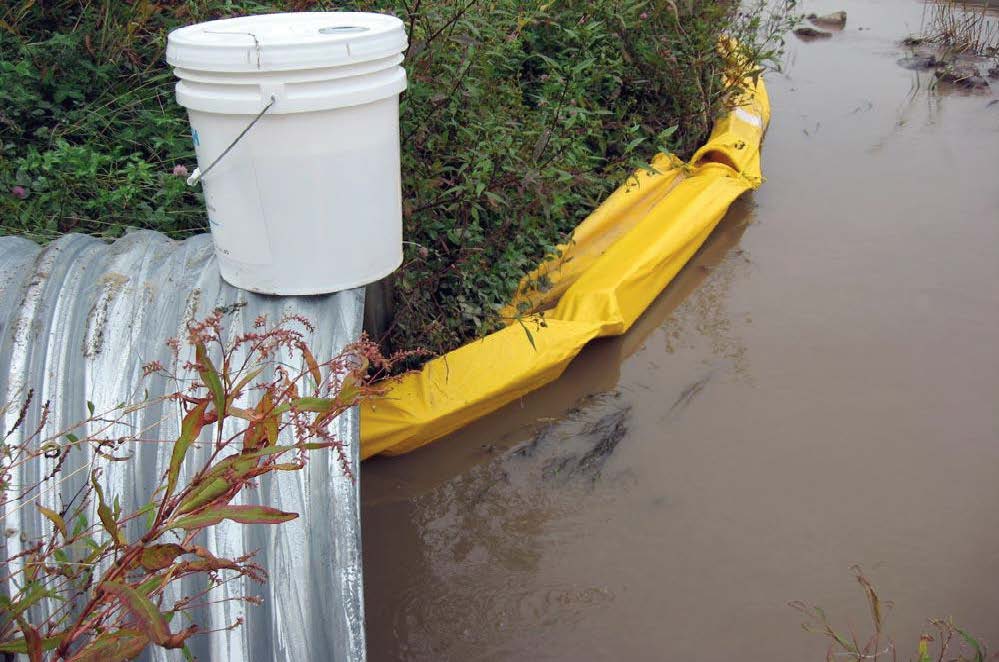
Adding flocculant to stormwater runoff can be as simple as drilling a hole in a bucket of the chemical and mounting it above the water (as shown here), although thorough mixing must be ensured. MnDOT hopes to develop a system that will automatically dispense a precise dose based on the amount of sediment in the water.
Adding flocculant to stormwater runoff can be as simple as drilling a hole in a bucket of the
chemical and mounting it above the water (as shown here), although thorough mixing must be ensured. MnDOT hopes to develop a system that will automatically dispense a precise dose based on the amount of sediment in the water.

Since it is not feasible for workers to constantly monitor sediment concentration in stormwater runoff, MnDOT hopes to leverage the knowledge gained from this project to develop an automated system that measures the amount of sediment in runoff and automatically adds the appropriate dose of flocculant to treat the water.

“We’re trying to develop a portable water treatment plant that can be applied to construction projects to deliver clean runoff water after a storm,” said MnDOT Environmental Specialist Dwayne Stenlund.

Any chemicals recommended for field usage will need to be approved by the Minnesota Pollution Control Agency, and methods for disposing of used chemicals will need to be identified as the environmental impacts of residual chemicals are unknown.

*Editor’s note: This article was adapted from the September-October 2014 issue of our Accelerator newsletter. Read it online or sign up for your free subscription.

Related Resources

MnDOT saves time, money with new contracting method

Thanks to a flexible new contracting method, the cost and time of delivering small highway projects in Minnesota should go down.

The Minnesota Department of Transportation is now able to put road construction contractors on standby for certain types of projects, rather than bid each project individually, due to the adoption of Indefinite Delivery/Indefinite Quantity (IDIQ) contracts.

“IDIQ contracts give MnDOT more flexibility and the ability to get to the field quicker for work that we need repeated routinely, such as culvert repairs, overlays and seal coats,” said Kevin Kosobud, project development engineer with MnDOT’s Office of Construction and Innovative Contracting.

IDIQs also provide flexibility when needs are uncertain.  Contracts are often used for multiple small projects that are similar in scope, but difficult to quantify in cost and timing.

For instance, the state of Florida awards IDIQs for hurricane debris removal, activating and paying contractors only when a hurricane necessitates the service.

Although IDIQs showed great promise, MnDOT had to develop a framework to implement them.

The federal government has used IDIQ contracts since the 1980s, but only a small number of state DOTS have used them to procure construction services. No standard procedures existed for their use by state DOTs, and federal procedures are not always applicable at the state level.

MnDOT hired Iowa State University researchers to examine IDIQ usage across the country and develop implementation procedures for Minnesota. (Read a summary of their research here.)

Researchers examined contracting practices at 14 different transportation agencies to  recommend guidelines for Minnesota to follow, which allowed MnDOT to begin awarding IDIQ contracts in April 2013.

Case study analyses show clear benefits where IDIQ has been used: acceleration of the project delivery period, reduced construction costs and flexible delivery scheduling.

“IDIQs can help DOTs get better prices for routine services via an economy of scale, for instance, by awarding a contract for a larger number of culvert repairs rather than awarding a single contract for each repair,” explained Doug Gransberg, professor of construction engineering at the Iowa State University Institute of Transportation.

Agencies can award IDIQ contracts individually or collectively.

With a single-award contract, a single contractor is awarded task orders based on the pricing furnished in the initial bid package; multiple-award contracts determine a pool of qualified contractors who may subsequently bid on task orders.

*Editor’s note: This article was adapted from the September-October 2014 issue of our Accelerator newsletter. Read it online or sign up for your free subscription.

Related Resources
  • Leveraging the Advantages of Indefinite Delivery/Indefinite Quantity Contracts – Technical Summary (1 MB, 2 pages); Final Report (expected Fall 2014)

Why is all the colored concrete deteriorating so fast?

There’s nothing like colored concrete to make a crosswalk, sidewalk or breezeway look snazzy.

But the extra touch that many cities are putting into their downtown streetscapes may not be so pretty in just a few short years.

Early cracking has prompted the city of Vadnais Heights to tear up its colored concrete, and the city of Centerville — which installed colored concrete only six years ago — plans to follow suit, said MnDOT’s Senior Road Research Engineer Tom Burnham.

Both cities participated in a recent study, sponsored by the Local Road Research Board and conducted by MnDOT, to determine what is causing the early deterioration.

Across Minnesota, many of the estimated 45 colored concrete projects have experienced early deterioration, particularly microcracking near contraction joints. While this type of distress also occurs with regular concrete, it appears to be accelerated in the colored concrete projects, within five years in some instances.

Although the newly released study identifies likely causes for the failing colored concrete, further research is needed to evaluate proposed solutions.

Findings

Researchers determined that the colored concrete mixtures have likely been too porous for Minnesota winters, allowing deicing chemicals to leach in and wreak havoc. Although not quite as problematic for sidewalks and medians — which aren’t salted as heavily — it is especially bad for colored crosswalks.

A denser concrete mixture (one formed with less water) is recommended; however, constructing the concrete panels this way will require extra steps.

“There are chemicals that can be added to the mixture to artificially lower that water-to-concrete ratio,” Burnham said. “This will allow a  denser mixture to be more easily placed.”

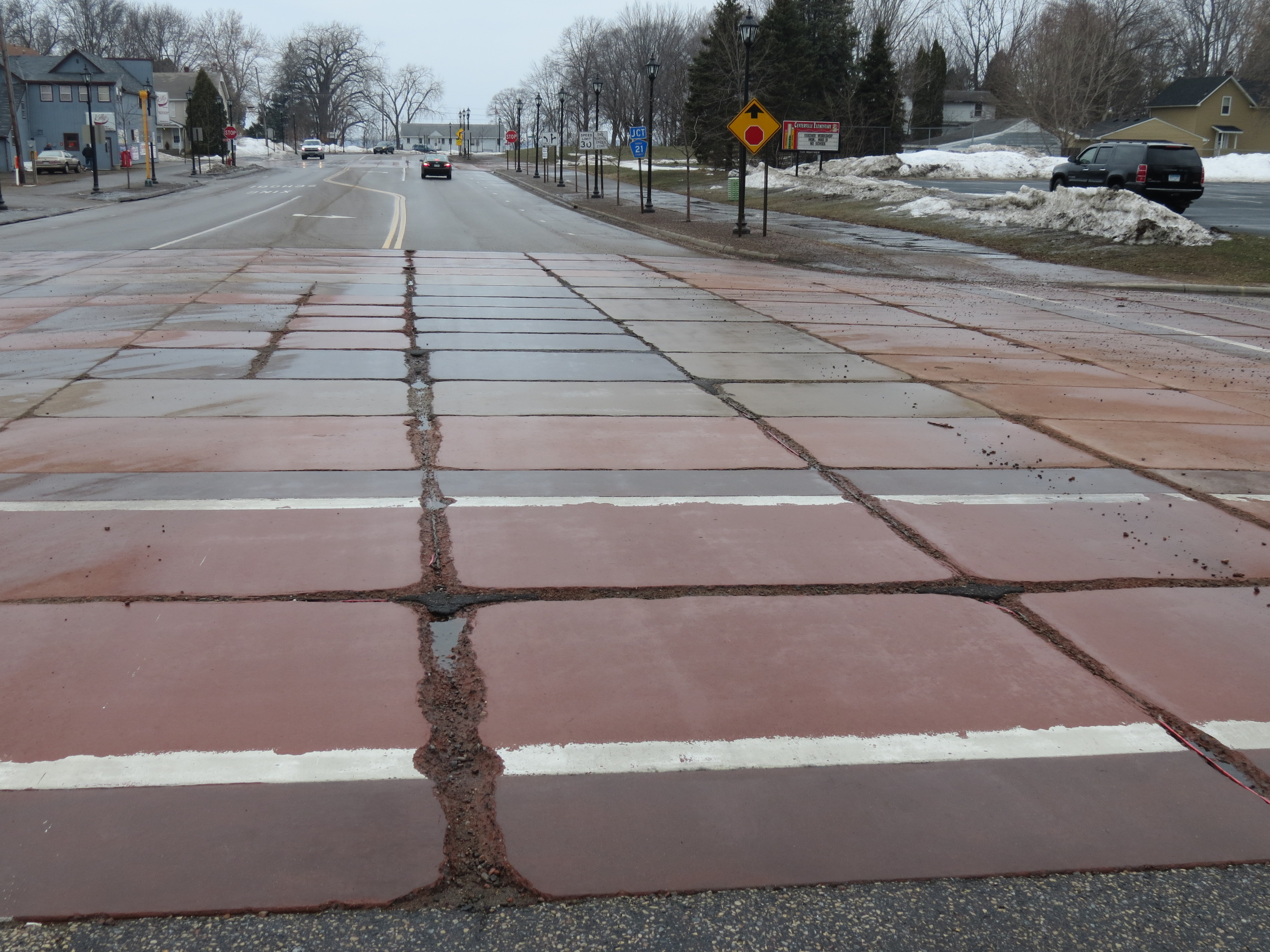
The city of Centerville plans to tear up its colored concrete. This photo shows early joint deterioration.
Color in vogue

Although there was a spate of colored concrete construction in Ramsey County in the late 1990s, it has only come into fashion in the rest of the state within the last five to six years, according to Burnham.

“You go to almost any community and they’re installing it — on their sidewalk and medians and also crosswalks,” said Burnham, who coordinated the research study.

Because of the added expense, cities may be very disappointed in the results.

The city of Stillwater, which installed a colored concrete panel crosswalk on its main street just two years ago (see top photo), is already experiencing cracking and deterioration in several panels.

Possible remedies

Although reducing the porosity of the colored concrete mixture should help,  it won’t solve everything.

Another issue is the curing. The typical white curing product can’t be applied like it is with standard concrete, so curing the colored panels is more challenging, Burnham explained.

There are possible remedies, however, to assist with the curing, such as wet burlap or curing blankets.

Adding complexity to the issue are the new deicing chemicals on the market, which are also impacting regular road materials.

Several test samples showed evidence of chemical attack of the cement paste and fine aggregates, as well as an alkali-silica reaction, which can cause cracking or spalling and isn’t normally seen in regular concrete.

“Is there anything unique with the coloring that would accelerate the observed chemical reactions? We didn’t feel we had enough samples and knowledge at this point to conclusively say,” Burnham said.

Different construction techniques could go a long way toward increasing the livelihood of colored concrete; however, it could take several years of observation to determine if other methods work.

MnROAD is considering adding colored concrete panels to its facility for testing.

Until more questions are answered, MnDOT researchers are recommending repair techniques and alternative streetscaping ideas to cities, such concrete stains, pavers or colored high friction surface treatments.

In addition to sharing the findings with cities and counties, Burnham wants to educate contractors.

“We hope this research is a wake-up call for the colored concrete industry too because we don’t want the industry to die in Minnesota,” he said. “If it can work, we want cities and counties to be able to use it.”

*Editor’s Note: This story was updated 09/04/2014 to specify that this research project was funded entirely by the Local Road Research Board, and that MnDOT conducted the research.

Related Resources
  • Investigation and Assessment of Colored Concrete Pavement — Final Report (PDF, 20 MB, 368 pages); Technical Summary (forthcoming)

Five Innovative Ways to Make Bicyclists and Pedestrians Safer

Last year, 41 people were killed while walking or biking on Minnesota roads and nearly 1,700 were injured.

Dozens of measures are available, however, for making roads safer for pedestrians and cyclists. Minnesota Department of Transportation Pedestrian and Bicycle Safety Engineer Melissa Barnes reviewed some of these design techniques in a recent presentation to city and state transportation engineers. (Watch the full webinar.)

We asked Barnes to highlight her favorite bike and pedestrian safety countermeasures used in Minnesota.

Rectangular Rapid Flashing Beacon RRFB

An unusually effective new pedestrian warning device, called the Rectangular Rapid Flashing Beacon, has become quite popular.

User-activated, the device alerts drivers to a pedestrian’s presence with a bright flashing beacon that “looks kind of like an ambulance or fire truck light,” Barnes said. (RRFBs can also be activated passively by a pedestrian’s presence.)

Studies have shown that the number of motorists stopping for pedestrians increases from 18 to 81 percent with the RRFB. Another plus: the device doesn’t appear to lose its effectiveness over time. After two years, compliance has been shown to still be more than 80 percent.

Advanced Stop Lines

It’s not uncommon for a motorist to stop for someone in a crosswalk, only for the vehicle following them to not see the pedestrian and veer around, driving through the crosswalk.

But an advanced stop line, placed 20 to 50 feet prior to a crosswalk, is effective at making both vehicles stop and see the person in the crosswalk.

“They are a really good option at an unsignalized, mid-block crossing,” said Barnes, although the stop line may not be a good option for a two-way stop.

Advanced stop lines have been shown to reduce pedestrian-vehicle conflict up to 90 percent; however, stop lines shouldn’t be placed too far in advance of the crossing, because motorists might then ignore them.

Leading Protected Interval

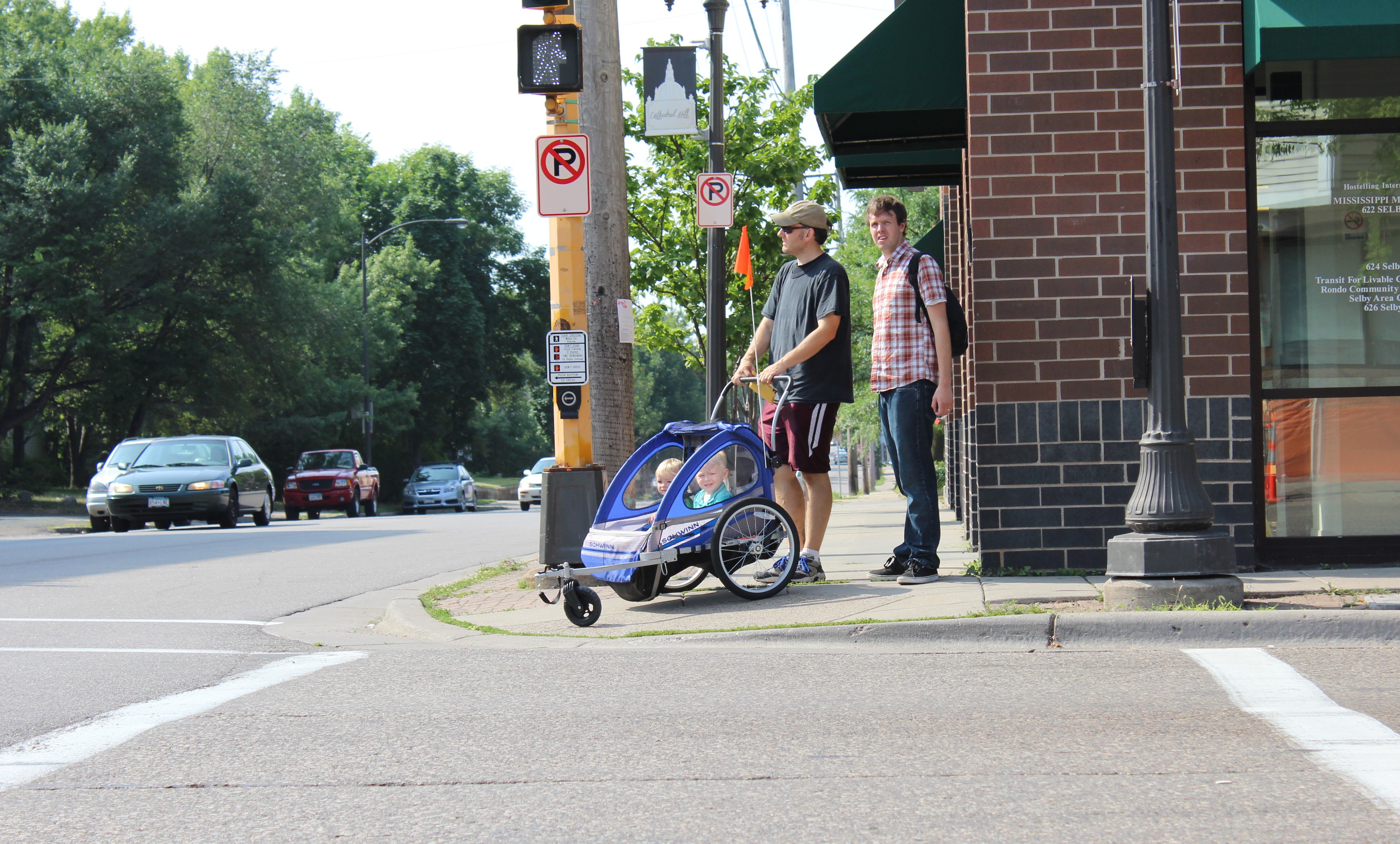
An innovative treatment called the Leading Protected Interval minimizes conflict by allowing pedestrians to enter a signalized intersection before vehicles do.

The walk signal begins three to seven seconds before the parallel street turns green by extending the time all lights are red.

A right turn on red can be prohibited with this device; however, even without the prohibition, the Leading Protected Interval has been shown to reduce crashes by 5 percent.

Protected Bike Lanes

Protected Bike Lanes

Bike lanes buffered from  traffic with some sort of physical barrier, even parked cars, will reduce all types of crashes. They also increase comfort levels for cyclists, helping keep bikes off the sidewalk.

“A lot of people are much more comfortable biking in these than a regular bike lane,” Barnes said. “It can be a very effective solution for places with lots of cyclists.”

Protected bike lanes, also called cycle tracks, also have a traffic-calming effect.

In New York City, the cycle track reduced all types of crashes an average of 40 percent and up to 80 percent on some roads.

“The challenge is how to design these at intersections,” Barns said. “It’s hard to get the turns right and get everybody visible. It’s pretty important to design these carefully at intersections.”

For those reasons, two-way cycle tracks work best on one-way streets, she said.

Flexible Bollards
Flexiblebollard
Photo courtesy of Reliance Foundry

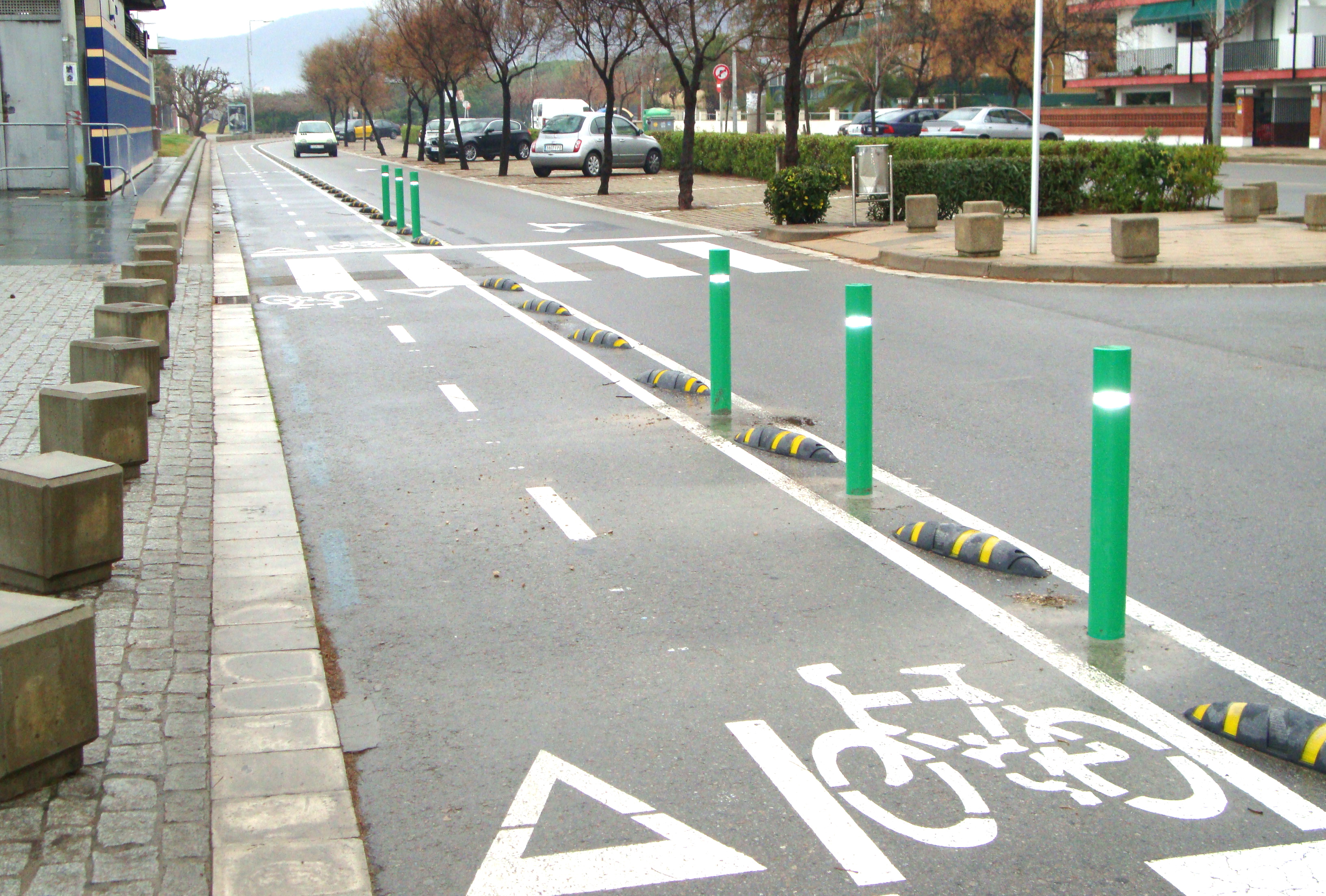
Flexible bollards create temporary curb lines that encourage vehicles to slow down. They can be installed easily and inexpensively.

Flexible bollards bend up to 90 degrees when struck by an errant vehicle. They do not physically stop a car, but encourage vehicles to stay within their lane. Although they can create additional maintenance, they are a good interim solution at locations that need an immediate fix, but have no funding to do so.

Program offers funding for “homegrown” road maintenance ideas

Attention Minnesota road maintenance staff:

Have you ever dreamed that all of your tinkering, fussing, and fiddling in the shop and on the road could help improve every road in Minnesota? Do you need funding to improve your sign maintenance and installation process? Or maybe you’ve come up with an idea for a new tool for controlling roadside vegetation or a design for a more effective work-zone safety product. Whatever it is, the Local Operational Research Assistance (OPERA) Program wants to hear about it.

Funding for 2015 OPERA projects is now available, and it’s easy to submit a proposal. Simply fill out the brief proposal application (50 KB DOC) and submit it via e-mail to Mindy Carlson at Minnesota LTAP. There isn’t a deadline to submit your proposal, but FY15 funds are limited and they often go quickly.

The maximum funding per project is $10,000, and local agencies are welcome to submit more than one proposal.

Project Guidelines

Your proposed research project should focus on the timely development of relevant ideas or methods that improve transportation or maintenance operations. Our goal is to collect and disseminate homegrown, innovative solutions to the everyday challenges our transportation workforce faces on the job. Counties, cities, and townships, this is your opportunity to encourage your maintenance staff to become actively involved in researching and testing their ideas.

To see what other local agencies have done with OPERA funding, check out our fact sheets and annual reports, or watch these videos highlighting previous OPERA projects:

Program Sponsors

The Local OPERA Program is funded by the Minnesota Local Road Research Board and administered by the Minnesota Local Technical Assistance Program.

Six effective low-cost safety improvements for roads

For the past 10 years, Minnesota and 37 other states have pooled their resources to test the effectiveness of roadway safety improvement strategies. The project, appropriately titled “Evaluation of Low-Cost Safety Improvements,” evaluates key strategies laid out in a national guidebook aimed at reducing the number of annual highway deaths.

Participating states say the project, which has now been extended a total of eight times beyond its original scope, has been a resounding success. MnDOT Safety Engineer Brad Estochen said the pooled-fund study has provided state DOTs much-needed evidence to gain support for implementing new safety improvements.

“Some states want to do a certain strategy, but don’t have the institutional support,” Estochen said. “Through the collaboration of the Peer Exchange, they have national results they can point to.”

We asked Estochen, MnDOT’s technical liaison for the pooled fund, to name his top strategies to come out of the study.

Traffic calming measures

Roadway

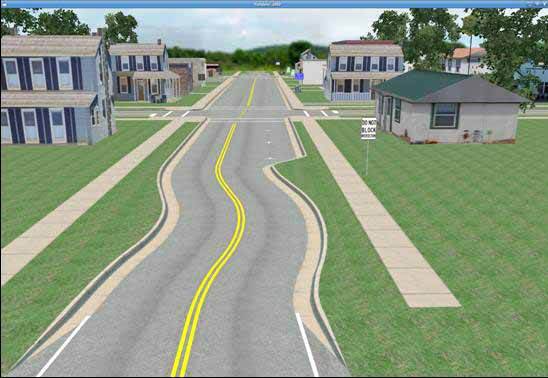
One phase of the study used simulated driving scenes to examine methods of traffic calming (i.e., getting drivers to slow down) in  rural towns. The research found that drivers were most impacted by chicanes — extra curves in the road — and the presence of parked cars on the street. An alternative strategy, curb extensions (also called “bulb-outs”), was found to offer only a small potential safety benefit or no benefit at all.

(Read more about this phase of the study.)

Nighttime visibility improvements

DSC_6498

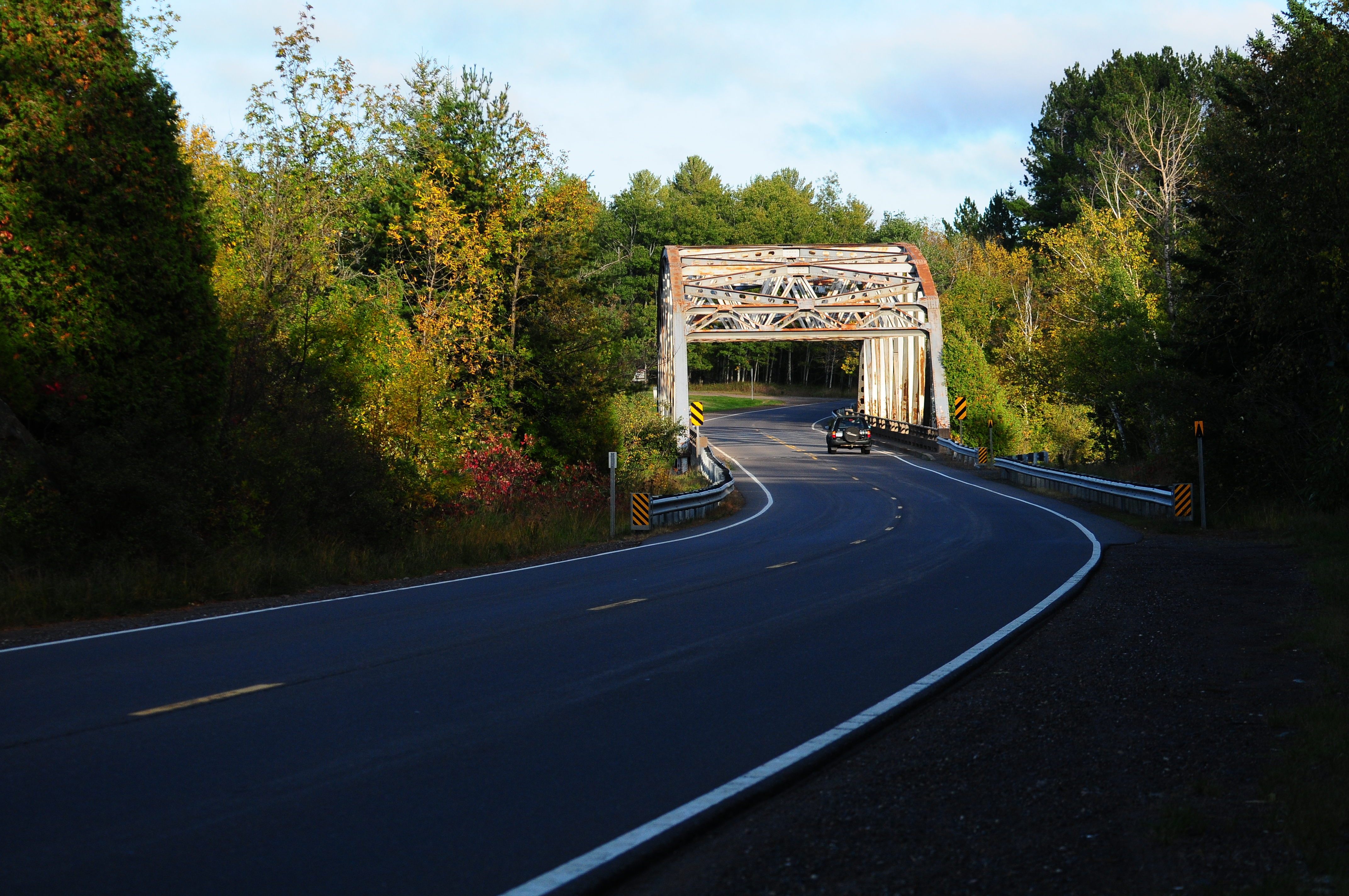
Researchers also looked at ways of improving nighttime driver visibility on rural roads. Edge lines and post-mounted delineators were selected as the best alternatives for improving curve visibility at night, with curve detection improving 12 percent to 70 percent due to enhanced edge lines. The results are significant, since horizontal curve sections of two-lane rural roads are a major source of roadway fatalities.

(Read more about this phase of the study.)

Flashing beacons at stop-controlled intersections

One way to make drivers aware that they’re approaching a stop sign is to add a flashing beacon to the intersection. Researchers installed various configurations of flashing beacons at more than 100 sites in North and South Carolina and examined the crash data before and after installation.

Courtesy of K-Kystems

Results indicate that standard flashing beacons, as well as some “actuated” beacons (i.e. those that only turn on when traffic is approaching the intersection), are not only effective at reducing crashes, but also economically justifiable based on cost-benefit calculations.This research helped pave the way for more widespread adoption of Minnesota’s Rural Intersection Conflict Warning Systems (RICWS).

(Read more about this phase of the study.)

Edgeline rumble strips

DSC_4106pse

Edgeline rumble strips on curves were shown to significantly improve safety in the third phase of the study, which tested a variety of techniques.

Whereas rumble strips are traditionally ground into centerline or on the shoulder, Kentucky and Florida experimented with placing rumble strips right along the white edgeline of curved sections of road. This method was shown to reduce overall crashes by 29 percent.

(Watch the FHWA website for updates on this phase of the study.)

Red light enforcement devices

Red light indicator
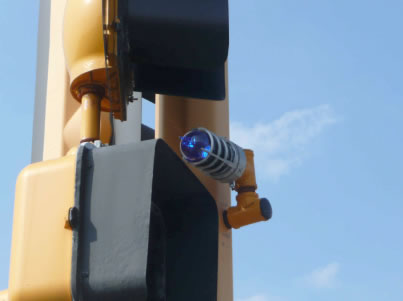
In Florida, crashes due to people running the red light fell by 33 percent thanks to a small light that turns on when the signal turns red. This little light bulb, which is placed on top of a signal, allows for a police officer to sit at the other end of the intersection rather than pursue a car right through the intersection. Not only is it safer, but motorists are also more likely to obey the signal if they know police might be watching on  the other side.

Researchers are also still collecting data on the other techniques studied in phase three, including surface friction treatments on curves and ramps and larger curve warning signs (called chevrons). Watch the FHWA website for updates.

Wider roads in rural areas

manufacturing

Could simply shifting the edge lines of a rural road reduce the number of accidental drive-offs?

Yes, according to this study, which evaluated the effectiveness of various lane-shoulder width configurations on rural, two-lane undivided roads using data from Pennsylvania and Washington.

In general, results were consistent with previous research, showing crash reductions for wider paved widths, lanes and shoulders. For specific lane-shoulder combinations, the study found a general safety benefit associated with wider lanes and narrower shoulders for a fixed pavement width; however, there are exceptions. The report has a chart that shows the optimal lane-shoulder combinations for different sizes of roads.

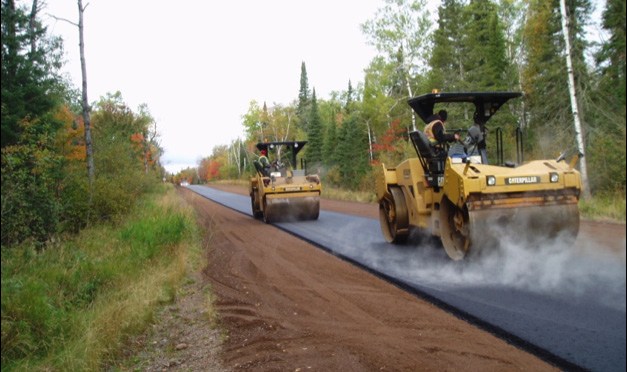
In theory, there should be no additional cost for these strategies, as an edgeline can be re-striped as part of an existing resurfacing project.