

While roundabouts improve traffic efficiency and reduce accidents, pedestrian safety concerns linger. A study of driver–pedestrian interactions at roundabouts produced guidance for local agencies to increase driver yielding and enhance the pedestrian experience.
Continue reading Enhancing Pedestrian Experiences at RoundaboutsAll posts by mndotresearch

Using Signal Phasing and Timing Data to Reduce Fuel Use
Fuel consumption increases when vehicles stop and start at traffic signals. Transmitting traffic signal data to connected vehicles could control vehicles’ driving speed and limit unnecessary stopping and starting, potentially lowering fossil fuel use. A recent study looked at the benefits and costs of deploying more signal messaging technology to inform future infrastructure investments.
Continue reading Using Signal Phasing and Timing Data to Reduce Fuel UseGuidance to Help Local Agencies Address Deferred Maintenance
Local government budgets are continually inadequate to meet increasing transportation maintenance needs. In a recent study, researchers analyzed maintenance investment decision-making in local governments across Minnesota, identifying the fiscal conditions that impact road repair spending, recommending steps to close maintenance funding gaps and providing context to inform communications with decision-makers.
Continue reading Guidance to Help Local Agencies Address Deferred Maintenance
Commodity Flow Data for Freight Network Infrastructure Planning
Minnesota’s economy depends on efficient freight movement across the state. To ensure that infrastructure can accommodate cargo transport by all modes, MnDOT needs commodity flow data to plan improvements and minimize supply chain disruptions. An analysis of existing resources and needs will support new tools to optimize investments in freight transport.
Continue reading Commodity Flow Data for Freight Network Infrastructure Planning
Comparing Additives Used in Stabilized Full-Depth Reclamation
Beltrami and Hubbard counties planned pavement rehabilitation on a shared road, presenting a unique opportunity to directly compare two stabilizers: engineered emulsion and Base One, a proprietary mix. While there were some variations in performance and cost, both met design values for pavement strength.
Continue reading Comparing Additives Used in Stabilized Full-Depth Reclamation
Exploring Region-Specific Roadside Turfgrass Varieties
Local agencies need cost-effective and durable turfgrass seed mixes to ensure grass coverage remains optimal along roadsides. In a recent study, researchers analyzed the performance of grass seed mixtures and planting costs, recommended region-specific mixes and developed a cost estimation tool for local agencies to be confident in their roadside vegetation choices.
Continue reading Exploring Region-Specific Roadside Turfgrass Varieties
Putting Research Into Practice: Fog Sealing Chip Sealed Roads Can Improve Performance
Applying a protective surface—or chip seal—to existing asphalt on relatively low-traffic roads is a pavement preservation method used by many transportation agencies. Yet despite its popularity, chip seals can cause various issues. Some agencies have found that applying a fog seal following a chip seal is a cost-effective strategy for improving asphalt performance and public satisfaction.
Continue reading Putting Research Into Practice: Fog Sealing Chip Sealed Roads Can Improve Performance
Effective Placement of High-Tension Cable Median Barriers
While cable median barriers have drastically reduced fatal and other serious crashes, the barrier’s distance from the road may impact its safety effectiveness. MnDOT has a new method to estimate the change in the frequency of crashes based on this distance, facilitating informed decisions about installing or moving cable median barriers.
Continue reading Effective Placement of High-Tension Cable Median Barriers
Investigating Max-Pressure Traffic Signal Timing
Inadequately timed traffic signals at intersections are a major contributor to traffic congestion and increased travel times. Adaptive signal timing can detect and respond to real-time vehicle queues, resulting in more efficient vehicle movement through a corridor than traditional traffic signals. A revised max-pressure traffic signal controller could decrease delays and increase vehicle throughput at intersections.
Continue reading Investigating Max-Pressure Traffic Signal Timing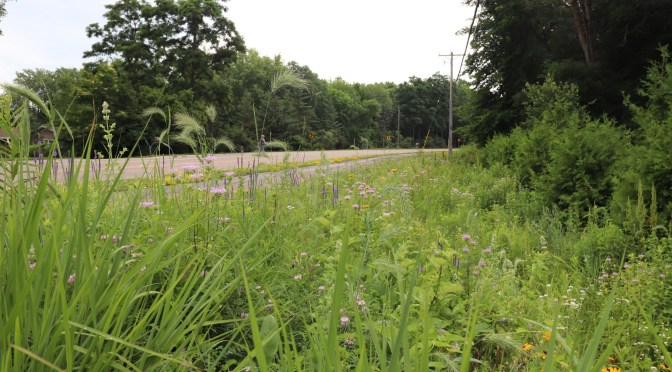
Improving Pollinator Habitat Through Cost-Effective Roadside Revegetation
Pollinating insect populations are declining worldwide. Revegetating roadsides after construction offers an opportunity to create pollinator-friendly habitat. Local agencies and MnDOT have new tools and strategies to cost-effectively derive multiple benefits from roadside revegetation efforts.
Continue reading Improving Pollinator Habitat Through Cost-Effective Roadside Revegetation Crossroads