

Complete Streets is a transportation policy and design approach that requires streets to be planned, designed, operated, and maintained to enable safe, convenient, and comfortable travel and access for users of all ages and abilities regardless of their mode of transportation.
Continue reading New Project: Assessing the Economic Effects of Context Sensitive Main Street Highways in Small CitiesAll posts by Micaela Kranz

Knowledge Books Preserve Expertise of Retiring Workers
MnDOT has successfully piloted a European knowledge retention method to preserve the expertise of retiring workers who are subject matter experts. The agency has produced interactive multimedia books that use graphics, video and written material to present valuable information on concrete pavements, asphalt pavements and steel bridges, learned over a person’s entire career, for use by future engineers.
Continue reading Knowledge Books Preserve Expertise of Retiring Workers


Selecting Uncontrolled Pedestrian Crosswalk Treatments
A new guidebook published by the Minnesota Local Road Research Board offers a uniform approach and practical methods for selecting locations and the right treatment for uncontrolled pedestrian crosswalks in Minnesota.
Continue reading Selecting Uncontrolled Pedestrian Crosswalk Treatments

Asphalt Delivery Tracking Goes Digital with Some 2020 Construction Projects
MnDOT construction projects require tons of hot mix asphalt each year, with over 188 road and bridge projects in the 2020 construction season alone.
Historically, plant mixed asphalt has been weighed, tracked and paid for with computer-generated paper tickets. Paper ticketing isn’t an ideal process for a variety of reasons—on-site ticket collection poses safety risks, tickets can be easily lost, and data must be tabulated manually, just to name a few.
Continue reading Asphalt Delivery Tracking Goes Digital with Some 2020 Construction Projects
Pavement Preservation Techniques for Local Agencies
Cities and counties need affordable pavement preservation treatments, but preservation strategies are often geared towards higher-volume roads. The Minnesota Local Road Research Board has developed new guidance on five lower-cost treatments that is more applicable to local agencies and can be used to preserve pavements based on the type and severity of pavement distress.
Continue reading Pavement Preservation Techniques for Local Agencies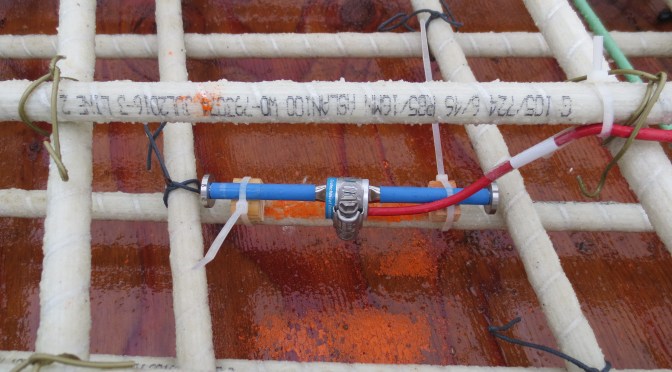
GFRP Rebar Shows Promise for Use in Bridge Decks
Reinforced concrete bridges are built to handle heavy loads and routine traffic for 75 years or more. But bridges in climates like Minnesota’s are exposed to moisture and chlorides from road salts that may penetrate these structures and corrode the steel.
In a recently completed research project, funded by MnDOT and the Local Road Research Board, researchers studied a rural bridge built in 2017 near Elgin, MN, that used glass fiber–reinforced polymer (GFRP) rebar in the bridge deck. They found that GFRP performed well, proving sufficiently strong for use as an alternative to corrosion-susceptible steel rebar.
Continue reading GFRP Rebar Shows Promise for Use in Bridge Decks
Improving Roadside Turfgrass Establishment
Just in time for spring, new guidance is available from the Minnesota Local Research Board on the best irrigation methods to establish fresh turfgrass. Researchers tested five irrigation methods for watering new installations of salt-tolerant turfgrass. They developed an instructional course for contractors and guidance for homeowners to promote successful turfgrass installation.
Continue reading Improving Roadside Turfgrass Establishment
Improving Traffic Volume Estimates By Monitoring Health of Loop DetecTORS
A newly developed system helps traffic engineers quickly spot failing loop detectors, which are used to monitor traffic volumes on Minnesota highways. The software program, developed by the University of Minnesota-Duluth for the Minnesota Department of Transportation, evaluates loop detector data and reports current loop detector health in an easy-to-read graphic format, making it easy to identify loop detectors in need of repair and which loop detectors should be used for the most accurate traffic counts.
Continue reading Improving Traffic Volume Estimates By Monitoring Health of Loop DetecTORS
Transverse Rumble Strips: Another Tool for Rural Road Safety?
Rural intersections account for 30% of crashes in rural areas and 6% of all fatal crashes, representing a significant but poorly understood safety problem.
Transverse rumble strips are one low-cost measure that some states have deployed to reduce rural intersection crashes.
Continue reading Transverse Rumble Strips: Another Tool for Rural Road Safety? Crossroads