This article was originally posted on Catalyst, January 2023.
Wearable technology could improve work-zone safety, but are highway workers on board?
Despite ongoing safety efforts, highway maintenance and operations workers have dangerous jobs. According to the Federal Highway Administration, an average of 135 highway workers loses their lives each year because of traffic incursions and limited space for maneuvering. Wearable technology embedded in work gear offers the promise of preventing injuries and deaths—and is already being used successfully in other construction fields. The big question: Would highway workers accept this technology?
This article was originally posted on Catalyst, January 2023.
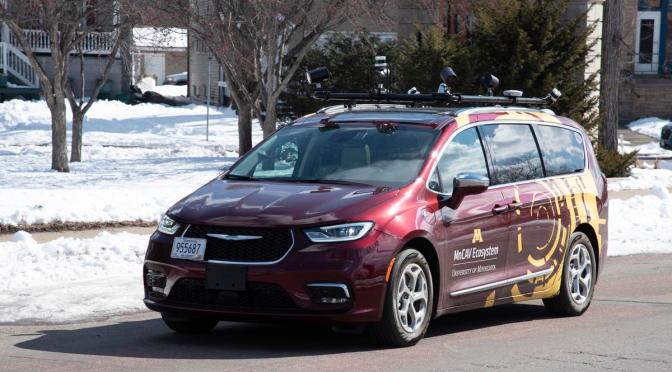
There’s been a lot of progress toward self-driving cars in recent years, but we still have a long way to go before the system runs like a well-oiled machine. Even with all the advances in artificial intelligence and machine learning, automated vehicles (AVs) are still not well-equipped to handle crashes, bad weather, poor visibility, and other unexpected situations on the road.
This article was originally posted on Catalyst, January 2023.
Transportation is the largest source of greenhouse gas emissions in both the US and the Twin Cities, and commuting trips are a major contributor to these emissions. To meet its emission-reduction mandates, Minnesota needs strategies to reduce auto trips—especially driver-only trips without passengers.
A recent U of M project aimed to leverage existing transportation infrastructure and systems to provide more flexible, multimodal transportation options for parking contract holders at Minneapolis’ ABC Ramps—thereby reducing the number of solo trips.
What’s next in transportation? CTS’s new Future of Mobility series collects the perspectives of top University of Minnesota researchers and other national experts.
In 17 articles, the authors scan the horizon and reflect on critical transportation topics ranging from rural transportation to automated vehicles to equity for users. The future of transportation will be a complex, interconnected set of practices and technologies, and this series brings bold thinking together in one place.
This article was originally posted on Catalyst, November 2022.
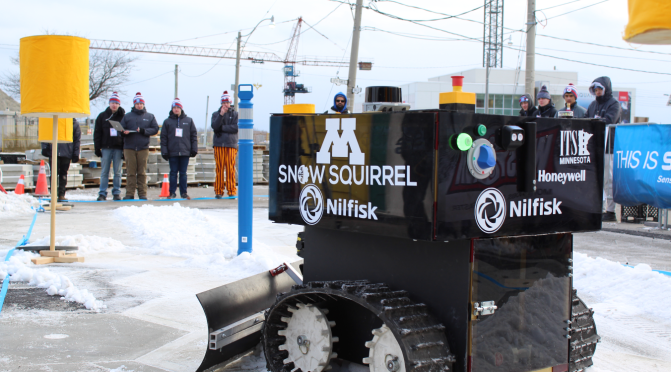
Snow fences are a useful tool for controlling snow and ice on Minnesota’s roads. However, installing them relies on the cooperation of landowners. An ongoing collaboration between U of M researchers and the Minnesota Department of Transportation (MnDOT) aims to develop outreach tools that can be used to attract more landowners to the MnDOT snow fence program.
This post was originally posted on Catalyst, November 2022.
Zippy electric scooters—often called e-scooters—have quickly become a common sight on sidewalks, bike paths, and roads in most US urban areas. Americans took 38.5 million e-scooter rides in 2018 and 88.5 million rides in 2019—a 130 percent increase in a single year. However, the rapid rise of the e-scooter has come at a cost, and e-scooter injuries and crashes have become a serious public health concern.
This post was originally posted on Catalyst, November 2022.
It’s no secret that the transportation system is an uneven playing field. Understanding disparities related to race, income, and other factors is critical, and much more work is needed. Gender in particular is an under-researched yet important aspect of the design of vehicles, infrastructure, and amenities.
This article was originally published in Catalyst, August 2022.
Ongoing research is looking into the possibility of using local industrial waste for roadside stormwater construction projects. This would help reduce material and transportation costs and put otherwise wasted materials to use.
This article was originally published in Catalyst, August 2022.
Connected and automated vehicle (CAV) technology is moving forward, with three pilot shuttle projects on tap in Minnesota this year alone. Rapid developments are leaving little time for planners and policymakers to prepare for the mainstreaming of technology and the evolution of the current transportation system—all while ensuring that transportation equity has a seat in the vehicle.
This article was originally published in Catalyst, August 2022.
A new technology combining nearly autonomous vehicles with remote “tele-operators” has the potential to overcome both the technological and societal hurdles posed by driverless vehicles. Ride-hailing providers will be an important application for remote-driving technology, and U of M researchers found it offers clear advantages for companies and their customers.







 Crossroads